
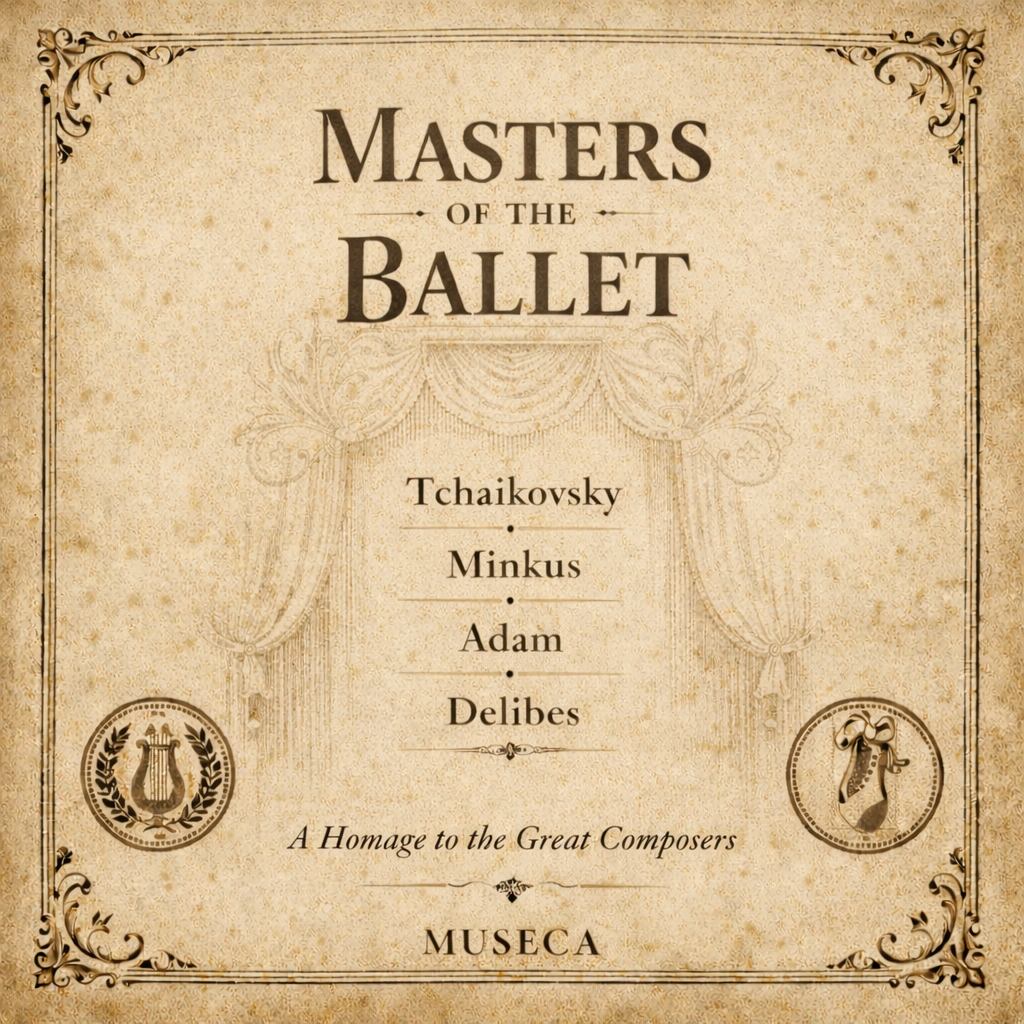
Album Introduction
This album began as a study: a practical survey of the ballets that shaped 19th-century stage music and still anchor the classical repertory today. Rather than treating “ballet music” as a broad historical category, we narrowed the question with intention: Which 19th-century ballet scores are not merely important, but continually performed—season after season, generation after generation—and which composers defined that enduring sound?
From that research, one pattern became unmistakable. The modern stage continues to revolve around a small constellation of titles—works that remain central not only for their stories and choreography, but because their music is structurally reliable for dance, emotionally immediate, and unmistakably crafted for the theater. When we filtered the century’s output through that lens—fame, frequency of performance, and repertory permanence—a final list emerged with clarity and inevitability:
Tchaikovsky, Minkus, Adam, and Delibes
This homage album is therefore deliberately focused. It looks only at 19th-century ballet composers, and within that period it honors the most famous and widely performed ballets—not as a medley of familiar tunes, but as a set of original orchestral scenes written in the spirit of their musical architecture, pacing, and orchestral signature. What follows is not quotation, but lineage: a modern suite that listens carefully to four distinct voices that still instruct the ballet stage.
Pyotr Ilyich Tchaikovsky
Tchaikovsky elevated ballet music into symphonic territory without sacrificing dance clarity. His scores are built on long emotional arcs, memorable motifs, and orchestration that can shift from courtly brilliance to private sorrow in a single breath. In the repertory, his three ballets stand as the defining pillars of the classical canon—works whose musical identity is inseparable from what “grand ballet” means today.
In this album, the Tchaikovsky tributes aim for that unmistakable combination: symphonic breadth shaped into stage-ready dance forms—a nocturne that breathes like a scene, and a processional that carries the ceremonial weight of an imperial theater.
Ludwig Minkus
Where Tchaikovsky symphonizes, Minkus perfects the engine. His genius lies in the exactitude of dance construction: phrases that land cleanly, variations that escalate with logic, and rhythms that communicate steps before the audience even sees them. Minkus represents the 19th-century ballet house at full stride—music written unapologetically for dancers, virtuosity, and theatrical momentum.
Here, the Minkus homages embrace classical clarity and kinetic design: a variations-driven showpiece shaped for brilliance and cadence, and a slower ceremonial scene that honors the processional grandeur ballet demands.
Adolphe Adam
Adam’s ballet music sings. Coming from an operatic sensibility, he writes melodic lines that feel like aria—direct, expressive, and emotionally legible—while keeping orchestration light enough for the stage to remain the center. His sound is the Romantic theater at its most poised: pastoral warmth on one side, and the supernatural hush of the moonlit world on the other.
This album’s Adam tributes are built around that contrast: human tenderness and spectral elegance, orchestrated with restraint and a strong sense of theatrical pacing.
Léo Delibes
Delibes brings sparkle—yet never superficiality. His orchestration is character itself: witty woodwind dialogue, buoyant rhythms, and a refined French clarity that makes ballet feel simultaneously elegant and alive. Delibes helped define what audiences recognize as “classical ballet charm,” while maintaining musical craft strong enough to stand on the concert stage.
In these tributes, Delibes is honored through precision, brightness, and playful mechanics: a clockwork waltz of nimble orchestral conversation, and a divertissement driven by athletic lift and luminous color.
This album is a return to fundamentals: the orchestra as storyteller, the dance as architecture, and the 19th-century stage as a living tradition. The aim is simple and exacting—to create new music that feels native to the world these composers built, while remaining unmistakably original.
Liner Notes
Pyotr Ilyich Tchaikovsky
Nocturne of Moonlit Water
This opening tribute embraces Tchaikovsky’s defining gift to ballet: symphonic emotion shaped into dance-ready form. A long-breathed melodic line rises from the hush of divided strings and harp, expanding in waves rather than in episodes. The orchestration is deliberately “theatrical-symphonic”—warm horns and singing woodwinds supporting a single evolving idea—so the listener feels the stage widening beneath the music. The climactic swell is restrained but inevitable, designed to crest and recede like memory, leaving the final bars suspended in quiet radiance.
Imperial Procession
Here the homage turns outward—courtly, formal, and bright—with the dignified stride of a processional. The rhythmic profile is ceremonial without becoming martial: noble brass and sweeping strings create pageantry, while the inner voices keep the music buoyant and danceable. A contrasting trio moment shifts the light toward the minor mode, offering a shadowed elegance before the return restores the full “imperial” palette. The ending closes with deliberate clarity: a clean cadence, a final lift of orchestral color, and the sense of a curtain drawing back on a grand hall.
Ludwig Minkus
Plaza Variations
This track salutes Minkus’s mastery of ballet’s kinetic blueprint: crisp phrases, clean cadences, and a natural escalation from entrée through variations to coda. The music is built to “read” in the body—short motifs that land with certainty, harmonic motion that supports turns and jumps, and orchestration that stays bright and transparent even at full energy. Woodwinds answer the strings in quick exchanges, while light percussion punctuation adds theatrical sparkle without crowding the rhythm. The final section tightens into a brilliant finish—virtuosity as architecture, not decoration.
Temple Shades
Where Plaza Variations celebrates speed and brilliance, Temple Shades honors Minkus’s capacity for ceremonial atmosphere. A low-string ostinato establishes the tread of a slow procession, allowing long melodic phrases to unfold with dignity and restraint. The orchestration is ritual rather than exotic: English horn and oboe lines float above muted strings and harp punctuations, keeping the scene austere and stage-focused. The center brightens into a radiant major-colored bloom, then returns to shadow with softened edges, ending not in spectacle but in a controlled hush—as if the dancers disappear into the wings one by one.
Adolphe Adam
Village Pastoral
Adam’s world is defined by melody that sings, and Village Pastoral is written as a dance that could almost be an aria without words. The orchestration stays light and transparent—oboe and clarinet warmth over gentle string motion—so the music feels intimate and human, like sunlight on a village square. The phrasing favors graceful symmetry and lyrical turn-taking rather than symphonic expansion, keeping the choreography implied in every cadence. The closing measures land with a quiet smile: uncomplicated, elegant, and unmistakably theatrical.
Wilis at Dusk
This is the nocturnal counterpart—an homage to Adam’s Romantic gift for supernatural atmosphere without heaviness. Muted strings and tremolo veils create a floating surface, while flute and oboe gestures appear like distant figures glimpsed through mist. Harmony leans into ambiguity, letting the listener feel the boundary between the earthly and the uncanny. A brief lift into warmer light arrives as a memory rather than a resolution, and the return to minor dissolves instead of concludes—ending in a hush that suggests the scene remains unfinished, lingering just beyond the edge of the stage.
Léo Delibes
Clockwork Waltz
Delibes is honored here through precision, wit, and orchestration that behaves like character. The waltz moves with playful exactness: pizzicato strings suggest mechanism, while woodwinds trade bright, conversational phrases as if the orchestra itself is smiling. Sparkle arrives in small, tasteful flashes—never overbearing—so the music retains French clarity even at lively tempo. The trio provides a brief change of color and posture before the return snaps back into elegant clockwork, finishing with a coda that feels both choreographic and mischievously theatrical.
Huntress Divertissement
This final tribute channels Delibes’s athletic brilliance and luminous stagecraft. Horn calls establish an open-air, mythic confidence, answered by quick woodwind figures and bright string propulsion. The music is designed to feel physical—springing, buoyant, and clean—while remaining refined in texture and balance. A lyrical middle section softens the posture without losing momentum, then the main material returns brighter and more expansive, culminating in a brilliant coda that closes the album with clarity, lift, and unmistakable ballet energy.
Playlist
- Track 1 — Nocturne of Moonlit Water (Homage: Tchaikovsky) Museca 3:53
- Track 2 — Imperial Procession (Homage: Tchaikovsky) Museca 2:28
- Track 3 — Plaza Variations (Homage: Minkus) Museca 1:50
- Track 4 — Temple Shades (Homage: Minkus) Museca 2:31
- Track 5 — Village Pastoral (Homage: Adolphe Adam) Museca 2:18
- Track 6 — Wilis at Dusk (Homage: Adolphe Adam) Museca 1:58
- Track 7 — Clockwork Waltz (Homage: Léo Delibes) Museca 2:02
- Track 8 — Huntress Divertissement (Homage: Léo Delibes) Museca 1:43