Scales of Western Music: A Historical Survey from Medieval to Neo-Classical
What is the raw material of Western music? Before harmony, before rhythm, before form — there is the scale. The particular arrangement of whole steps and half steps that a composer selects determines everything that follows: the emotional character of the melody, the logic of the chord progressions, the sense of tension and release that makes music feel like it moves somewhere rather than simply existing in time.
This monograph traces the history of that fundamental choice across fifteen centuries of Western art music, from the eight church modes that governed Gregorian chant in the medieval monasteries of Europe to the synthetic modes of Olivier Messiaen, who in the mid-twentieth century devised entirely new scale systems whose internal symmetry made them, in his words, impossible to exhaust.
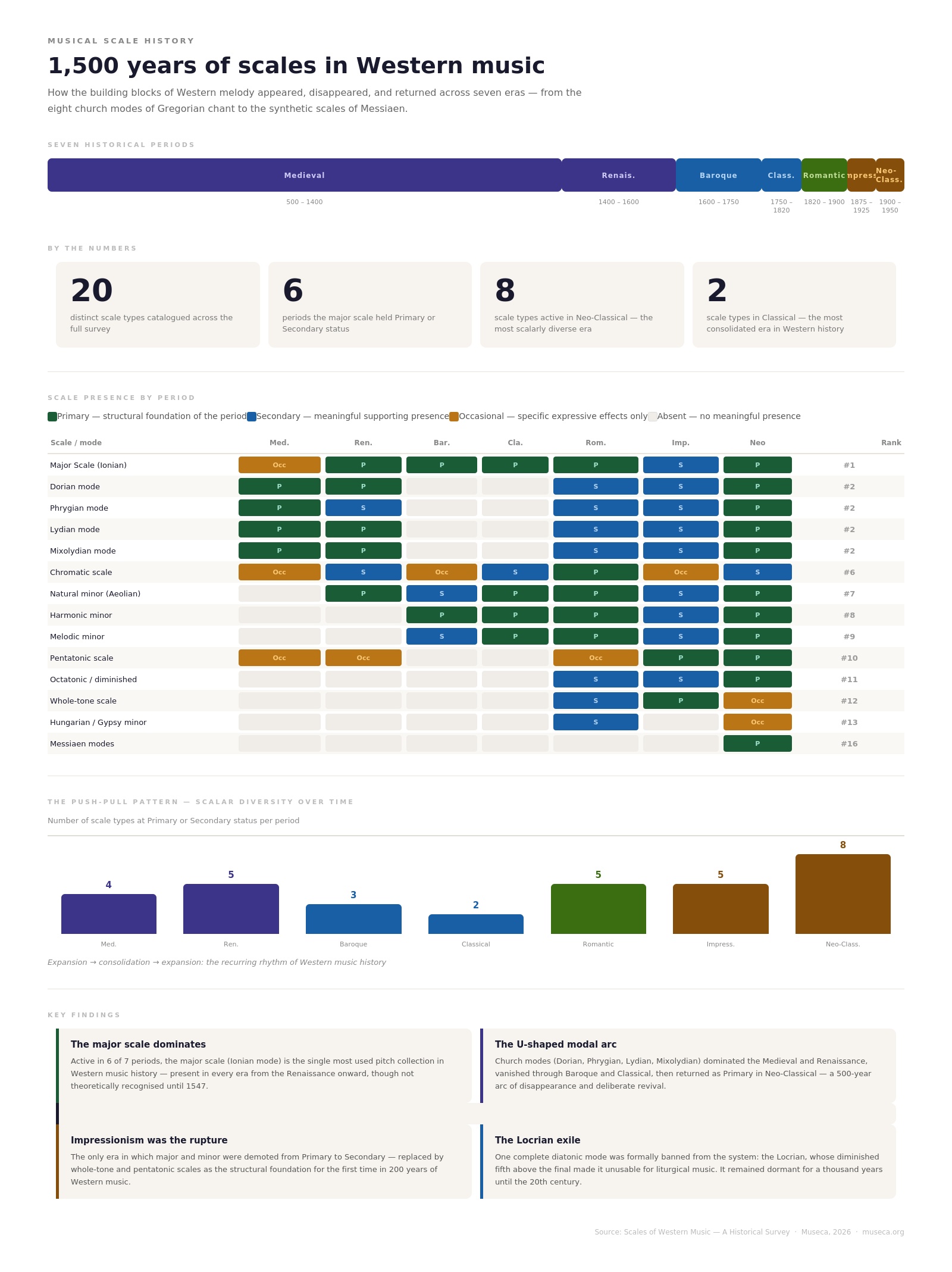
The survey covers seven historical periods — Medieval, Renaissance, Baroque, Classical, Romantic, Impressionist, and Neo-Classical — and tracks twenty distinct scale types across all seven. For each period and each scale, it asks the same questions: Was this scale a structural foundation, or a coloristic effect? Was it a deliberate revival of something older, or something genuinely new? And when it disappeared, why did it disappear — and what replaced it?
The findings are more surprising than the question suggests. The major scale, which most listeners assume has always been the natural center of Western music, was not even theoretically recognized until 1547. The church modes that preceded it — Dorian, Phrygian, Lydian, Mixolydian — vanished almost entirely for two centuries before returning in the late Romantic and Neo-Classical periods with renewed force. One complete diatonic mode, the Locrian, was formally excluded from the system for a thousand years because a single interval above its tonic was considered unusable. And the Impressionist period emerges as the single most radical disruption in the history of Western scales — the only era in which the major and minor scales were displaced from their position as the primary organizing principle of Western music, replaced by whole-tone collections, pentatonic fields, and revived medieval modes.
The report also traces the deeper pattern beneath these surface changes: the recurring oscillation between periods of chromatic expansion, when composers push the boundaries of the available scale vocabulary, and periods of consolidation, when a new generation pulls back toward structural clarity. Gesualdo’s extreme chromaticism in the Renaissance was followed by the Baroque’s strict major-minor system. Wagner’s chromatic saturation in the Romantic era was followed by Stravinsky’s and Hindemith’s Neo-Classical order. This push-pull rhythm, repeated across fifteen centuries, is the heartbeat of Western musical history.
The monograph is intended for musicians, musicologists, music educators, and informed listeners who want a rigorous but accessible account of how the building blocks of Western music have changed over time. It requires no prior knowledge of music theory beyond a basic familiarity with scales and modes. Every scale is explained from first principles, with its interval formula, its characteristic sound, its typical use, and its historical context.
Each chapter concludes with a curated listening example — a single work chosen to make the period’s scalar practice immediately audible rather than merely legible.
A free PDF download of the complete monograph — including the Scale Frequency Master Table, full bibliography, and listening guide — is available below.