
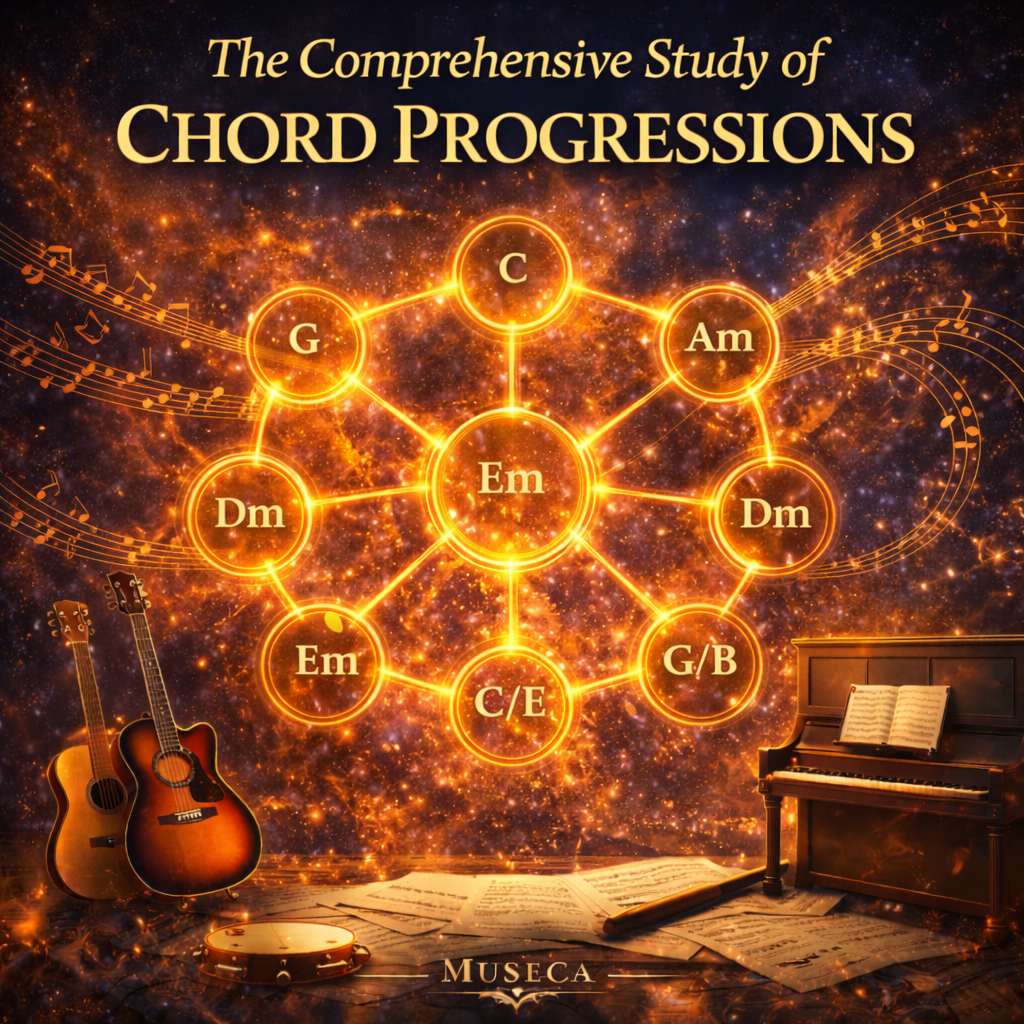
Comprehensive Study of Chord Progressions, Volume I is a practical guide to the structural foundations of harmonic motion. It treats chord progressions not as disconnected lists of symbols, but as patterns of expectation, release, phrase punctuation, tonal direction, and formal design. Beginning with the core grammar of harmony—function, cadence, root motion, voice leading, and harmonic rhythm—it then moves through the major progression families of tonal music, from diatonic patterns and ii–V–I structures to blues, pop loops, descending-line designs, chromatic enrichment, modulation, and large-scale tonal planning.
What gives this volume its distinctive strength is its insistence that harmony must be heard as motion rather than as static sonority. Written for composers, arrangers, songwriters, students, and curious musicians, it provides a clear theoretical and practical grammar for understanding how progressions behave across phrase, section, and whole-form architecture. The result is a strong conceptual framework: one that teaches the reader not only to name chords, but to hear how harmonic movement creates coherence, tension, continuity, and return.
Comprehensive Study of Chord Progressions, Volume II is a practical companion devoted to the living, applied world of harmonic writing. Where the first volume establishes the grammar of progression, this volume shows how that grammar behaves inside real musical situations: style, genre, emotional design, reharmonization, formal context, analysis, and composition. It explores how progressions function in classical, jazz, gospel, pop, film, ambient, world, and hybrid traditions, while also examining how harmony shapes mood, character, scene, narrative, bass identity, and stylistic rhetoric.
What makes this volume distinctive is its emphasis on creative use. It is written not only to help the reader identify progressions correctly, but to understand what they can do, how they can be transformed, and how they can serve real compositional problems. With sections devoted to variation, reharmonization, comparative analysis, the progression atlas, ear training, exercises, and project-based practice, it becomes an applied toolkit for composers, songwriters, arrangers, producers, and advanced students who want to move from harmonic knowledge into deliberate musical craft.
Download a Free PDF Edition of Comprehensive Study of Chord Progressions, Volume I and Comprehensive Study of Chord Progressions, Volume II
To receive a free PDF copy of Volume 1 and 2 of this textbook, simply complete the form below with your first name and email address. After submitting the form, you will be taken to a separate page where the PDF may be downloaded.
The information you provide is collected solely to make this free PDF available to you. Museca does not sell personal information and does not use it for commercial marketing purposes.