
Introduction
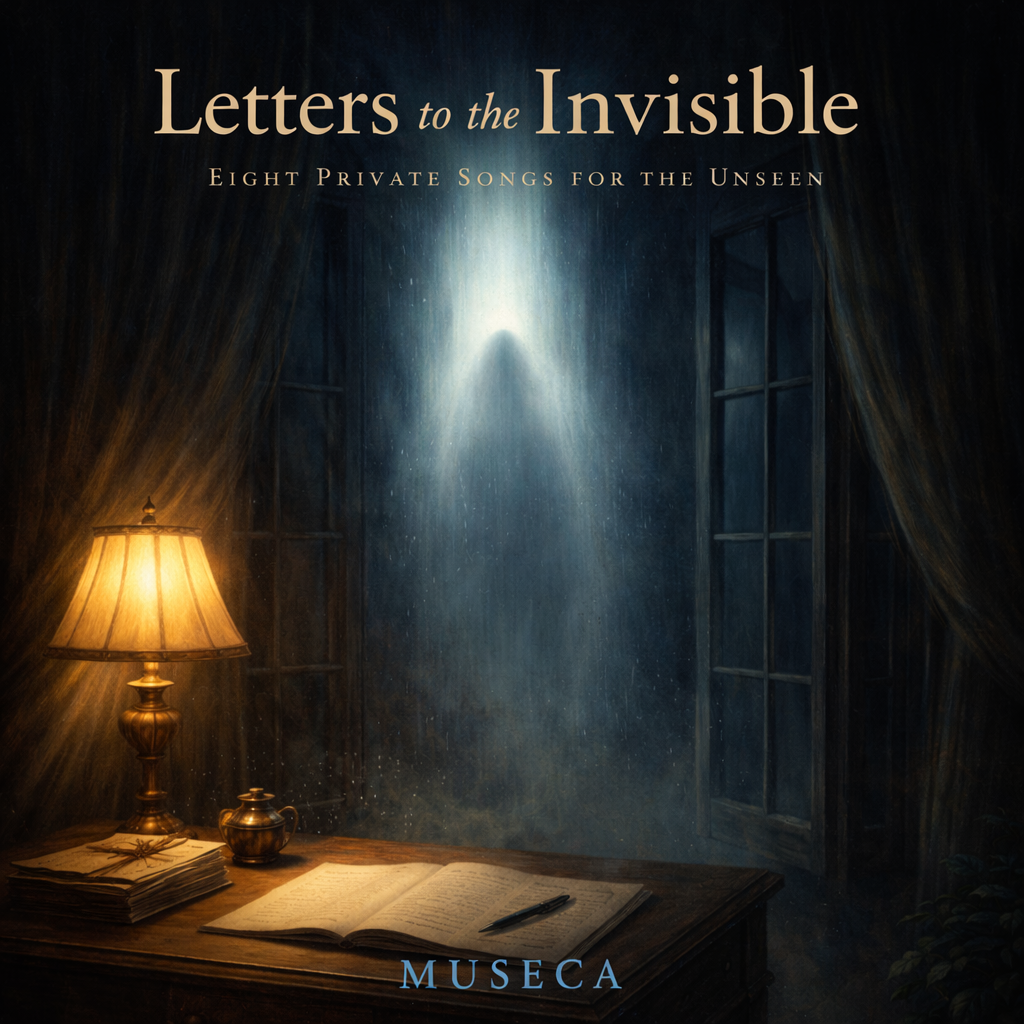
Letters to the Invisible: Eight Private Songs for the Unseen is a song cycle built from intimate acts of address. Each track begins as a private letter spoken into the unseen — to God, to the absent beloved, to the dead, to the soul, to the child within, to the future self, to silence, and finally to the invisible reality that seems to hold them all. What follows is not merely a song after a poem, but a musical response: as though the words themselves have opened a door, and the music steps through it.
The album lives in a space between prayer, memory, longing, and inner revelation. Its language is personal, but not confessional in a narrow sense. These letters are written from the human threshold where certainty fails and feeling deepens — where one speaks not because an answer is guaranteed, but because the act of speaking itself becomes a form of faith. The unseen here is not treated as abstraction. It is presence felt through absence, shape inferred through silence, love discovered through distance, and meaning recognized only after loss.
Musically, the album joins cinematic sacred pop with neoclassical chamber intimacy. Piano stands at the center, supported by warm strings, cello, ambient pads, and occasional weather-like textures that create a feeling of interior space. Some tracks bloom into full songs; others remain instrumental after the spoken text, allowing the poem’s emotional residue to continue without words. This mixture gives the album its breathing rhythm: now sung, now silent, now suspended between speech and song.
At its heart, Letters to the Invisible is an album about relationship with what cannot be fully grasped. It suggests that much of human life is lived in conversation with realities that cannot be held in the hand — God, memory, grief, hope, love, the deeper self, and the future that calls to us from beyond our present understanding. These songs are the sound of those conversations made audible.
The Concept of the Album
The central concept of Letters to the Invisible is simple but deep: each track is a letter addressed to something real yet unseen. Rather than presenting unrelated songs gathered under a loose theme, the album is designed as a unified poetic and musical journey. The spoken poems are not decorative introductions; they are the conceptual key to each piece. They frame the emotional subject, establish the addressee, and create the threshold through which the music enters.
The album follows an inner arc. It begins by looking upward and outward, addressing the unseen divine presence. It then turns toward love, death, the soul, childhood memory, and the future self. From there it enters silence itself, not as emptiness, but as a final chamber of listening. The last track gathers the whole journey into one culminating address: not merely to one invisible presence among others, but to the mystery behind them all. In this way, the album moves from separation toward integration, from many letters to one deeper recognition.
The spoken poems are intentionally brief, usually only a few lines long. Their purpose is not to dominate the track, but to focus it. They act like a match being struck in darkness. Once lit, the song expands the feeling, implication, or unanswered ache contained in the words. Sometimes the response is lyrical and sung; sometimes it is instrumental, as if music says what language can only begin. This structure allows the album to remain literary without becoming static, and emotional without becoming sentimental.
The phrase “the invisible” is meant broadly. It includes God, certainly, but also love that cannot be possessed, the dead who remain inwardly near, the truest self beneath social identity, the child who still lives within memory, and the future self who waits ahead like a hidden witness. Even silence becomes one of the invisible presences addressed by the album. The concept rests on the belief that much of what most deeply shapes human life is unseen, yet continuously felt.
For that reason, the music avoids spectacle for its own sake. Its task is not to overwhelm the poems, but to deepen their resonance. The style of cinematic sacred pop with neoclassical chamber elements was chosen because it can hold reverence, tenderness, interiority, and lift all at once. The result is an album that feels at once private and expansive: a collection of inward letters that open into larger emotional and spiritual space.
In the end, Letters to the Invisible is about the human need to speak beyond what is visible, measurable, or immediately answerable. It is about writing into mystery and discovering that mystery has, in some quiet way, already been listening.
Liner Notes
To the One I Cannot See
Addressed to: God / the unseen divine presence
The album opens with a letter spoken into mystery. This first track is not written from certainty, but from longing — the longing to be heard by a presence that cannot be proven, only sensed. The poem speaks quietly, almost as if testing whether the room itself can bear the weight of prayer. What follows musically is gentle and restrained: piano, warm strings, and a luminous refrain that does not declare faith so much as reach toward it. The track sets the tone for the entire album by establishing that these letters are not proclamations, but intimate acts of address. The invisible is first encountered here as divine nearness felt through silence.
Lyrics
[Spoken word, intimate, hushed, reverent, close-mic, over soft rain and piano] I have spoken to the walls so long they almost learned Your name. Tonight I leave the window open in case You enter as air. I do not ask for thunder. A breath would be enough. Even silence, if it is Yours, would be a kind of answer. [Brief instrumental swell] [Soft sung refrain, tender, simple, luminous] If You are near, stay near tonight If You are light, remain I have no proof, only this open door and Your forgotten name
Letter to the Beloved Unseen
Addressed to: an absent beloved / love itself in invisible form
This track turns from the divine to the intimate. The beloved here is deliberately ambiguous: perhaps a lost love, perhaps a future love not yet met, perhaps even the ideal form of love that has always remained just beyond reach. The song explores the strange emotional truth that some of the deepest loves in life are not fully possessable. They remain half memory, half promise. Musically, the track broadens into a fuller song form, allowing longing to become melodic and expansive. It carries tenderness without closure, preserving the idea that some presences are most powerful precisely because they remain unseen.
Lyrics
[Spoken word, intimate, close-mic, tender, over soft piano and distant pad]
I have loved what I could not hold,
and held what I could not keep.
Somewhere between memory and promise,
your name became my silence.
I write to the shape of your absence
as if it were a door of light.
If you are nowhere, answer gently.
If you are near, remain unseen.
[Brief instrumental breath]
[Verse 1, soft and tender]
You were the room behind the room,
the candle after flame,
the warmth that touched the edge of night
without a face or name.
I followed echoes through the dark,
I learned the art of waiting,
and every star I could not reach
felt like your pulse still waking.
[Pre-Chorus, slightly rising]
I called you through the hidden years,
through windows, rain, and sleep,
and all the love I could not place
became the love I keep.
[Chorus, open and luminous]
Beloved unseen, stay close to me,
not in the hand, but in the air.
Beloved unseen, if love is real,
then let me feel you there.
No proof, no sign, no spoken vow,
just this fire I cannot name.
Beloved unseen, I sing to what
arrives and leaves the same.
[Verse 2, warmer, more intimate]
I saw your shadow in the glass,
in stations left behind,
in letters never sent at all,
in weather of the mind.
You were the almost in each joy,
the hush in each confession,
the tender ache that made my life
a question and a blessing.
[Pre-Chorus, fuller]
I called you through the hidden years,
through windows, rain, and sleep,
and all the love I could not place
became the love I keep.
[Chorus, fuller]
Beloved unseen, stay close to me,
not in the hand, but in the air.
Beloved unseen, if love is real,
then let me feel you there.
No proof, no sign, no spoken vow,
just this fire I cannot name.
Beloved unseen, I sing to what
arrives and leaves the same.
[Bridge, softer, suspended]
Maybe you live where music goes
when no one hears the end.
Maybe you are the part of love
that time cannot rescind.
I will not force you into form,
I will not break the sky.
I only leave this heart ajar
whenever night is nigh.
[Final Chorus, most emotional]
Beloved unseen, stay close to me,
not in the hand, but in the air.
Beloved unseen, if love is real,
then let me feel you there.
No proof, no sign, no spoken vow,
just this fire I cannot name.
Beloved unseen, I sing to what
arrives and leaves the same.
[Outro, soft, almost whispered]
[Optional spoken reprise, intimate]
I write to the shape of your absence
as if it were a door of light.
Letter to the Dead
Addressed to: one who has died but remains inwardly present
This is one of the album’s most restrained and intimate pieces. The spoken poem addresses the dead not as an abstraction, but as someone still emotionally near — someone whose physical absence has not erased relationship. The music responds without sung lyrics, allowing piano, cello, and strings to carry what words cannot. The effect is elegiac but not despairing. The track suggests that grief is itself a kind of continued conversation, and that love may remain a channel of address even after death has removed the possibility of answer. Here the invisible is the persistence of the departed within memory, love, and inward presence.
Lyrics
[Spoken word, intimate, close-mic, calm grief, over soft piano and distant strings]
I still speak to you in rooms
that have forgotten your footsteps.
The air does not answer,
but it keeps your shape.
I lay this letter on the silence
where your hands once were.
If the dead can hear through love,
then hear me now.
Letter to the Soul
Addressed to: the deepest self beneath fear, role, and identity
After addressing God, love, and death, the album turns inward. This track is written to the soul — not in a theological or doctrinal sense, but as the truest self beneath noise, performance, and habit. The spoken lines recognize how often we confuse activity with aliveness, and how the soul waits beneath all external names for a return of attention. The music remains light, inward, and almost weightless, with a short sung refrain that functions less as a chorus than as a gentle invocation. The track marks a turning point in the album, because the invisible is no longer only outside the speaker, but within.
Lyrics
[Spoken word, intimate, close-mic, calm, inward, over soft piano and distant pad]
I have mistaken noise for life,
and fear for motion.
But beneath the names I answer to,
someone has been waiting.
Not wounded. Not lost.
Only covered.
So I write to the one within me
who never left.
[Brief instrumental breath]
[Soft sung refrain, tender, simple, luminous]
Soul of mine, remain
Under all I name
When the world is loud
Call me back again
[Instrumental response, piano and warm strings, no ad-libs]
[Optional final whispered spoken reprise]
[Spoken word, barely above a whisper]
Call me back again.
Letter to the Child Within
Addressed to: the inner child / innocence, memory, and the earlier self
This track carries tenderness, vulnerability, and the ache of retrospection. It is addressed to the part of the self that still lives beneath adulthood — the child who remembers wonder, fear, first wounds, and the need for comfort. The letter does not treat childhood sentimentally. Instead, it honors the child within as someone still waiting to be seen, protected, and spoken to with kindness. Musically, this track is one of the warmer and more lyrical songs on the album, allowing the emotional directness of the subject to bloom into fuller melodic shape. Here the invisible is memory itself made personal and living.
Lyrics
[Spoken word, intimate, close-mic, tender, over soft piano and harp]
I write to the child
who still lives in my weather.
The one who learned too early
how to smile and disappear.
I have not forgotten you.
I have only taken long roads back.
If you are still waiting in that small room,
leave the light on.
[Brief instrumental breath]
[Verse 1, soft and tender]
You were the hush behind the door,
the question in my eyes,
the hand that reached for something warm
and learned to memorize.
You kept your wonder folded up
inside a paper sky,
while grown-up days put on their coats
and taught the heart to hide.
[Pre-Chorus, gently rising]
But I can hear you in the rain,
in laughter half-remembered,
in every room where love went dim
but never fully ended.
[Chorus, warm and luminous]
Child within, I see you now,
small flame against the blue.
All the years I could not stay,
I have carried you.
Child within, come out of fear,
you do not have to run.
I will be the voice that says
you were never the forgotten one.
[Verse 2, warmer]
You were the drawer of secret things,
the window left ajar,
the name you whispered to the dark
while wishing on a star.
You wore your silence like a coat,
too heavy for your frame,
and every time the world grew cold
you learned to take the blame.
[Pre-Chorus, fuller]
But I can hear you in the rain,
in laughter half-remembered,
in every room where love went dim
but never fully ended.
[Chorus, fuller]
Child within, I see you now,
small flame against the blue.
All the years I could not stay,
I have carried you.
Child within, come out of fear,
you do not have to run.
I will be the voice that says
you were never the forgotten one.
[Bridge, soft, suspended]
If I could stand beside your bed
and gather up your night,
I would tell you broken things
can still become the light.
I would tell you none of this
was yours alone to bear,
and every door you feared was locked
still held a little air.
[Final Chorus, most emotional]
Child within, I see you now,
small flame against the blue.
All the years I could not stay,
I have carried you.
Child within, come out of fear,
you do not have to run.
I will be the voice that says
you were never the forgotten one.
[Outro, soft]
[Optional spoken reprise, intimate]
Leave the light on.
Letter to the Future Self
Addressed to: the self yet to come
With this track, the album begins to lean forward. The speaker addresses the future self with a mixture of hope, humility, and blessing. The letter imagines a person not yet fully formed — one who may still carry present wounds, but perhaps more lightly, more wisely. There is an almost ethical tenderness in the poem: a desire that the future self become kinder, freer, and less burdened by the unfinished pain of the present. The music remains instrumental after the spoken text, allowing the feeling of anticipation to unfold without further language. The invisible here is time itself — the person one is becoming, still hidden ahead.
Lyrics
[Spoken word, intimate, close-mic, calm, hopeful, over soft piano and distant pad] I write to the one I have not yet become, hoping you are kinder than I was. If you still carry these same wounds, carry them more lightly. If joy has found you, do not apologize for it. Remember me not as unfinished, but as the hand that kept reaching.
Letter to Silence
Addressed to: silence as a presence rather than an emptiness
This is the most stripped and spacious track on the album. Silence is addressed not as absence, but as a final chamber in which truth may be heard after noise has fallen away. The spoken poem acknowledges how often silence is feared, avoided, or mistaken for emptiness. Yet in this track, silence becomes a witness — vast, patient, and capable of holding what language buries. The musical response is minimal and suspended, with piano, cello, and ambient stillness doing the work of continuation. This track prepares the way for the final one by revealing that even what seems empty may contain presence. The invisible here is not a figure, but a condition of listening.
Lyrics
[Spoken word, intimate, close-mic, slow, reverent, in the middle after the opening]
I have run from silence
as if it meant absence.
But when everything fell away,
it was the last thing that remained.
Not empty.
Not cold.
Only vast enough
to hear what I had buried.
Letter to the Invisible
Addressed to: the unseen reality that holds God, love, death, soul, memory, future, and silence within it
The final track gathers the entire album into one culminating address. After writing separately to the divine, the beloved, the dead, the soul, the child within, the future self, and silence, the speaker now turns to the larger mystery behind them all. This is not a narrowing, but an expansion. The invisible is finally understood as the hidden thread joining all earlier addressees — the presence beneath every loss, yearning, and recognition. Musically, this is the fullest and most luminous song on the album, bringing together the intimacy of the earlier tracks with a broader sense of arrival. The closing effect is not resolution in a simplistic sense, but integration: the realization that all these letters may have been addressed, in different forms, to one underlying reality.
Lyrics
[Spoken word, intimate, close-mic, reverent, over soft piano and distant pad]
I have written to God,
to love,
to the dead,
to the soul,
to the child,
to the future,
to silence.
Now I write to what held them all.
[Brief instrumental breath]
[Verse 1, soft and luminous]
You were the thread behind the thread,
the fire beneath the flame,
the hidden hand in every loss,
the pulse beneath each name.
I met You first in broken things,
in doors that would not open,
in every grief that left behind
a sentence still unspoken.
[Pre-Chorus, gently rising]
I called You by a thousand words,
and still You stayed unnamed,
but every letter that I wrote
returned to You the same.
[Chorus, open and radiant]
Invisible, I know You now
not by sight, but by the way
the night gave back a deeper light
and sorrow learned to pray.
Invisible, receive this heart,
its ashes and its flame.
All I could not hold or heal
was always Yours to name.
[Verse 2, warmer, fuller]
You were the room behind my fear,
the stillness under weather,
the silent gold inside the wound
that held the world together.
You lived in every absent face,
in every hour of yearning,
and all the roads I thought were loss
were roads of Your returning.
[Pre-Chorus, fuller]
I called You by a thousand words,
and still You stayed unnamed,
but every letter that I wrote
returned to You the same.
[Chorus, fuller]
Invisible, I know You now
not by sight, but by the way
the night gave back a deeper light
and sorrow learned to pray.
Invisible, receive this heart,
its ashes and its flame.
All I could not hold or heal
was always Yours to name.
[Bridge, suspended, tender]
So take the names I used before,
the ones I could not carry.
Take every unanswered cry,
each place I chose to tarry.
If love was only part of You,
and silence was Your door,
then let me live inside that truth
and be afraid no more.
[Final Chorus, most luminous, emotionally full]
Invisible, I know You now
not by sight, but by the way
the night gave back a deeper light
and sorrow learned to pray.
Invisible, receive this heart,
its ashes and its flame.
All I could not hold or heal
was always Yours to name.
[Outro, soft, spacious]
[Spoken word, barely above a whisper]
Now I write to what held them all.
Playlist
- Track 1 - To the One I Cannot See Museca 2:03
- Track 2 - Letter to the Beloved Unseen Museca 5:58
- Track 3 - Letter to the Dead Museca 1:33
- Track 4 - Letter to the Soul Museca 1:47
- Track 5 - Letter to the Child Within Museca 4:38
- Track 6 - Letter to the Future Self Museca 1:14
- Track 7 - Letter to Silence Museca 1:18
- Track 8 - Letter to the Invisible Museca 5:47