
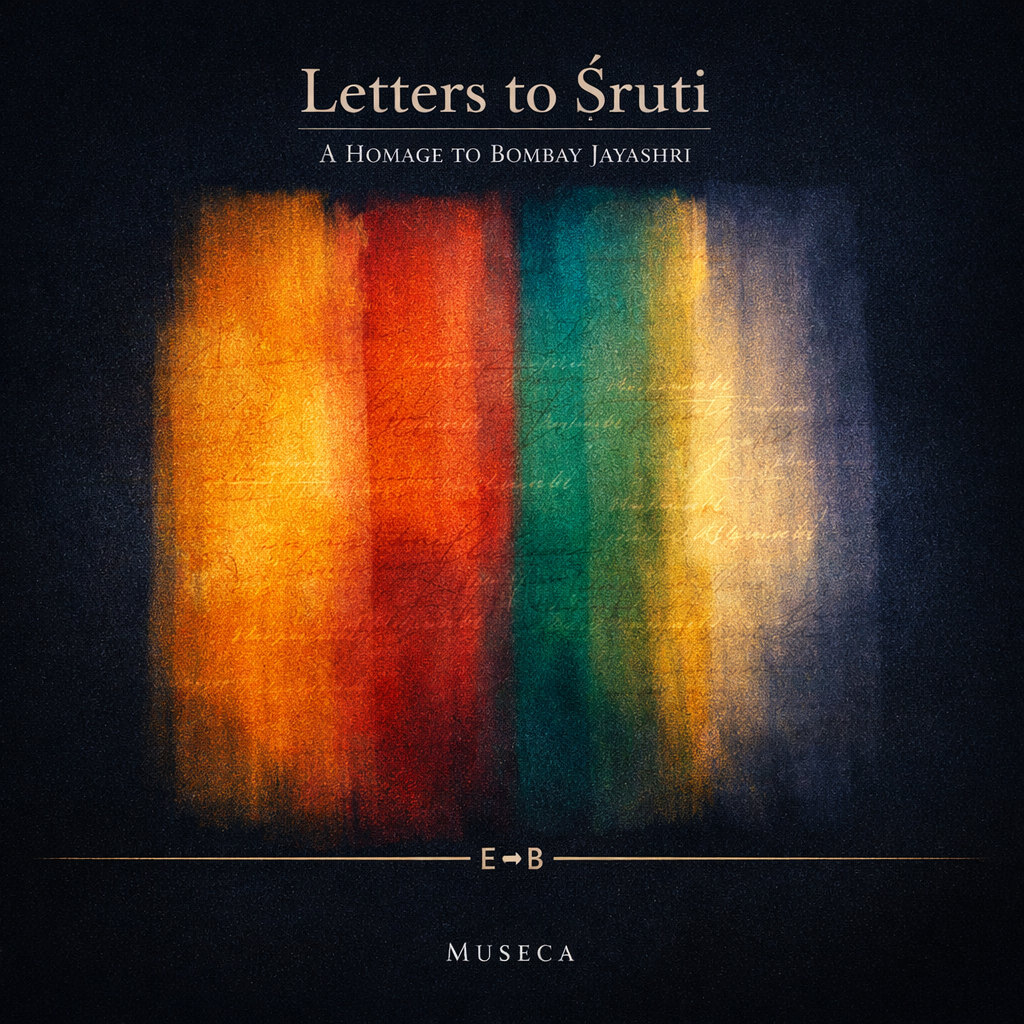
Letters to Śruti — A Homage to Bombay Jayashri honors a singular musical gift: the ability to make a raga feel like a spoken truth. Bombay Jayashri (Jayashri Ramnath) is among the most respected Carnatic vocalists of her generation—trained first within a family of musicians and later under luminaries including Lalgudi Jayaraman and T. R. Balamani, with additional Hindustani training that broadened her expressive palette. For many listeners worldwide, her voice is also inseparable from South Indian film music at its most lyrical—performances that carry Carnatic integrity into cinematic melody, from landmark playback songs to her Academy Award–nominated “Pi’s Lullaby.”
This album is written as four “letters” addressed to śruti—the tonal home that Indian classical music continually returns to, and the discipline of sruti śuddham: unwavering pitch alignment to the tonic and its drone field. Across the suite, Museca’s home key is set as Sa = E, with an E–B drone as the constant thread, reflecting the musical virtues Jayashri embodies: centered intonation, lyric violin-like line, restrained ornamentation, and bhava-led phrasing. Each track explores a different emotional “room”—longing, stillness, renewal, and warmth—while keeping the same Carnatic-cinematic grammar: raga-shaped melody first, accompaniment second, and a voice that never performs at the emotion, but simply reveals it.
Liner Notes
Natabhairavi Nocturne
The album opens in night-blue introspection: a raga-shaped line that speaks softly but never wavers. The drone is the ground beneath the listener’s feet, while the vocal phrasing moves with a violin’s patience—gliding, settling, returning. It is a “letter” written in quiet longing, where emotion is carried by contour and breath, not by harmonic spectacle.
Sanctum of One Breath
This piece turns inward, devotional without declaring itself a hymn. The space is spare by design: a steady śruti field, a shadowing violin, and the smallest possible rhythmic pulse—if any at all. The voice becomes the architecture, shaping stillness into melody, as though each phrase were offered and released in a single exhale.
Kalyani Horizon
Here the suite opens to light. The raga world brightens, but the discipline remains: no rush, no dramatic harmonic turn—only widening register, gentle swells, and the sensation of first dawn appearing at the edge of silence. Strings provide a distant horizon and bansuri air drifts through the gaps, framing the voice as something both intimate and vast.
Velvet Kapi
The closing track is the most human and songful—warmth you can touch. A soft groove suggests everyday life rather than ritual, yet the melodic logic stays Carnatic at its core: raga-first phrasing, careful ornament, and a refrain that feels inevitable. It ends not with a climax, but with a return—one last settling into the tonic, as if sealing the final letter with calm hands.
Playlist
- Natabhairavi Nocturne Museca 2:33
- Sanctum of One Breath (Madhyamavati Letter) Museca 2:47
- Kalyani Horizon (Dawn Letter) Museca 2:42
- Velvet Kapi (Warmth Letter) Museca 2:53