
Introduction
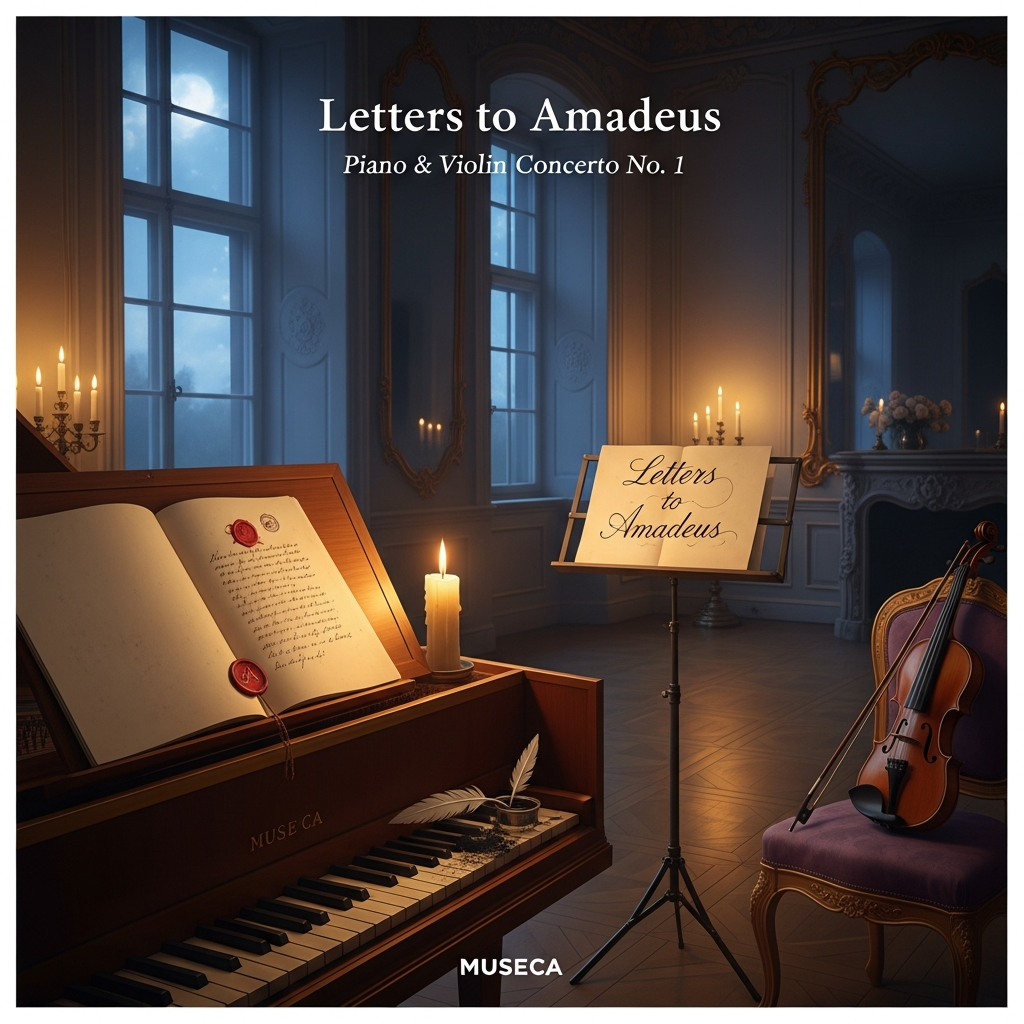
Letters to Amadeus is conceived as a four-movement piano and violin concerto written in the spirit of correspondence—intimate, searching, and reverent rather than imitative. The work does not attempt to recreate Mozart’s voice; instead, it speaks to him across time, as one composer addressing another with admiration, gratitude, and quiet audacity. Each movement functions as a “letter,” revealing a different facet of dialogue: wonder, wit, vulnerability, and final benediction.
The concerto acknowledges Wolfgang Amadeus Mozart not as a monument, but as a living presence—brilliant, human, playful, and profound. Classical balance and clarity form the architectural foundation, while subtle modern inflections allow the music to breathe in the present tense. The piano and violin act as equal correspondents, alternating between intimacy and debate, echo and reply.
I. Salutation — Allegro con luce (Movement 1)
The opening movement unfolds as a formal greeting. Bright, poised, and gracious, it evokes the ceremonial elegance of the Classical era while allowing flashes of modern harmonic color to pass like light through old glass. The piano introduces the principal idea with confidence and clarity; the violin responds with warmth and lyric ease. Their dialogue establishes the concerto’s central premise: respect without reverence, admiration without mimicry. Beneath the surface brilliance lies a quiet joy—the joy of writing to someone whose language you know by heart.
Piano and Violin Concerto No. 1, Movement 1 “Letters to Amadeus”
II. Confidences — Andante cantabile (Movement 2)
Here the music turns inward. This movement is the private letter, written late at night, where formality dissolves into candor. Long-breathed lines and restrained orchestration frame a tender exchange between piano and violin, each voice listening as much as it speaks. The harmonic language lingers between familiarity and yearning, suggesting questions Mozart never answered and feelings he rarely put into words. Time slows; the concerto becomes a meditation on intimacy, fragility, and the courage to be sincere.
Piano and Violin Concerto No. 1, Movement 2 “Letters to Amadeus”
III. Mischief & Wit — Allegretto giocoso (Movement 3)
Mozart’s irrepressible humor steps into the foreground. This movement sparkles with rhythmic play, quick turns of phrase, and light-footed virtuosity. Motifs dart, tease, and occasionally interrupt one another, as if the music itself were smiling mid-sentence. Classical symmetry is gently bent, not broken, allowing surprise to coexist with grace. It is a reminder that genius need not be solemn—that laughter, agility, and intelligence can share the same breath.
Piano and Violin Concerto No. 1, Movement 3 “Letters to Amadeus”
IV. Postscript — Adagio → Allegro risoluto (Movement 4)
The final movement serves as both farewell and affirmation. It begins reflectively, as if rereading the letters just written, before gathering resolve and forward motion. Themes from earlier movements return in transformed guise, now unified and purposeful. The concerto closes not with nostalgia, but with continuation—a sense that the conversation does not end, but passes onward. The final cadence is neither grandiose nor apologetic; it is clear, open, and quietly confident.
Piano and Violin Concerto No. 1, Movement 4 “Letters to Amadeus”
Letters to Amadeus is ultimately an act of gratitude: a modern voice shaped by a classical inheritance, offering thanks not through imitation, but through dialogue. It invites the listener to hear Mozart not only as history, but as presence—and to recognize that great music is, at its core, a letter meant to be answered.
Playlist
- Piano and Violin Concerto No. 1, Movement 1 (Remastered) Museca 7:20
- Piano and Violin Concerto No. 1, Movement 2 (Remastered) Museca 5:34
- Piano and Violin Concerto No. 1, Movement 3 (Remastered) Museca 6:09
- Piano and Violin Concerto No. 1 Movement4 (Remastered) Museca 5:22