
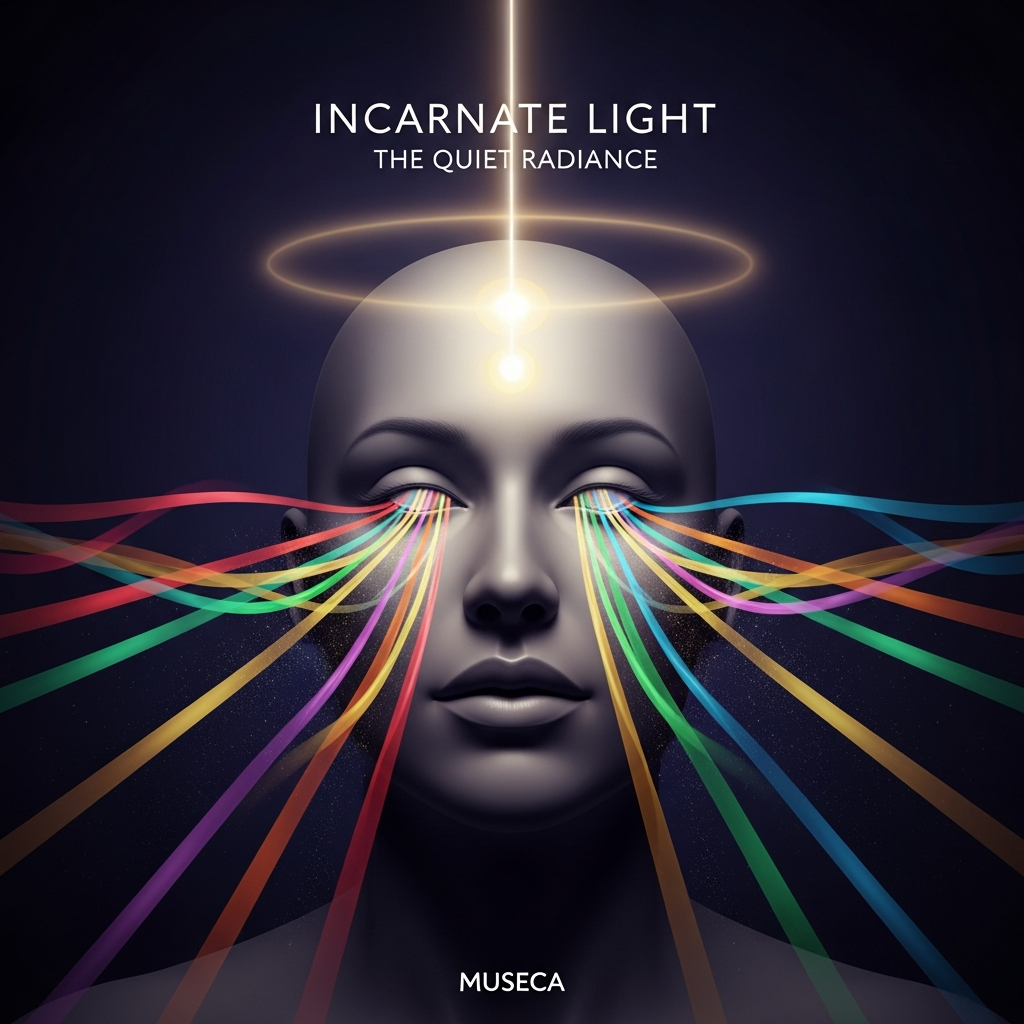
Incarnate Light: The Quiet Radiance unfolds as a continuous nocturne cycle rather than a collection of separate pieces. Each work grows from the same inner source, reshaped through different textures, emotional weights, and degrees of intimacy. What binds the album together is not orchestration alone, but a shared language of singing lines—melodies that move independently, overlap, and lean into one another so that harmony arises through motion rather than declaration.
The opening string adagio introduces the core character of the album: warm, patient, and inward. Long-breathed phrases pass gently between voices, establishing light not as brilliance but as presence. The Museca Signature Mix expands this atmosphere with harp and celesta, whose small points of shimmer behave like reflections rather than spotlights. These colors recur throughout the album, never overwhelming the strings, always suggesting quiet illumination at the edges of thought.
As the cycle deepens, the nocturnal variations explore solitude from different angles. Nightfall withdraws into hush and closeness, Lantern Mix introduces a sense of guidance and slow forward motion, and Nocturne for One Light offers a tender warmth that feels personal rather than public. Midnight Solitude moves further inward still, colder and more spectral, where lines feel slightly distanced from one another, as if sound itself were breathing in thin air.
The ballet and symphonic adagios widen the physical space without breaking the album’s restraint. Here the music learns to move, to arc, and to carry weight, yet it never abandons its lyrical center. Even at its most expansive, the sound remains human-scaled, built from voices that continue to sing rather than proclaim.
The tragic sequences mark the emotional core of the cycle. In these pieces, the counterpoint tightens, suspensions ache longer, and lines strain upward before yielding. The intensity recalls the late-Romantic edge where beauty and exhaustion coexist. What follows are not alternate mixes, but alternate endings—different answers to the same emotional question. Dying Embers thins toward disappearance, Extinguished Light allows the glow to go fully dark, while Ascendant Light chooses a gentler ascent, lifting without urgency.
The cycle closes with Morning Ember, a reprise that does not resolve in triumph, but in calm recognition. Light returns quietly, as if it never truly left. The final sound is not a statement, but a resting place.
Taken as a whole, The Quiet Radiance is music for still hours and reflective spaces. It favors continuity over contrast, listening over spectacle, and depth over brightness. Each piece stands on its own, yet the album is best experienced as a single arc—a long, slow breath in which light becomes incarnate not through force, but through patience.
Liner Notes
Incarnate Light (String Adagio)
The cycle opens in pure intimacy: strings only, singing lines moving as if they are discovering the theme in real time. Harmony is not presented as blocks but emerges from interwoven motion—gentle suspensions, soft resolutions, and a calm, searching breath. This is the album’s “source tone,” where radiance begins as presence rather than brilliance.
Incarnate Light (Museca Signature Mix)
Harp and celesta enter like faint starlight—pinpoints and glimmers around the string core. The theme becomes more luminous without becoming louder, as if the music is lit from within. This mix defines the album’s signature: quiet shimmer, warm depth, and an unhurried sense of wonder.
Incarnate Light (Nightfall — Museca Signature Mix)
Nightfall narrows the focus and draws the listener closer. The same materials feel more private, with softer edges and a darker hue, as if the light has moved behind a veil. The counterpoint becomes more whispered than declared—lines drifting past one another in a hush that feels protective rather than bleak.
Incarnate Light (Lantern Mix — Museca Signature Mix)
Here the radiance becomes directional—less like starlight and more like guidance. The music suggests a slow forward motion, a light carried through darkness, steady and human. The shimmer is warmer, the phrases more gently purposeful, and the inner voices feel like steps taken with care.
Incarnate Light (Nocturne for One Light — Museca Signature Mix)
This is solitude without coldness: a single inward flame. The theme is treated with tenderness, as though the music is speaking to one listener rather than an audience. The lines breathe longer, and the harmonies settle into a warm, nocturne-like calm—quietly emotional, quietly complete.
Incarnate Light (Midnight Solitude — Museca Signature Mix)
The album’s deepest hush. The space feels colder, more spectral, with distance between the voices—still connected, but suspended in thin air. Shimmer becomes frost-like, the melodic motion more restrained, and the emotional register shifts from comfort to contemplation, as if the music has entered the hour when the mind becomes most honest.
Incarnate Light (Ballet Adagio)
The cycle widens into movement. The theme learns to arc, to turn, to carry the lyrical weight of dance—graceful without becoming decorative. Even as the canvas grows, the writing remains voice-led: lines guiding one another like dancers sharing balance, with elegance that never abandons vulnerability.
Incarnate Light (Symphonic Adagio)
This is the panoramic view: the theme expanded into a broader symphonic breath. The emotion becomes more cinematic, not through spectacle but through scale—longer spans, fuller resonance, deeper harmonic gravity. The inner voices intensify the feeling of inevitability, as if the light has become an atmosphere rather than a point.
Incarnate Light (Tragic Adagio)
The tone shifts toward the Romantic edge where beauty and sorrow occupy the same room. Suspensions hold longer; resolutions arrive late, almost reluctantly. The theme remains luminous, but the light now feels costly—earned through pressure, through restraint, through the courage to stay present when the heart wants to look away.
Incarnate Light (Last Cry of Light)
A fierce surge of emotion—one final insistence, a protest made of melody. The counterpoint tightens and climbs; lines strain upward as if reaching for a last breath of radiance. This is not anger so much as intensity: love refusing to disappear quietly, then breaking into fragility.
Incarnate Light (Dying Embers Adagio)
After the cry, the music softens into aftermath. The theme returns in fragments, quieter each time, as though the light is receding but leaving warmth behind. Texture thins gradually, and the listening experience becomes intimate again—like watching the last embers shift in a hearth long after the room has fallen silent.
Incarnate Light (Extinguished Light Adagio)
The most desolate answer the cycle offers. The glow finally goes out; the harmonies remain ambiguous, drained of forward motion, and the counterpoint feels exhausted—beautiful, but beyond consolation. The piece does not “resolve” so much as it accepts emptiness as a real emotional place, and then lets the air speak.
Incarnate Light (Ascendant Light Adagio)
A different choice: lift rather than vanish. The music rises with gentleness, as though the same darkness has been transfigured into clarity. Without forcing triumph, the theme finds altitude—less grief, more release. The radiance here is calm and steady, like dawn arriving before the world is ready to believe it.
Incarnate Light (Reprise: Morning Ember)
The cycle closes with quiet return. Morning Ember is not a victory march; it is recognition—the sense that light persists even when it is small. The reprise gathers what came before and holds it softly, letting the listener step out of the night with warmth still on the skin. The final sound feels like breath settling, the day beginning not with brilliance, but with peace.
Playlist
- Incarnate Light (String Adagio) Museca 2:57
- Incarnate Light (Museca Signature Mix) Museca 2:25
- Incarnate Light (Nightfall – Museca Signature Mix) Museca 3:04
- Incarnate Light (Lantern Mix – Museca Signature Mix) Museca 2:58
- Incarnate Light (Nocturne for One Light — Museca Signature Mix) Museca 1:11
- Incarnate Light (Midnight Solitude – Museca Signature Mix) Museca 2:20
- Incarnate Light (Ballet-style orchestral version) Museca 2:43
- Incarnate Light (Symphonic Adagio)+ souledout 3:00
- Incarnate Light (Tragic Adagio) Museca 4:43
- Incarnate Light (Last Cry of Light) Museca 1:38
- Incarnate Light (Dying Embers Adagio) Museca 2:00
- Incarnate Light (Extinguished Light Adagio) Museca 2:58
- Incarnate Light (Ascendant Light) Museca 2:47
- Incarnate Light (Reprise: Morning Ember) Museca 2:33