
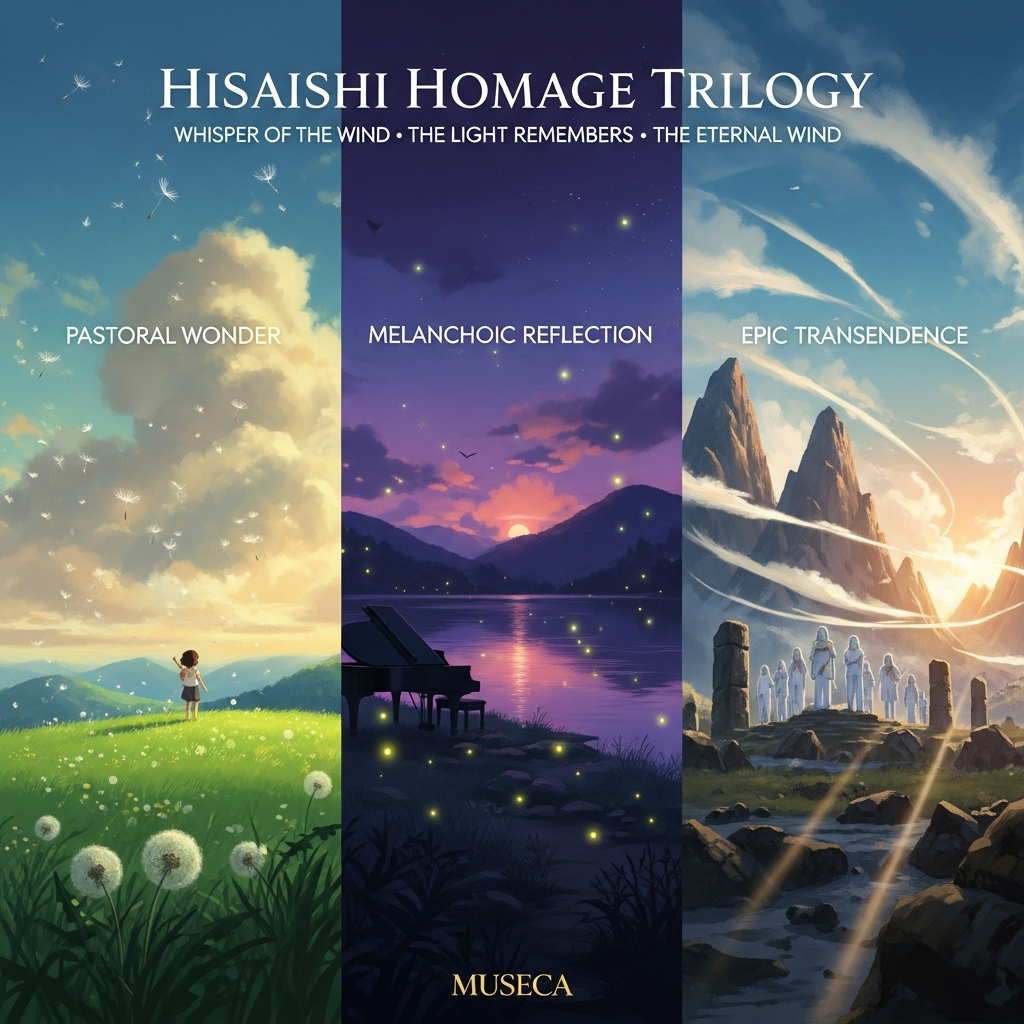
Hisaishi Homage Trilogy
Whisper of the Wind • The Light Remembers • The Eternal Wind
Introduction
The Hisaishi Homage Trilogy is a three-part musical journey inspired by the timeless artistry of Joe Hisaishi, whose scores for the films of Hayao Miyazaki and Studio Ghibli have come to define the sound of wonder, memory, and transcendence in modern cinema.
Each piece in this trilogy reimagines a different facet of Hisaishi’s musical spirit — from pastoral innocence to meditative reflection to symphonic elevation — while remaining faithful to the emotional sincerity and compositional elegance that characterize his work.
Hisaishi’s music has always existed in harmony with the natural and spiritual world. It balances Western classical lyricism with Japanese aesthetics of space and silence (ma), creating an atmosphere where melody breathes and meaning is found between the notes. This trilogy celebrates that aesthetic — not by imitation, but through translation: a dialogue between homage and originality.
I. Whisper of the Wind (Pastoral Wonder)
This opening movement recalls the radiant innocence of My Neighbor Totoro and the spirit of adventure in Laputa: Castle in the Sky.
Composed in C major with Lydian inflections (♯4), it features a piano-led theme supported by strings, flute, and harp, symbolizing discovery and light.
The harmonic structure uses the “Ghibli cadence” — I–vi–IV–V — while gentle 6/8 rhythms evoke motion through air and grass.
Dynamic arcs rise and fall like a child’s breath of wonder.
This is the sound of sunlight meeting the wind — a celebration of curiosity and open-heartedness.
II. The Light Remembers (Melancholic Reflection)
The second piece drifts inward, embracing the quiet ache of remembrance found in Kikujiro’s Summer and Spirited Away.
A minimalist piano ostinato unfolds over sustained string textures and ambient resonance, gradually revealing harmonic colors of A minor and C major add9.
Moments of silence (ma) are essential here — pauses that let emotion echo naturally, transforming absence into music.
The piece explores modality and suspended harmony (add2, add9, sus4) to evoke impermanence and beauty without closure.
Each phrase lingers like light fading on water — memory, not melancholy, is the true theme.
III. The Eternal Wind (Epic Transcendence)
The final movement expands into the symphonic and spiritual realm, inspired by Princess Mononoke and The Wind Rises.
It opens in D minor, anchored by taiko pulse and low strings, before ascending to D major, symbolizing transformation and renewal.
The main theme, introduced by horns and choir, moves through parallel fifths and modal shifts, reflecting the Japanese sense of strength within simplicity.
As the orchestra swells — strings, brass, and percussion in full unity — the harmony modulates toward radiant consonance.
In its closing passage, a solo piano reprises the opening motif in stillness, completing the cycle from earth to air, from breath to eternity.
Musical Techniques and Inspirations
Across the trilogy, several hallmarks of Hisaishi’s compositional voice are honored and reinterpreted:
Melodic simplicity built from pentatonic and modal scales
Theme and variation to reveal evolving emotional landscapes
Ostinato figures and minimalist repetition for timeless flow
Iadd9 and IVmaj7 chords for warmth and openness
Dynamic phrasing and natural rubato to mirror breath and wind
Orchestration blending piano, strings, woodwinds, and choir, emphasizing purity and human warmth over spectacle
Balance of silence and sound — the Japanese concept of ma, where pauses are as meaningful as melody
Conclusion
Hisaishi Homage Trilogy is not merely a tribute, but an act of gratitude — a reflection of how one composer’s sincerity and beauty can awaken the inner child in all of us.
Through these three pieces — pastoral wonder, melancholic reflection, and epic transcendence — the listener travels from the innocence of discovery, through the quiet acceptance of memory, to the vast light of renewal.
Like the wind itself, the music asks for nothing — it simply moves through us, reminding us that the soul remembers what the mind forgets.
Liner Notes
Track I — Whisper of the Wind
(Pastoral Wonder)
The opening piece drifts across a meadow of sound — a conversation between piano, flute, and strings suspended in sunlight.
Built on a simple Lydian-colored theme in C major, it sings of curiosity and skybound innocence.
Harmonic cadences (I–vi–IV–V) unfold like footsteps through tall grass; a child’s wonder breathes between each phrase.
Harp arpeggios shimmer beneath, creating the sensation of light touching motion.
Every repetition glows a little brighter — not through volume, but through discovery.
The piece closes where it began: a whisper returned to the wind.
Track II — The Light Remembers
(Melancholic Reflection)
Here the world slows. A lonely piano circles a three-note memory, each note falling like dusk over still water.
Strings hover in sustained tones, forming halos of resonance around the melody.
Written in A minor with suspended 9ths and unresolved cadences, the harmony breathes and pauses — practicing ma, the art of silence as meaning.
No drama, no despair; only the quiet realization that memory is not loss.
At the final chord, the music barely ends — it simply exhales, leaving the listener suspended between yesterday and light.
Track III — The Eternal Wind
(Epic Transcendence)
The trilogy ascends toward the sacred. Low strings and taiko form the earth’s heartbeat in D minor; horns rise above them like prayer.
Gradually the tonality turns toward D major — darkness resolving into radiance.
A wordless choir joins the orchestra, its voices built on open fifths and modal planing, evoking courage and elemental unity.
This is Hisaishi’s spirit reborn: power without aggression, grandeur without weight.
The final measures reduce back to a solitary piano — the same wind that began the journey now eternal, quiet, infinite.
Coda
Across these three movements, Museca traces the arc of Hisaishi’s musical philosophy:
simplicity as truth, silence as grace, melody as memory.
Each work listens as much as it sings, reminding us that even the softest tone can carry a world when played with sincerity.
Playlist
- Whisper of the Wind Museca 1:15
- The Light Remembers Museca 1:40
- The Eternal Wind Museca 2:28