
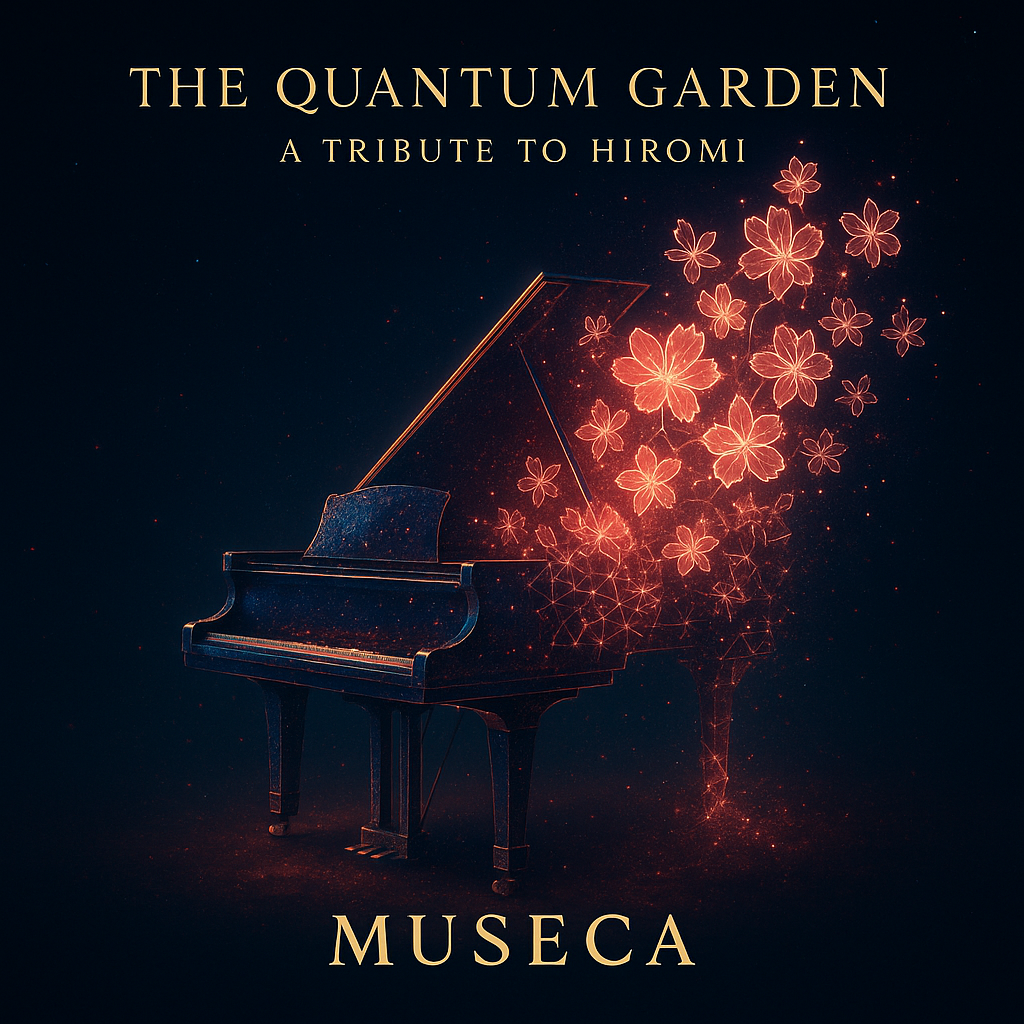
The Quantum Garden: A Tribute to Hiromi
Introduction — The Quantum Garden
There are artists who play music, and there are artists who become it.
Hiromi Uehara belongs to the latter — a force of nature at the piano, whose hands seem to paint light across time. Her music transcends genre, culture, and gravity itself; it dances between classical precision and jazz improvisation, between order and chaos, between the mechanical and the miraculous.
The Quantum Garden is a tribute not of imitation, but of gratitude — a reflection of the light she continues to cast into the world. Each piece in this album explores one facet of that brilliance: the pulse of Tokyo, the calm of silver rain, the curiosity of time travel, the geometry of blossoms, the metamorphosis of sound, the longing for home, and the joyful paradox of rhythm itself.
Hiromi’s music is a paradox made audible — emotional yet mathematical, disciplined yet free.
This album steps into that paradox, seeking not to solve it, but to celebrate it.
In this garden, sound blooms and fades like light through cherry petals — ephemeral, radiant, eternal.
Purpose of the Album
The purpose of The Quantum Garden is to honor Hiromi’s unique synthesis of precision and passion, and to extend her influence into new compositional terrain.
Each of the seven original works draws inspiration from a distinct element of her musical world:
her rhythmic mastery (complex meters and polyrhythms),
her virtuosic command of touch and tone,
her harmonic inventiveness,
and her ability to merge structure with improvisational spontaneity.
The album invites listeners into a sonic landscape where mathematics becomes emotion, and where joy, curiosity, and introspection coexist.
It is not merely a tribute — it is an offering, a thank-you letter written in the universal language Hiromi taught so many to speak: music that breathes.
Expanded Album Narrative Arc
The Quantum Garden is designed as a seven-part journey of transformation, both musical and emotional.
Each track corresponds to a stage of artistic evolution, reflecting Hiromi’s own progression from student to master, and from form to freedom.
| Phase | Symbolic Theme | Track | Essence |
|---|---|---|---|
| I. Motion | The birth of rhythm and vitality | Tokyo Polyrhythm | Awakening — the pulse of creative life begins. |
| II. Reflection | Light within silence | Silver Streetlights | The heart turns inward; emotion finds calm form. |
| III. Exploration | Journey through time and genre | Time Traveler’s Groove | Curiosity drives invention; boundaries vanish. |
| IV. Contemplation | Beauty through simplicity | Cherry Blossom Algorithm | The intellect and soul find harmony in minimalism. |
| V. Transformation | The breaking and rebuilding of identity | Electric Butterfly | Rebirth through energy and metamorphosis. |
| VI. Remembrance | Gratitude and return | Letter from Hamamatsu | The artist remembers where she began. |
| VII. Transcendence | Joy beyond measure | Quantum Waltz | Time dissolves; music becomes timeless play. |
Liner Notes
1. Tokyo Polyrhythm
Ensemble: Jazz Fusion Trio
Mood: Urban, dynamic, electrified
A thrilling opening — syncopated 7/8 piano riffs collide with 4/4 drum grooves in a rhythmic duel that captures the heartbeat of Tokyo at night.
This piece pays homage to Hiromi’s fearless live energy and her ability to balance precision with joyful chaos. The bass and piano chase each other through shifting time signatures, like two trains crossing beneath the city lights.
Where mathematics meets motion, rhythm becomes human.
2. Silver Streetlights
Ensemble: Piano & String Quartet
Mood: Cinematic, reflective, nocturnal
A quiet reverie beneath the rain.
Piano and strings weave through harmonic reflections in C♯ minor, inspired by Hiromi’s Silver Lining Suite.
The piece embodies restraint — emotion told in whispers — with a luminous final cadence in E major symbolizing hope after solitude.
When the city sleeps, its soul sings softly through silver reflections.
3. Time Traveler’s Groove
Ensemble: Fusion Quartet (Piano, Synth, Bass, Drums)
Mood: Playful, adventurous, temporal
A musical time machine built from ragtime, fusion, and ambient jazz.
The opening stride piano evokes early jazz before the piece leaps into complex 11/8 fusion and then dissolves into minimalist synth atmospheres.
This track honors Hiromi’s genre-hopping imagination — always grounded in groove yet unbound by time.
Past and future fold into one groove — rhythm as a portal through centuries.
4. Cherry Blossom Algorithm
Ensemble: Solo Piano
Mood: Meditative, mathematical, Japanese
A delicate solo piano piece that merges traditional Japanese pentatonic modes with impressionistic harmony.
The melody unfolds like a haiku — brief, balanced, and endlessly deep.
Each phrase blooms and vanishes, illustrating the Japanese aesthetic of ma (the beauty of silence and space).
Every blossom is a code — and every code is a breath of beauty.
5. Electric Butterfly
Ensemble: Piano, Moog Synth, Bass, Drums
Mood: Transformative, explosive, radiant
A burst of color and metamorphosis.
This fusion powerhouse celebrates Hiromi’s stage persona — her laughter, precision, and sheer kinetic joy.
The music morphs through modes and tempos like a butterfly changing form mid-flight, ending in a radiant unison chord that dissolves into light.
Transformation is not a moment — it is a current of pure energy.
6. Letter from Hamamatsu
Ensemble: Solo Piano
Mood: Nostalgic, heartfelt, intimate
A musical love letter to Hiromi’s hometown — and to the roots of every artist’s journey.
In gentle rubato phrases, it reflects the tenderness of memory and the gratitude of return.
This track recalls her early studies, her teachers, and the quiet Japanese mornings where the seeds of her genius took root.
Every note is a memory written in the language of home.
7. Quantum Waltz
Ensemble: Piano Trio
Mood: Whimsical, complex, joyful
A closing dance of paradox and precision — a waltz that refuses to stay in 3/4, shifting through 5/4 and 7/8 with playful abandon.
This finale encapsulates the essence of Hiromi’s artistry: technical mastery infused with boundless fun.
It feels as if time itself is smiling — looping, leaping, and finally dissolving in laughter.
In this waltz, time bends — and joy becomes infinite.
Closing Reflection
Every note in The Quantum Garden was composed not merely to emulate Hiromi’s sound,
but to speak her language of freedom — where rhythm breathes, harmony tells stories,
and the piano becomes a window into something both infinite and deeply human.
“Hiromi’s music doesn’t ask us to understand it.
It asks us to feel the miracle of being alive inside sound.” — Museca