
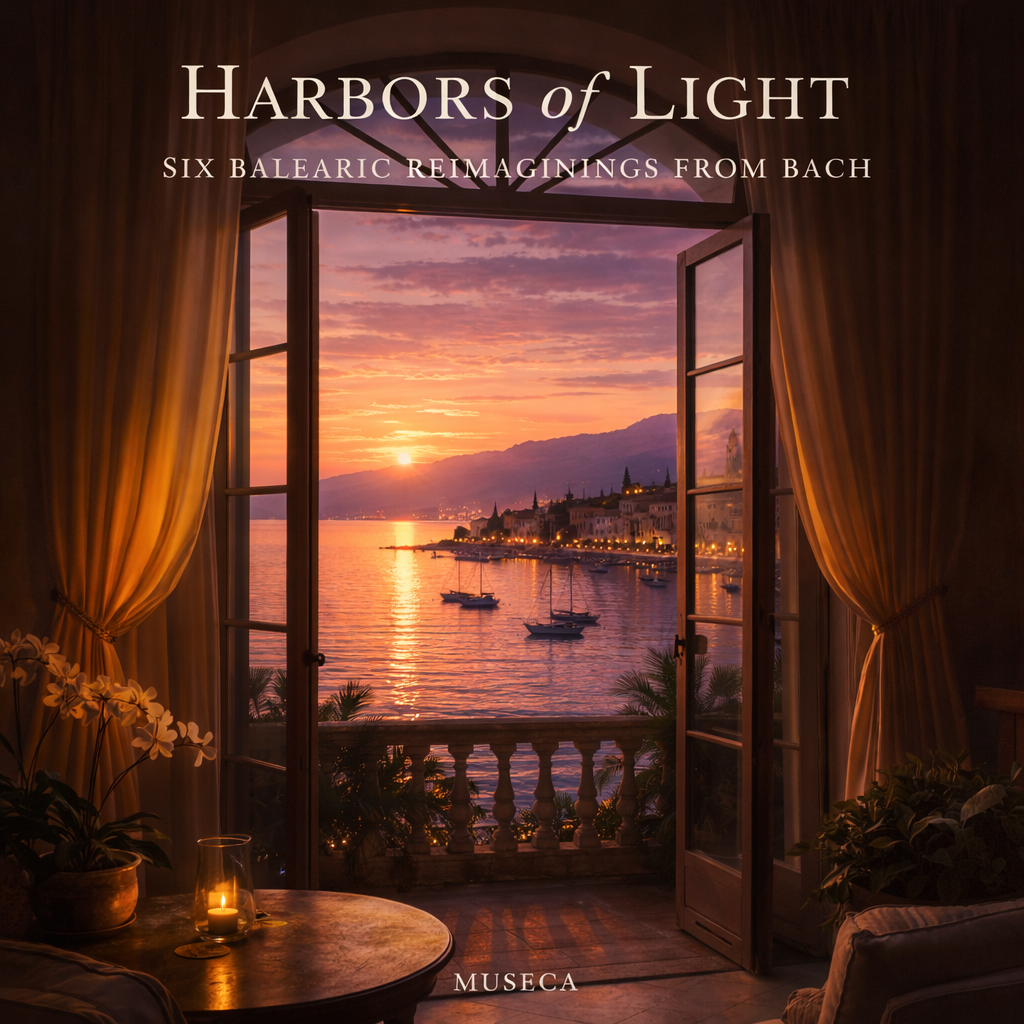
Harbors of Light begins with a simple but demanding idea: to take the most recognizable material from the first movements of Bach’s six Brandenburg Concertos and place it in an entirely different emotional climate. Instead of courtly brilliance, chamber energy, and Baroque propulsion, these pieces are recast in the atmosphere of Mediterranean dusk — slow light, sea air, warmth, distance, and reflective motion. The aim was never parody, and never mere novelty. The aim was to let Bach remain audible while changing the world around him.
Each track was constructed from melodic material drawn from the opening movement of one Brandenburg Concerto. The familiar themes were first isolated in guide form, then used as the structural seed for a new interpretation. From there, the music was reshaped through a Balearic chillout palette: warm bass lines, soft hand percussion, airy pads, suspended reverb, gentle lounge rhythm, and luminous string color. In every case, the central task was balance — preserving enough of the original melodic identity that the listener feels the presence of Bach immediately, while allowing the arrangement, texture, pacing, and sonic environment to speak in a contemporary sunset language.
What emerges is not an attempt to improve or modernize Bach, but to refract him. The contrapuntal vigor, formal clarity, and melodic contour of the Brandenburg world remain the foundation, yet they are filtered through a calmer horizon. The result is a sequence of musical transformations in which familiar Baroque gestures become coastal, spacious, and dreamlike without losing their essential profile. One hears not a copy, but a recoloring: Bach remembered through amber light, salt air, and twilight rhythm.
Taken as a whole, the album is an experiment in continuity across centuries. It asks what happens when some of the most durable instrumental ideas in Western music are removed from their original architecture and placed inside a modern atmosphere of ease, glow, and inwardness. The answer, one hopes, is that the Brandenburg Concertos reveal another side of themselves: not only brilliance and invention, but serenity, elegance, and a surprising affinity for the language of evening.
Credits & Attribution
Harbors of Light — Six Balearic Reimaginings from Bach is based in part on MIDI source materials from Tobi’s Notenarchiv, used under the CC BY-NC license. Original compositions by Johann Sebastian Bach. Reimaginings, production, sequencing, and album concept by Museca.
Liner Notes
Pastoral Ember
Based on Brandenburg Concerto No. 1 in F major, BWV 1046 — First Movement (Allegro).
The opening of the First Concerto carries a festive, outdoor character, and this reinterpretation preserves that sense of spacious nobility while softening its edges. The rhythmic vitality of Bach’s original is recast in a warmer and more atmospheric setting, with gentle pulse, suspended harmony, and a dusk-lit sense of distance. What was once courtly brilliance becomes something more reflective and pastoral, as though the music were passing across an evening shoreline.
Sea of Glass
Based on Brandenburg Concerto No. 2 in F major, BWV 1047 — First Movement (Allegro).
The Second Concerto is one of the brightest and most exhilarating of the set, and this track transforms that brilliance into radiance rather than display. The familiar melodic energy remains, but it is filtered through a calmer and more fluid atmosphere, where light seems to shimmer rather than blaze. The result is smooth, luminous, and expansive: a reimagining that preserves the lift of Bach’s writing while allowing it to unfold in a gentler horizon of air, water, and light.
Sunset Engine
Based on Brandenburg Concerto No. 3 in G major, BWV 1048 — First Movement (Allegro).
The Third Concerto is built on motion, repetition, and the thrilling physical drive of strings in rhythmic alignment. In this version, that momentum is not removed but translated into a hypnotic chillout pulse. The track keeps the strong profile and forward motion of the source while surrounding it with warmer textures and more spacious production. It becomes a study in controlled propulsion: Bach’s kinetic architecture glowing from within, as if carried forward by heat and horizon rather than sheer force.
Water and Wing
Based on Brandenburg Concerto No. 4 in G major, BWV 1049 — First Movement (Allegro).
The First Movement of the Fourth Concerto has an especially graceful and airborne quality, and this adaptation leans into its agility and fluidity. Its dancing lines and buoyant exchanges are reimagined as something airy, coastal, and shimmering. The melodic identity remains clear, yet the surrounding environment is calmer and more translucent, giving the impression of motion over water or light caught in wind. It is one of the album’s most delicate transformations, balancing elegance, play, and drift.
Golden Current
Based on Brandenburg Concerto No. 5 in D major, BWV 1050 — First Movement (Allegro).
The Fifth Concerto is inseparable from keyboard brilliance, refinement, and a sense of poised musical intelligence. This reinterpretation keeps that elegance intact while changing its emotional temperature. The sharp clarity of the original is softened into a glowing flow of rhythm and atmosphere, where each gesture seems to move through warm air and reflected light. What emerges is less a display of virtuosity than a current of illuminated thought, graceful and measured, carrying Bach’s formal beauty into a more relaxed and luminous space.
Violet Harbor
Based on Brandenburg Concerto No. 6 in B-flat major, BWV 1051 — First Movement (Allegro).
The Sixth Concerto has a darker, more intimate sonority than its companions, and that inward quality shapes this track from the outset. Its lower-register warmth lends itself naturally to a twilight palette, producing an atmosphere of closeness, shadow, and depth. Rather than opening outward into spectacle, the music gathers inward, unfolding with a quiet gravity that feels reflective and almost private. This is Bach heard through dusk-colored resonance: restrained, warm, and quietly absorbing.
Playlist
- Track 1 - Pastoral Ember Museca 2:35
- Track 2 - Sea of Glass Museca 2:29
- Track 3 - Sunset Engine Museca 2:49
- Track 4 - Water and Wing Museca 1:20
- Track 5 - Golden Current Museca 2:47
- Track 6 - Violet Harbor Museca 2:29