
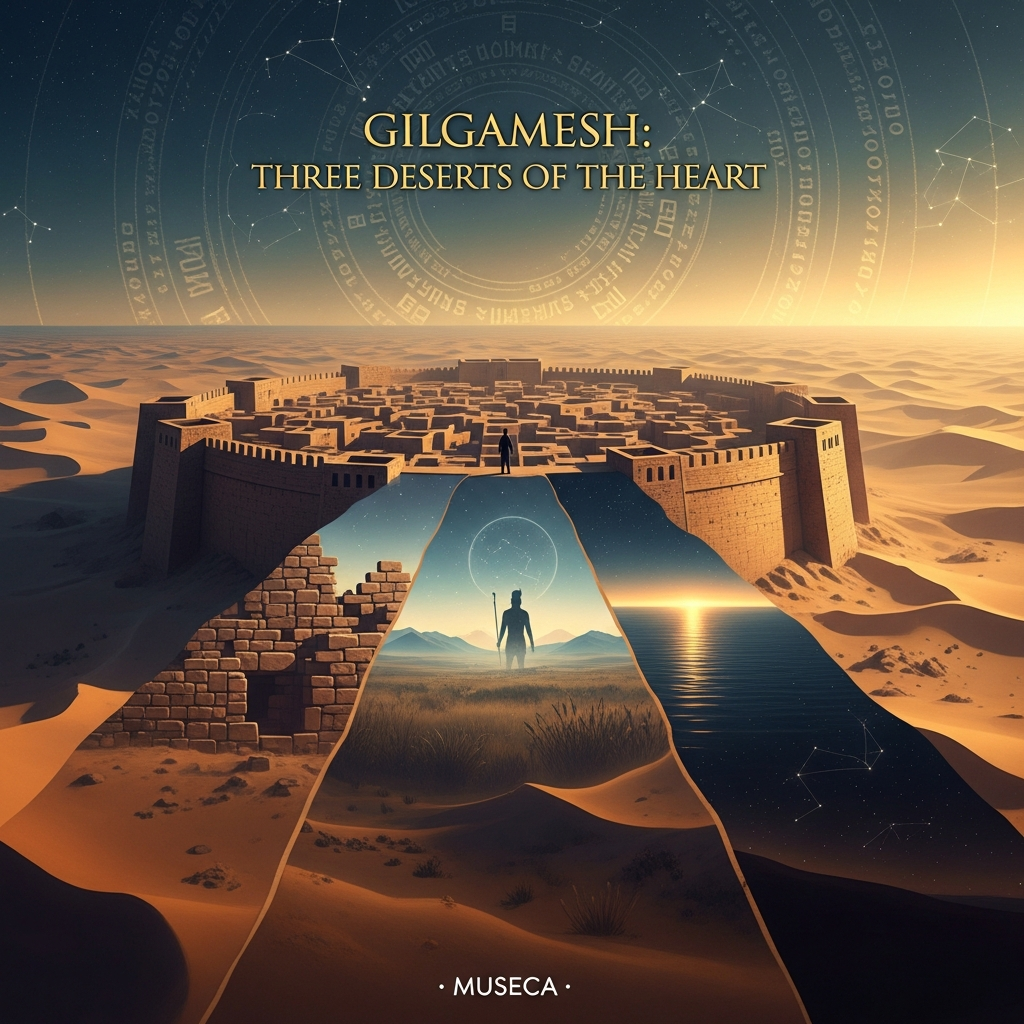
Gilgamesh: Three Deserts of the Heart
Gilgamesh: Three Deserts of the Heart is rooted in one of humanity’s oldest surviving stories. The Epic of Gilgamesh comes from ancient Mesopotamia, where it was carved into clay tablets thousands of years ago. At its center stands Gilgamesh, a king who is part god and part human, who begins as a tyrant and ends as a wiser, wounded man. He meets Enkidu, a wild man created by the gods to oppose him; they become friends, undertake heroic exploits, defy divine warnings, and pay for that defiance with Enkidu’s slow, devastating death. Shattered by grief and terror of his own mortality, Gilgamesh journeys to the edges of the world in search of a way to escape death, only to discover that there is no escape. What he brings back instead is understanding: that the true endurance of a human life lies in love, in the city one builds, and in the stories that carry one’s name forward.
Beneath the mythic battles and gods, the epic is a meditation on spiritual questions that have never gone away. It asks what it means to be human in a universe where death is non-negotiable, where the gods (or fate) are powerful but not always just, and where our deepest awakening often comes through love and loss. It presents friendship as a mirror of the soul: only when Gilgamesh loves Enkidu does he truly see himself, and only through losing him does he confront his fear of non-existence. It shows civilization as both gift and wound—granting language, law, and memory, but costing innocence and animal ease. And through Siduri’s quiet counsel (“eat, drink, love, and accept your allotted days”), it suggests that spiritual maturity is not about conquering death, but about consenting to a finite life and living it fully.
This album follows that inner journey through sound. Three Deserts of the Heart is structured as three arcs—three “deserts”—that chart Gilgamesh’s movement from power without wisdom, through the wild grace and wound of friendship, into the long night of grief and, finally, a humbled peace. The music stays close to dark modes and unstable harmonies: Phrygian for the ancient, earthy, ritual world of Mesopotamia; Locrian for the feeling that the ground itself is giving way; Dorian and Mixolydian for those rare moments when balance and warmth break through. Across the album, recurring motifs return in altered forms: the restless rhythm of the tyrant king, the raw vitality of Enkidu, the fragile “friendship theme” that fractures under the weight of death, and the faint, high light of hope that never entirely disappears.
Desert I – Uruk the Restless, the music evokes a city driven by an unsatisfied king: heavy drums, low strings, and jagged motifs that never quite come to rest. Enkidu enters as a different kind of energy—wild, asymmetrical, closer to earth than to stone walls—until both forces collide and, unexpectedly, resolve into the first hint of genuine brotherhood.
Desert II – The Wild and the Wound moves into denser, more conflicted textures: the lush, perilous beauty of the Cedar Forest; the brutal, punishing force of the Bull of Heaven; and finally the slowing, dissolving harmonies of Enkidu’s illness and death, where rhythm thins and tonality itself begins to fall apart.
Desert III – The Long Night of the Soul traces the wandering king who has lost his axis. The sound world here turns more spacious and inward: desert dirges, low ostinati like weary footsteps, and long stretches where almost nothing moves. As Gilgamesh meets Siduri and Utnapishtim, the music opens briefly into warmer modes and simpler, songlike lines—a reminder that joy, food, touch, and shared stories are themselves sacred. The crossing of the Waters of Death, the fleeting possession and loss of the plant of youth, and the final walk along the walls of Uruk are rendered as a gradual clearing: the harmonies become simpler, the textures thinner, and the energy quieter. By the time we reach “Walls of Uruk,” the quest for immortality has given way to something more human: a mortal voice, still shadowed by what it has seen, accepting that the real legacy is the city, the people, and the story itself.
He does not conquer death. The music does not end in a blazing triumph. Instead, this cycle closes on a clear horizon—a king who knows he will die, standing atop walls that will outlast him, and a listener invited to feel that same tension between fragility and endurance in their own heart.
Liner Notes
Desert I – Uruk the Restless
Tyrant-king energy, power without wisdom. Phrygian dominant, with Locrian “cracks” in the foundation.
Uruk the Restless
The cycle opens inside the city that bears Gilgamesh’s name—stone, dust, and unspent force. Heavy Phrygian harmonies grind forward like laborers under command, while Locrian inflections (the destabilizing flattened fifth) slip through the foundations like hairline fractures in the walls. The music never fully settles; it circles, pushes, and leans, mirroring a king who cannot sleep and a people who cannot rest. This is power before wisdom—impressive, imposing, and deeply uneasy.
Enkidu of the Steppe
The perspective shifts from city to wilderness. The harmony relaxes into a more open Phrygian ♮6, raw and vital rather than oppressive. Hand drums, drones, and a leaping melodic line sketch a being who belongs to animals and wind more than bricks and laws. Enkidu’s theme is asymmetrical and untamed, moving in irregular phrases that refuse the grid of the city—an answer to Uruk’s restlessness, but on its own, no more “civilized” than the king he will soon confront.
The Wrestlers of Uruk
Two worlds collide in the dust outside the wedding house: the tyrant’s Phrygian cell and the wild man’s steppe motif. The first half of the track is bitonal and tense—rhythms lock, break apart, and slam into each other. Gradually, a new contour emerges between them in Dorian: neither Gilgamesh nor Enkidu alone, but a shared, balanced theme that could not exist without their struggle. By the final section, the tension has not vanished, but it has been re-harmonized into trust. Heroism begins, paradoxically, with someone who can finally stand as your equal.
Desert II – The Wild and the Wound
Enkidu, friendship, hubris, and the divine sentence. Phrygian ↔ Locrian collisions, with a fleeting Dorian “friendship” oasis.
Cedar Blood
The Cedar Forest is both sanctuary and crime scene. Phrygian roots anchor the sound in darkness, while Lydian flashes—raised fourths in high winds and strings—suggest shafts of impossible light through towering trees. The friendship theme appears briefly, heroically expanded, as Gilgamesh and Enkidu move in dangerous harmony. Underneath, subtle Locrian shifts warn that something is off-balance. When Humbaba falls, the music tightens; the forest’s beauty and the brutality of the act coexist in the same chord.
Bull of Heaven
Here the gods’ anger takes shape in sound. Phrygian riffs in low strings and brass are twisted by Locrian intervals until the tonal floor almost disappears. Percussion pounds like hooves and collapsing masonry. There is no space for tenderness here, and almost no memory of Dorian balance—the “friendship oasis” is shoved aside by sheer force. The track is deliberately brief; it is meant to feel overwhelming, then abruptly cut, mirroring the impossible cost of offending the divine.
The Dream of Death
After the noise comes a slow collapse. This piece sits almost entirely in Locrian, stripped of firm tonics and clear pathways. Enkidu’s illness and prophetic dreams unfold in drifting chords and fragmented echoes of the friendship theme, now distorted and incomplete. Rhythmic motion thins; the sense of time stretches. The music feels less like external narrative and more like a fevered inner state, where death is no longer theoretical but approaching. The desert of the wild ends not with a battle, but with a bedside.
Desert III – The Long Night of the Soul
The death-quest, Siduri, Utnapishtim, the serpent, and quiet acceptance. Locrian core, gradually admitting Dorian / Mixolydian / Lydian light.
Skin of the Lion
Gilgamesh steps out of Uruk no longer as a king, but as a grieving wanderer in a lion’s pelt. The harmonic ground remains Locrian—unsteady, exhausted—but small Aeolian and Dorian fragments appear like scraps of remembered humanity. The percussion feels like solitary footsteps across rock and sand. This is not the confident march of the opening, but an exile’s slow walk. The piece holds space for disorientation: a man who has lost both his friend and his former self, unsure of what he seeks, only certain that he cannot go back.
The Alewife’s Counsel
Siduri’s tavern by the sea offers the first real warmth since Enkidu’s death. The mode opens into Dorian, with hints of Mixolydian brightness in the upper voices, and the sound narrows to an intimate circle—voice, strings, simple percussion. Her melody is gentle but firm, offering a spiritual reversal: let go of the chase after literal immortality and return to food, clothing, love, and daily joy as the rightful center of a mortal life. It is the album’s most clearly “song-like” moment, a human-scale confession and blessing in the middle of myth.
Lyrics
[Verse 1]
You are not made for the endless horizon,
you are a heartbeat drawn in sand.
Bread and wine and the warmth of your lover,
these are the gifts placed in your hand.
[Pre-Chorus]
Leave the road of sleepless questions,
let the waves erase your fear.
[Chorus]
Stay for the bread and the wine,
dance while the fire is warm,
love while your garment is bright,
laugh in the eye of the storm.
This is the counsel I pour in your cup:
mortal and shining is more than enough.
[Verse 2]
Kings and heroes fall into the river,
names like stones sink out of sight.
But you can sing while the daylight is burning,
you can rest soft under velvet night.
[Final Chorus – shorter]
Stay for the bread and the wine,
love while your garment is bright.
This is the counsel I pour in your cup:
mortal and shining is more than enough.
Across the Waters of Death
This movement is a slow passage over an unseen threshold. A low, oar-like ostinato anchors shifting Phrygian and Locrian harmonies, suggesting both physical rowing and the steady, unavoidable motion of time. Choral textures rise and fall like waves, then gradually thin into open fifths that feel almost outside any fixed mode—an elemental region where the categories of god, man, and fate blur. The piece does not offer answers; it is a study in endurance, and in what it means to keep moving through a landscape defined by loss.
The Serpent’s Gift
Here the music briefly touches a different kind of light. A fragile Lydian theme, carried by harp and high strings, represents the plant of youth: a delicate, almost innocent hope that the laws of mortality might be undone. The serenity is short-lived. Sliding lines, sudden percussive “bites,” and Locrian harmonies mark the serpent’s theft and the shattering of that hope. Earlier themes return in fractured form; nothing truly new is given, only the stripping away of an illusion. What remains is not melodrama, but a clear, aching emptiness where false comfort once sat.
Walls of Uruk
The cycle closes where it began: on the walls of the city. This time, though, the mode is Mixolydian—grounded, open, and modestly bright—with faint Locrian shadows woven into inner voices as a reminder of what has been learned. Motifs from earlier tracks reappear in gentler form: the tyrant’s rhythm slowed and softened, the friendship contour folded into the cadence, a distant echo of Siduri’s counsel. Gilgamesh has not transcended death; he has come to terms with it. The music stands still more than it surges, offering a different kind of victory: not the overthrow of mortality, but the decision to live meaningfully within it, as long as the walls stand and the story can be told.
Lyrics
[Verse 1]
Here are the stones that remember my footsteps,
here are the gates that have tasted my name.
I have run to the edge of the world and back,
and the dust on my skin is the same.
[Pre-Chorus]
I have argued with death in the darkness,
I have woken alone by the sea.
[Chorus]
Build me no throne in the heavens above,
let me belong to the city I love.
Write what I saw in the heart of the deep,
give it to children and sing them to sleep.
I am a man, and my story is long—
mortal and broken, but carved into song.
[Verse 2]
These are the hands that once trembled with terror,
these are the hands that now open in peace.
Let every brick in the walls of Uruk
carry my failure and quiet release.
[Final Chorus – shortened]
Build me no throne in the heavens above,
let me belong to the city I love.
When the last echo has swallowed my name,
Uruk will whisper the shape of my flame.
Playlist
- Uruk the Restless Museca 3:18
- Enkidu of the Steppe Museca 3:48
- The Wrestlers of Uruk Museca 2:29
- Cedar Blood Museca 4:07
- Bull of Heaven Museca 2:04
- The Dream of Death Museca 2:13
- Skin of the Lion Museca 3:34
- The Alewife’s Counsel Museca 3:10
- Across the Waters of Death Museca 2:57
- The Serpent’s Gift Museca 1:50
- Walls of Uruk Museca 3:10