
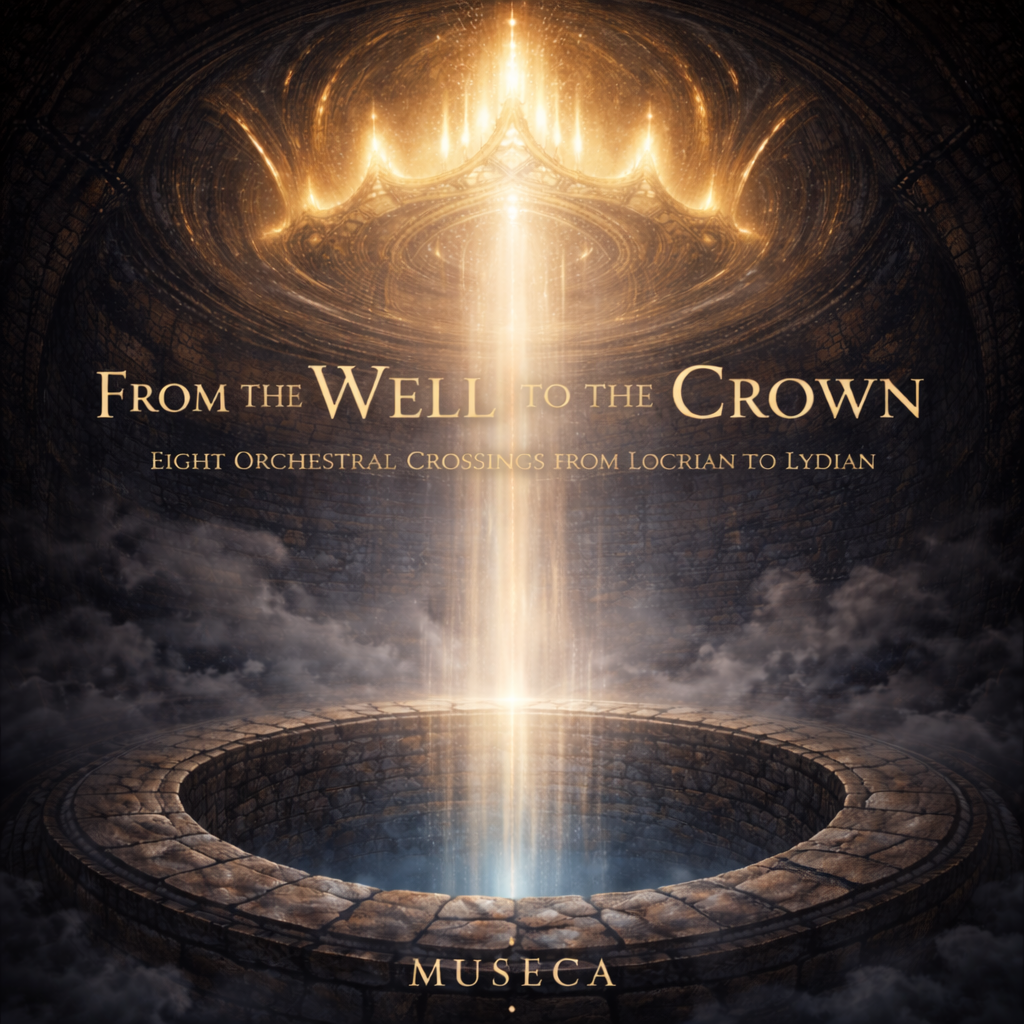
From the Well to the Crown is an orchestral album built around one of the most extreme polarity relationships available within the diatonic modal system: the movement from Locrian to Lydian. The premise of the album is not merely emotional, but structural. Each track explores some aspect of how a musical language built from instability, compression, and weakened tonal support can be transformed into one of openness, luminosity, and expanded harmonic architecture. In that sense, the album is a study in modal reorientation: not just a change of color, but a change in the very conditions under which musical space is perceived.
Technically, Locrian and Lydian stand at opposite ends of the diatonic brightness spectrum. Locrian is the darkest of the seven church modes because its modal structure destabilizes the tonic from within. Most crucially, it contains a diminished fifth above the tonic rather than a perfect fifth. That matters because the perfect fifth is one of the principal acoustic and tonal supports in Western hearing; when it is removed, the tonic loses its “spine.” Locrian also lacks the kind of leading-tone luminosity that helps project forward pull and vertical clarity. The result is a mode that feels compressed, provisional, and inwardly unstable. It is not darkness in a sentimental sense, but in a harmonic sense: weakened root support, increased tritone pressure, and a persistent refusal of full tonal grounding.
By contrast, Lydian is the brightest diatonic mode. Like Ionian, it preserves the tonic’s perfect fifth, but it differs through its raised fourth degree, which produces an augmented fourth above the tonic. This interval is acoustically identical to the tritone that haunts Locrian, but in Lydian it behaves very differently. Instead of functioning as a fracture within a weakened tonal frame, it appears inside a stable and radiant one. Because the tonic triad remains intact and the perfect fifth is restored, the raised fourth is heard less as collapse and more as lift, suspension, or upward illumination. Lydian therefore becomes an ideal modal destination: structurally secure, harmonically elevated, and capable of carrying brilliance without losing coherence.
This album uses those two modes not as isolated color choices but as architectural poles. The early tracks draw on Locrian-derived materials: diminished sonorities, tritone emphasis, low-register orchestration, semitone friction, and phrases that avoid full cadential settlement. The music often withholds registral brightness and delays the formation of broad consonant support. As the album progresses, these unstable conditions begin to tilt. Common tones are reinterpreted, tritone pressure is redirected, registral space opens, and orchestration becomes increasingly vertical and resonant. Harp arpeggiation, sustained upper strings, horn-supported fifths, and widening intervallic spans all help enact the gradual restoration of tonal architecture.
The central idea behind the album is that the same intervallic material can be heard under different modal conditions. The tritone is the clearest example. In the Locrian world, it behaves like a fault line; in the Lydian world, it becomes a source of brilliance. That transformation is the album’s deepest musical argument. What sounds broken in one harmonic environment can sound crowned in another. The change is not merely one of mood, but of function, placement, support, and voicing.
For that reason, From the Well to the Crown should be heard as a sequence of modal crossings rather than a set of disconnected orchestral pieces. Each track inhabits a different stage in the passage from diminished support to radiant suspension. The album begins near the bottom of the brightness field, where the tonic cannot fully stand, and ends in a Lydian space where the harmonic frame is not only restored but transfigured. Its expressive arc is therefore inseparable from its technical design: this is music built on the idea that instability can be revoiced into light, and that the path from fracture to radiance can be composed directly into the intervals themselves.
Liner Notes
The Unlit Well
The album opens at the lowest end of the brightness field, where the tonic is deprived of its usual structural authority. The writing emphasizes the Locrian condition through diminished support, low-register orchestration, and harmonic language built from semitone friction and unstable intervallic clustering. Cellos, basses, bassoons, and muted brass are used not to ground the harmony, but to question it. The absence of a secure perfect fifth is felt as a physical weakness in the music’s architecture: phrases seem to gather themselves without ever fully standing upright. The effect is not simply dark, but structurally airless, as though the orchestra were sounding from the bottom of a stone chamber where resonance exists, but certainty does not.
Footsteps Without Ground
This track introduces motion, but not yet arrival. Rhythm begins to play a more active role, though it is deliberately restrained and hesitant, with pulses that suggest forward movement while withholding metric confidence. Fragmented motifs in low strings and woodwinds create the impression of a body testing unstable terrain. Harmonic progressions avoid cadential closure, often shifting by half-step or through ambiguous diminished sonorities rather than through strong functional relationships. The orchestration remains close to the earth, but the ear begins to sense a journey underway. It is music that walks without floor, propelled less by destination than by necessity.
Fracture in the Air
Here the album turns its full attention to the tritone as a governing force. The central technique of the track is suspension under pressure: dissonant intervals are prolonged, revoiced, and transferred across the orchestra so that instability becomes the track’s real thematic material. Rather than treating tension as something to be resolved quickly, the music magnifies it, allowing strings, low winds, and muted horns to circulate around the fault line. Crescendos form and collapse without release. The tritone is not yet a color; it is a wound in the harmonic atmosphere. The air itself seems split, and every phrase is written as if it must pass through that split in order to continue.
First Glint
After so much compressed darkness, the smallest registral lift becomes meaningful. This track is built around the technique of controlled illumination: upper strings enter not in triumph, but in suspension, often sustaining tones that do not yet resolve the harmony so much as expose a new vertical space above it. The orchestration begins to widen, and the ear encounters the first real sense of aerial perspective. Woodwinds shimmer around the strings rather than pushing thematic material forward, creating an impression of light arriving before structure is fully rebuilt. This is the album’s first soft release of pressure, the first sign that instability may be capable of transformation rather than merely endurance.
Harp Before Dawn
With this track, the album introduces one of its most important timbral agents of transition: the harp. Its arpeggiated writing does more than decorate the texture; it begins to reconnect harmonic space vertically, quietly implying continuity where earlier tracks emphasized fracture. Beneath it, the strings move with greater legato breadth, and woodwinds breathe into the harmony with less constriction. The modal language remains transitional, but the music now permits tenderness. Registral spacing grows more generous, and the listener begins to hear intervals not only as tensions, but as openings. Dawn has not yet broken, but the orchestral fabric has started to remember how to carry light.
The Tilting Tritone
This is the pivot of the album, the point at which its deepest intervallic argument becomes explicit. The tritone remains present, but its function begins to change. Through careful recontextualization—especially through stronger fifth-relations in the lower orchestra, more confident horn writing, and upward-reaching string lines—the interval is no longer heard exclusively as rupture. Instead, it begins to tilt toward suspension, brilliance, and ascent. That shift is the track’s central compositional technique: not the removal of dissonance, but the re-framing of dissonance within a more stable field. Harmonically, this is the moment where the album proves that the same interval can signify collapse in one environment and radiance in another. The wound begins, almost imperceptibly, to resemble a crown.
Architecture of Light
By this stage, the restoration of structure is unmistakable. The perfect fifth regains its full supporting role, and the orchestration broadens accordingly. Horns, cellos, and basses now participate in building a stable harmonic frame rather than undermining one. Harp arpeggios and high strings no longer suggest light from afar; they inhabit it. The writing becomes more vertical, more resonant, and more cathedral-like, with broader spans and more clearly supported harmonic pillars. This is why the title is apt: the music does not merely brighten, it becomes architectural. Light is no longer an event passing through the score; it is the space in which the score now stands.
Locrian to Lydian – Romantic Orchestral Version
The final track gathers the entire album into a single large-scale modal crossing. It begins in unmistakable Locrian territory, with weakened support, tense spacing, and dark orchestral weight, but unlike the earlier tracks, it carries within it the memory of what is to come. As the piece unfolds, the orchestra enacts the full transformation the album has been preparing: the restoration of the fifth, the widening of registral space, the release of accumulated semitone pressure, and the re-emergence of the tritone as a luminous rather than corrosive force. In the final Lydian bloom, the music does not simply arrive at brightness; it reveals that brightness was latent in the intervallic material all along. The journey from well to crown is completed, and the harmonic world, once bent inward, stands at last in radiant suspension.
Playlist
- Track 1 — The Unlit Well Museca 2:59
- Track 2 — Footsteps Without Ground Museca 3:21
- Track 3 — Fracture in the Air Museca 3:20
- Track 4 — First Glint Museca 3:15
- Track 5 — Harp Before Dawn Museca 3:23
- Track 6 — The Tilting Tritone Museca 3:45
- Track 7 — Architecture of Light Museca 3:02
- Track 8 — Locrian to Lydian – Romantic Orchestral Version Museca 3:14