
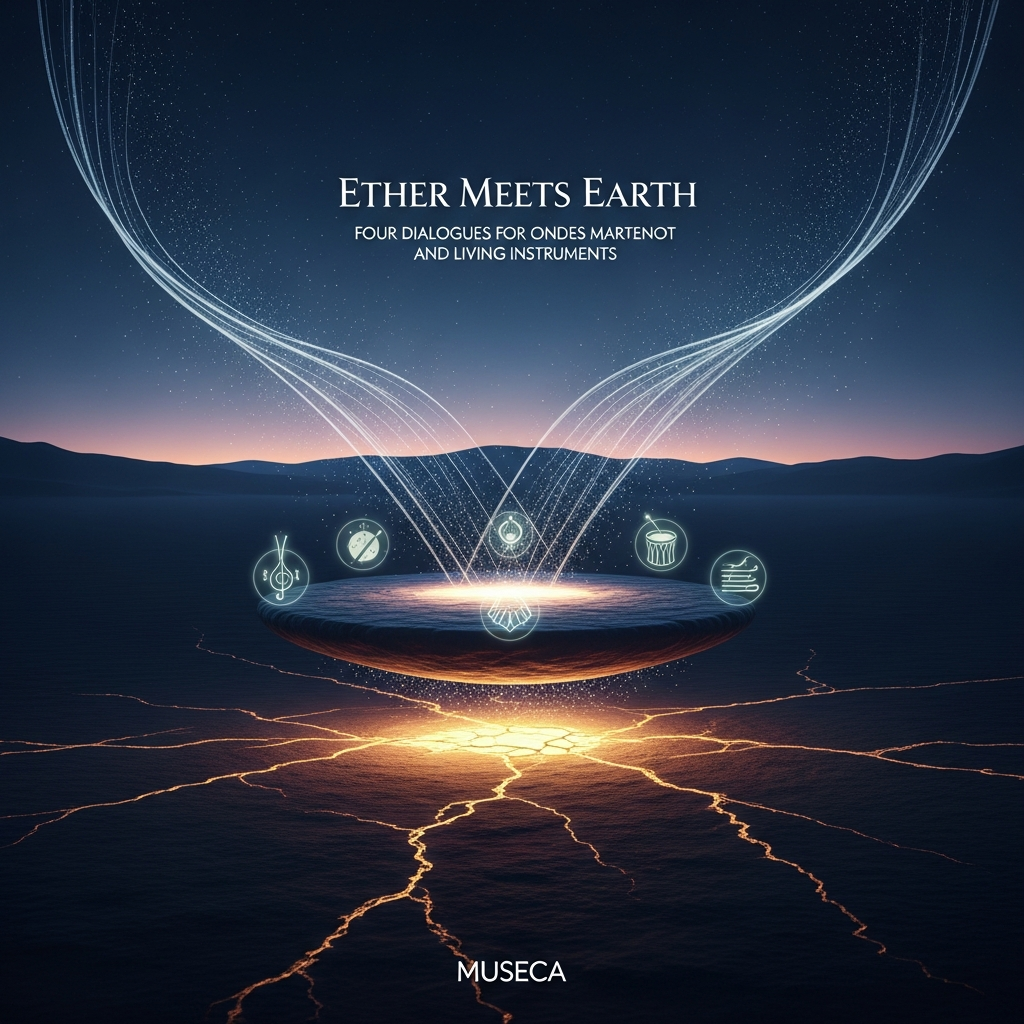
Ether Meets Earth
Four Dialogues for Ondes Martenot and Living Instruments
Ether Meets Earth is conceived as a meeting point between two worlds: the intangible realm of pure vibration and the physical traditions of instruments shaped by hands, breath, wood, metal, and skin. At the center of this dialogue stands the ondes Martenot, an instrument born not from folklore or geography, but from electricity itself.
Invented in 1928 by Maurice Martenot, the ondes Martenot was among the earliest electronic instruments to be embraced by serious composers. Unlike later synthesizers, it was designed first and foremost for expressivity. Its ring-controlled glissandi, pressure-sensitive dynamics, and voice-like vibrato allowed performers to shape sound with an intimacy closer to singing or bowing than to playing keys. In the mid-20th century, composers such as Olivier Messiaen used the instrument to suggest the sacred, the cosmic, and the unseen—often treating it as an angelic or otherworldly presence within the orchestra.
Yet for all its beauty, the ondes Martenot has historically lived almost exclusively within Western art music and film scoring. Ether Meets Earth deliberately steps outside that lineage. Rather than placing the instrument back into an orchestra or synthesizer tradition, this EP asks a different question:
What happens when an instrument of pure electricity speaks directly with instruments rooted in soil, ritual, and physical labor?
Each track pairs the ondes Martenot with a “living instrument” drawn from a distinct musical culture—not as an exotic color, but as an equal conversational partner.
Pedal steel guitar was chosen for its shared vocabulary of continuous pitch and emotional glide. Both instruments bend notes rather than strike them, creating a slow, mournful dialogue between electronic ether and American earth—desert, horizon, and memory.
Taiko drums embody the opposite extreme: physical force, communal rhythm, and ritual impact. Against these thunderous pulses, the ondes Martenot becomes a voice of sky and weather, transforming rhythm into invocation rather than accompaniment.
Afrobeat groove introduces cyclical rhythm, joy, and motion. Here the ondes abandons its traditional role as a sustained, hovering presence and instead learns to dance—phrasing rhythmically, responding like a talking drum, and engaging groove as conversation rather than backdrop.
Hang drum / handpan offers resonance born of touch and breath. Its circular, meditative patterns allow the ondes Martenot to float gently above metallic ripples, dissolving the boundary between percussion and melody, pulse and atmosphere.
Together, these four dialogues reposition the ondes Martenot—not as a historical curiosity or orchestral color, but as a traveler: an instrument capable of crossing traditions, absorbing rhythm, and speaking with cultures that predate electricity itself.
Ether Meets Earth is not a fusion album in the conventional sense. Nothing is blended or diluted. Instead, each piece allows two distinct sound-worlds to remain fully themselves while listening deeply to one another. The result is music that feels ancient and futuristic at once—where electricity remembers ritual, and rhythm remembers the sky.
Liner Notes
The Horizon Between Worlds
This opening piece unfolds slowly, like light appearing at the edge of a vast landscape. The ondes Martenot and pedal steel guitar share a rare kinship: both speak through glide rather than attack, bending pitch with a human fragility that feels closer to voice than to mechanism. Here, the ondes carries the role of distant sky—pure, hovering, almost weightless—while the pedal steel answers from the ground, warm and resonant, shaped by gravity and touch. The music resists forward motion; instead, it suspends time, allowing each note to linger until its emotional contour is fully revealed. What emerges is a quiet conversation about longing, space, and the beauty of unresolved horizons.
Thunder Above Silence
This track shifts the album into ritual. Taiko drums enter not as rhythm alone, but as physical presence—impact, breath, and collective force. Against this immense percussive body, the ondes Martenot becomes elemental: wind, lightning, and distant call. Rather than competing with the drums’ power, the ondes floats above and between the strikes, transforming rhythm into atmosphere. The dynamic range is intentionally extreme, moving from near-silence to overwhelming resonance. This is not narrative music but ceremonial sound, evoking an imagined gathering where sky and earth answer one another through vibration.
Waves of the Sun
In this dialogue, the ondes Martenot steps into motion. Afrobeat rhythm provides a cyclical, life-affirming groove built on repetition, syncopation, and communal pulse. Here, the ondes abandons its traditional role as sustained halo and instead phrases rhythmically, bending short melodic gestures like a talking drum. The result is playful and radiant, but never superficial; joy is treated as a serious musical force. This piece explores what happens when an instrument associated with the sacred and cosmic learns to dance—finding expression not in stillness, but in movement and heat.
Echoes in Still Water
The closing track returns the listener to stillness, but with a different depth than the opening. The handpan’s circular, metallic tones create ripples of sound that feel both ancient and intimate, shaped by direct human touch. Above these patterns, the ondes Martenot drifts with gentle glissandi, blurring the boundary between melody and reflection. The interaction is subtle and patient; nothing is rushed, nothing is forced. As the sound gradually dissolves, the dialogue between ether and earth becomes almost indistinguishable—wave and surface, sky and water, vibration and silence merging into one.
Playlist
- The Horizon Between Worlds Museca 3:55
- Thunder Above Silence Museca 1:57
- Waves of the Sun Museca 2:41
- Echoes in Still Water Museca 4:45