
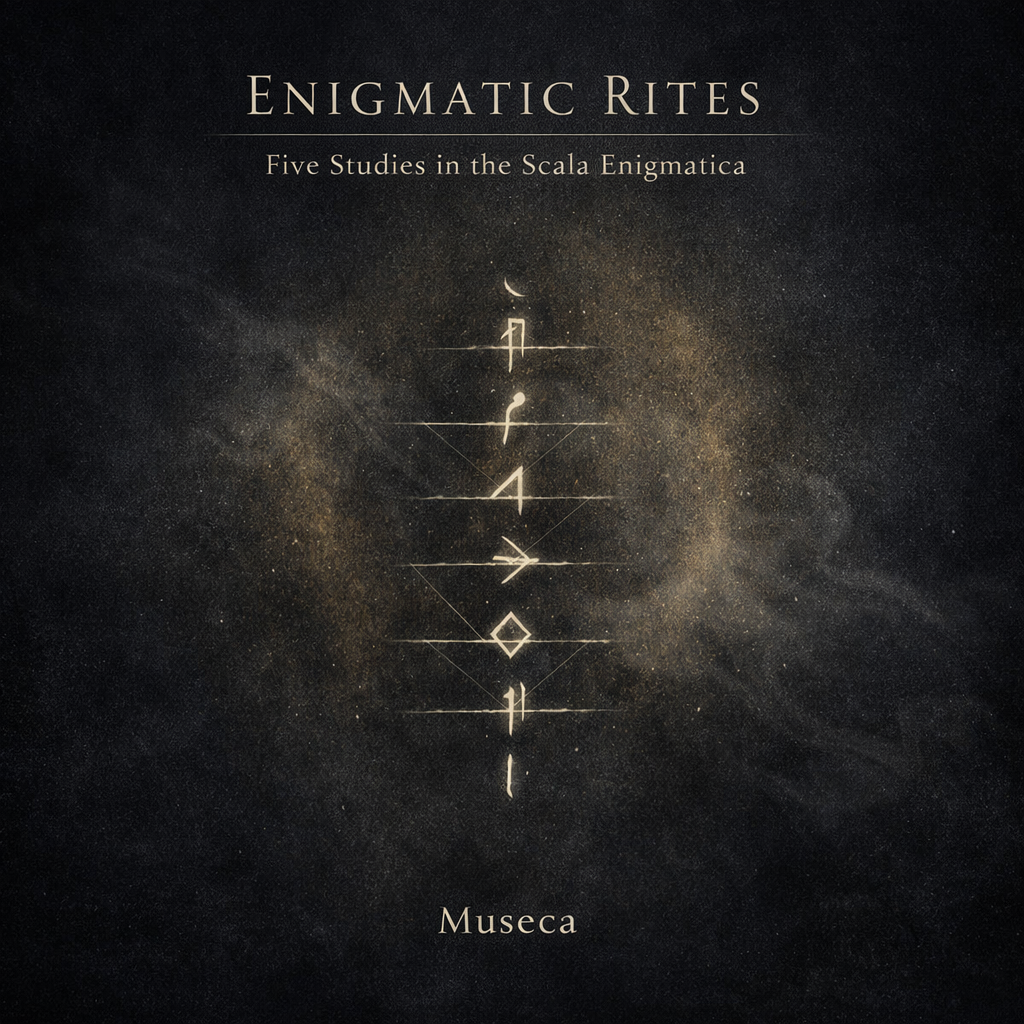
The Enigmatic Scale (Scala Enigmatica)
The Enigmatic scale—scala enigmatica—is one of Western music’s most famously “impossible” scales: a seven-note collection designed to sound beautiful and unsettling at the same time. It was invented by the Italian musician Adolfo Crescentini and introduced to the public in Milan in 1888 as a compositional dare. In Ricordi’s Gazzetta musicale di Milano, readers were challenged to harmonize the scale—a kind of late-Romantic musical riddle meant to test the limits of functional harmony and voice-leading ingenuity.
In its best-known form on C, the Enigmatic scale is:
C – D♭ – E – F♯ – G♯ – A♯ – B – C
What makes it “enigmatic” is not merely its chromatic flavor, but its refusal to supply the usual harmonic landmarks. The scale famously lacks a perfect fourth and a perfect fifth above the tonic, the very intervals that normally anchor chord progressions and establish a home key with confidence. The result is a sound-world of constant implication: luminous, tense, and perpetually unresolved—like a question that keeps changing as you ask it.
Verdi’s answer to the riddle
The scale might have remained a footnote in music history if Giuseppe Verdi had not taken the bait. Verdi composed “Ave Maria (sulla scala enigmatica)”—first drafted in 1889 and later included (revised) in his Quattro pezzi sacri (published 1898). His solution is the scale’s most celebrated “proof of concept”: he treats the Enigmatic scale as a cantus firmus and builds an austere, daring harmonic world around it, turning the puzzle into something devotional and emotionally charged.
Music theorists still return to this episode because it captures a turning point: the late-19th-century fascination with chromaticism, symbolic harmony, and the edge of tonality—without fully abandoning the craft of voice-leading and counterpoint.
How Museca Reinterprets the Enigmatic Scale
At Museca, we treat the Enigmatic scale not as a museum puzzle, but as a living harmonic language—a palette for modern emotional storytelling. Our approach honors the scale’s original identity (a challenge to harmony), while reframing it through Museca’s signature aesthetic: cinematic clarity, luminous darkness, and ritual-like atmosphere.
Instead of forcing the scale to behave like a conventional key, we embrace what it naturally wants to do:
Tension as architecture (sustained “questions,” not tidy cadences)
Counterpoint as meaning (lines that imply multiple truths at once)
Color over function (harmonic “light” and “shadow” rather than textbook progression)
Ritual motion (slow pulses, drones, choral halos, and string textures that feel timeless)
Where Verdi used the Enigmatic scale to prove it could be harmonized, Museca uses it to prove something else:
that mystery can be musical structure—not confusion, but a deliberate emotional space where the listener feels suspended between worlds.
In our Enigmatic-scale works—ranging from string-quartet counterpoint to drone-ritual atmospheres, from quartet + wordless choir hybrids to full orchestral developments—the scale becomes a Museca “portal sound”: elegant, haunting, and quietly radiant, as though the music is revealing a secret it cannot fully explain.
Liner Notes
- The Riddle of Seven Shadows
This opening study introduces the Enigmatic scale as a question rather than a key. Built on a slow, ascending chromatic arc, the music never settles into a tonal “home,” instead unfolding like a cipher being revealed step by step. The orchestration favors restraint: whispered strings, distant harmonic light, and carefully suspended tensions.
Here, the scale is treated as a philosophical object. Each pitch feels provisional, as if meaning is always just ahead of the listener. The piece establishes the album’s central idea: mystery not as confusion, but as a deliberate musical state.
- Enigma in Four Voices
This work explores the Enigmatic scale through strict string-quartet counterpoint, honoring the tradition of intellectual chamber music while quietly subverting it. Lines enter in imitation and inversion, weaving past one another without ever forming a conventional cadence.
Rather than vertical harmony, meaning emerges through motion and relationship. Each instrument carries an independent truth, and the tension arises from their coexistence. The absence of perfect fourths and fifths keeps the texture permanently unsettled, creating a sound world that feels refined, cerebral, and quietly unstable.
- Enigmatic Night Rite
The third study abandons forward motion in favor of ritual stasis. Sustained drones, sul ponticello textures, and slow internal shifts transform the quartet into a single breathing organism. Time stretches; harmony thickens.
Here, the Enigmatic scale becomes atmosphere. Notes are no longer steps in a line but layers of shadow and light. The piece evokes an ancient ceremony with no known origin or conclusion—music designed not to resolve, but to hold space.
- The Enigma Ascending
This is the album’s largest gesture: a full orchestral development that expands earlier motifs into a broad cinematic arc. Strings, winds, brass, choir textures, and low percussion assemble into dense, unresolved sonorities that rise and recede like a controlled storm.
The scale’s tension is amplified rather than softened. Instead of resolving at the climax, the music deliberately suspends itself at maximum intensity before dissolving. This study embodies the Enigmatic scale’s original challenge—can such a structure sustain grandeur without release?—and answers with a resounding yes.
- Enigmatic Voices of Four
The closing work pairs string quartet with wordless choir, merging intimacy and the sacred. Human voices do not sing text; they function as harmonic light, hovering above the strings in slow, shimmering clusters.
This final study feels like a benediction without doctrine. The Enigmatic scale here is luminous rather than severe, unresolved yet calm. The album ends not with a cadence, but with acceptance—the understanding that some questions are meant to remain open.
Album Note
Across these five studies, Museca approaches the Scala Enigmatica not as a historical curiosity, but as a living language—one capable of ritual, intellect, darkness, and quiet radiance. Each piece refracts the same scale through a different lens, revealing how mystery itself can become form.
Playlist
- The Riddle of Seven Shadows (Enigmatic Scale) Museca 2:35
- Enigma in Four Voices Museca 2:53
- Enigmatic Night Rite Museca 4:08
- The Enigma Ascending Museca 2:57
- Enigmatic Voices of Four Museca 3:13