
The Emotional Scale
Twenty-One Degrees of Feeling
The Emotional Scale is a 21-track musical cycle designed as both an album and a listening experiment: one recognizable motif is “recomposed” twenty-one times, each time calibrated to a different emotional state. The goal is not simply to paint moods, but to demonstrate—step by step—how emotion can be translated into musical structure with consistency and intention.
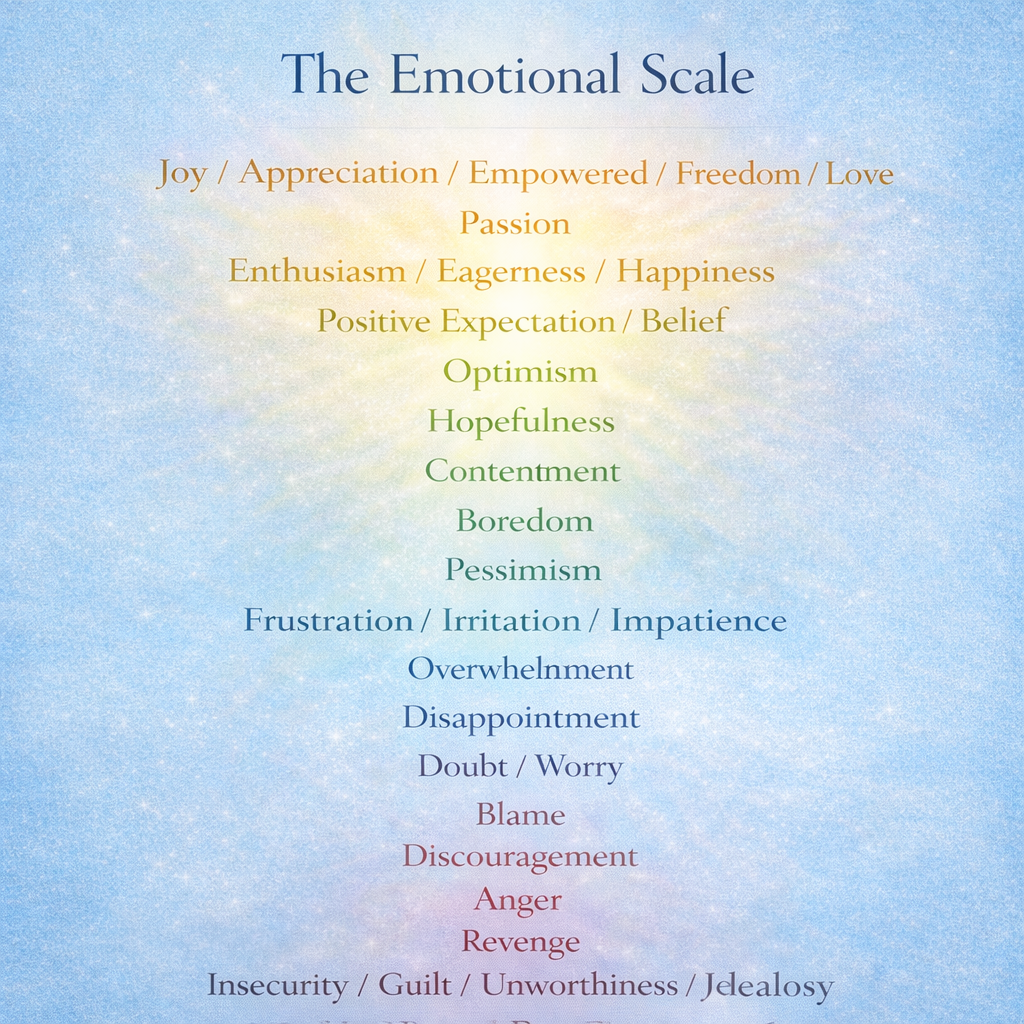
This project is built on the Abraham Hicks emotional scale, arranged here in 21 degrees. Abraham Hicks often presents 22 emotions; for this album, Doubt and Worry are combined to create a clean set of 21, which naturally forms three groups of seven—like three “octaves” of experience. The top octave emphasizes emotional agency and openness. The middle octave depicts drift and instability. The bottom octave explores constraint, pressure, and powerlessness.
What the scale means in musical terms
Across cultures and listening habits, emotion in music tends to be perceived through three broad dimensions:
Valence: how pleasant or painful the emotion feels
Arousal: how energized or subdued it feels
Agency (dominance/control): whether the emotion feels empowered or powerless
Your 21 degrees descend not only in positivity, but also in certainty and control—and that descent has direct musical analogs. Music also has “certainty” and “control”: clear tonal centers, stable pulse, predictable phrase lengths, and satisfying cadences feel confident. Unstable harmony, disrupted meter, crowded textures, denied resolution, and sonic fog feel uncertain or overwhelmed.
So the album maps each emotional degree to a specific compositional preset: a repeatable combination of tempo, meter, harmony, rhythm, register, texture, timbre, and cadence behavior.
The unifying method: one motif, twenty-one emotional “transpositions”
To keep the journey coherent, every track begins with the same anchor:
An 8-bar solo piano statement of the motif
The motif’s contour and rhythmic fingerprint remain consistent
After that opening, the motif is “emotionally transposed” using the preset for that degree
This is the central artistic idea: the listener hears the same musical identity repeatedly, but watches it change as if the emotional lighting and physical environment around it have shifted. In other words, the motif becomes a character moving through inner weather.
The three “octaves” of the album
The cycle is intentionally structured in three sets of seven:
Octave I — Ascent (Degrees 1–7):
High agency, open space, stable centers, clear arrivals. The motif is allowed to bloom.
Octave II — Drift (Degrees 8–14):
Neutral-to-negative transition states. Repetition becomes stagnation, stability becomes uncertainty, and the motif starts to circle, tighten, and lose resolution.
Octave III — Descent (Degrees 15–21):
Low agency, pressure, narrowing options. The motif becomes heavy, fragmented, mechanical, or distant—sometimes only a memory of itself—until it reaches near-stasis.
How each emotion maps to composition technique and mood
Each track corresponds to an emotion degree, and each degree is expressed through a primary composition technique—the dominant tool shaping the listener’s perception.
1) Joy / Appreciation / Empowered / Freedom / Love
Technique: open consonance + confident cadences
Mood: luminous, breathable, present. Clear tonal gravity, open voicings, satisfying closure.
2) Passion
Technique: rhythmic propulsion + harmonic saturation
Mood: heat and forward motion. Denser midrange, stronger accents, intensifying sequences.
3) Enthusiasm / Eagerness / Happiness
Technique: bright articulation + quick harmonic rhythm
Mood: sparkle, momentum, play. Crisp attacks, rising figures, frequent mini-arrivals.
4) Positive Expectation / Belief
Technique: sustained suspension + delayed resolution
Mood: leaning forward. Half-cadences, pedals, “nearly there” harmonies.
5) Optimism
Technique: warm lift (plagal energy) + rounded orchestration
Mood: grounded confidence. Less urgency than belief, more warmth than brightness.
6) Hopefulness
Technique: incomplete closure + fragile counterline
Mood: tender and unresolved. Soft ambiguity that still faces upward.
7) Contentment
Technique: stable repetition + minimal development
Mood: settled. Small changes, gentle rocking motion, quiet acceptance.
8) Boredom
Technique: static loop + deliberate lack of development
Mood: emotional flatline. Repetition becomes the point; music “stops trying.”
9) Pessimism
Technique: downward bass gravity + dim tonal color
Mood: forecasting loss. Minor-leaning centers and sighing resolutions.
10) Frustration / Irritation / Impatience
Technique: re-accented meter + interrupted phrases
Mood: agitation and friction. Off-balance rhythms, clipped gestures, “almost” cadences.
11) Overwhelmment
Technique: density (canon/layering) + saturated texture
Mood: too much information. The motif multiplies until it crowds its own air.
12) Disappointment
Technique: deceptive cadences + thinning after failure
Mood: the smaller landing. Promised arrival collapses into something weaker.
13) Doubt / Worry
Technique: oscillation between centers + looping questions
Mood: circling mind. Harmony won’t settle; the motif repeats like a thought you can’t complete.
14) Blame
Technique: accusatory gesture (call/response stabs) + cold closure
Mood: projection outward. Sharp attacks, verdict-like chords, clipped endings.
15) Discouragement
Technique: heavy touch + low-energy pacing
Mood: drained agency. Longer decays, slower motion, weaker cadential certainty.
16) Anger
Technique: unison/octave insistence + hard dissonant edge
Mood: impact and force. The motif becomes a hammer rather than a phrase.
17) Revenge
Technique: mechanized ostinato + controlled precision
Mood: cold purpose. Less chaotic than anger—engineered, relentless, exact.
18) Hatred / Rage
Technique: fragmentation into clusters + abrasive timbre
Mood: combustion. The motif is still there, but shattered; resolution is denied.
19) Jealousy
Technique: shadow imitation (suspicion canon) + off-beat entrances
Mood: watchful, tense, comparative. The motif appears as a lurking double.
20) Insecurity / Guilt / Unworthiness
Technique: hesitation and omission + exposed voicings
Mood: self-interruption. Fragile phrases, withheld endings, unresolved exposure.
21) Fear / Grief / Depression / Despair / Powerlessness
Technique: near-stasis + drone + cadence denial
Mood: no ground. Space becomes structural; the motif sinks from statement into memory.
Listening guidance: how to hear the “scale”
If you listen straight through, notice four things changing as you descend:
Cadences: from full closure → to postponed closure → to denied closure
Pulse certainty: from confident groove → to off-balance meter → to broken or frozen time
Harmonic clarity: from clear centers → to oscillation → to obscured gravity
Space vs. pressure: from air and openness → to crowding → to suffocation or emptiness
The result is a coherent emotional architecture: not 21 unrelated moods, but one motif traveling through 21 internal climates—demonstrating, in musical terms, how feeling can be mapped, shaped, and transformed.
Liner Notes
Open Sky (Joy / Appreciation / Empowered / Freedom / Love)
The cycle begins with the motif stated plainly and confidently, as if it has nothing to prove. The harmony is clear, the pulse is steady, and the spacing is open—musical equivalents of agency and room to breathe. Strings arrive not to add drama, but to widen the sky around the piano, letting resolution feel natural and unforced.
Aflame (Passion)
Here the same motif is heated and pressurized. The rhythm rolls forward with a stronger engine, and the harmony grows richer—more color, more weight, more insistence. Passion is portrayed as forward motion with purpose: not chaotic, but consuming, with arrivals that feel earned through momentum.
Quickening (Enthusiasm / Eagerness / Happiness)
The motif becomes bright, quick, and playful, articulated with crisp attacks and buoyant energy. Short phrases and frequent mini-arrivals create the sensation of delighted anticipation—like laughter that keeps restarting. The music stays nimble and sparkling, as if joy has turned into motion.
Lantern Ahead (Positive Expectation / Belief)
Belief is the art of leaning forward without yet arriving. The motif remains recognizable, but the harmony holds it in suspension—promising resolution while postponing it. The result is a feeling of guided direction: the lantern is visible, the path is real, but the final landing is intentionally delayed.
Green Light (Optimism)
Optimism is warmer than belief and less urgent than enthusiasm. The motif is carried by a gentle sway that suggests forward movement without strain. Cadences soften and broaden, as if confidence has become a quiet, enduring force rather than a burst of energy.
Almost There (Hopefulness)
Hopefulness is fragile strength. The motif is stated with tenderness and a slightly incomplete quality—less certainty, more vulnerability—while a softer counterline suggests companionship or inner reassurance. The music avoids hard closure, ending like a question asked with sincerity rather than fear.
Still Warm (Contentment)
Contentment rests. The motif repeats with only small changes, emphasizing stability over development. The sound is intimate and settled; the music does not reach upward or push forward—it simply remains present, illustrating the comfort of emotional equilibrium.
Same Room, Same Hour (Boredom)
Boredom is repetition without meaning. The motif becomes a loop that refuses to evolve, and harmonic motion slows to the point of near-stasis. The effect is deliberate: the music demonstrates how the absence of change becomes its own emotional statement, not dramatic—just empty of momentum.
Grey Forecast (Pessimism)
Pessimism tilts the motif downward. The bass feels heavier, the color dims, and the phrasing carries a quiet surrender, as if expectation has narrowed into prediction. Cadences soften into sighs, suggesting a mind that has already decided what will happen next.
Tapping the Table (Frustration / Irritation / Impatience)
The motif is unchanged, but the ground beneath it becomes uneven. Off-balance meter and clipped phrasing turn familiar material into agitation—like a thought that keeps hitting the same wall. Resolution is repeatedly interrupted, capturing impatience as a rhythmic and structural condition.
Too Much (Overwhelmment)
Overwhelmment is not one strong feeling—it is too many feelings at once. The motif multiplies through layering and canon until it crowds the listener’s attention. Texture becomes pressure, space disappears, and the music refuses release, demonstrating overwhelm as density that outpaces control.
The Smaller Landing (Disappointment)
Disappointment is the moment expectation collapses into less than promised. The motif sets up arrival, then repeatedly lands somewhere weaker—deceptive endings that drain energy rather than fulfill it. The texture thins after each failure, mirroring the emotional drop that follows a hope that doesn’t come true.
Circling Thought (Doubt / Worry)
Doubt and worry are built from oscillation. The motif becomes a question that cannot find a home, pulled between competing centers that never settle. Repetition shifts from boredom’s flatness into anxiety’s loop—an active circling, where every near-resolution restarts the problem.
Pointing Finger (Blame)
Blame redirects discomfort outward. The motif turns pointed and declarative, answered by sharp gestures that feel like verdicts. The music becomes less ambiguous and more accusatory—clear attacks, cold separations, and clipped endings that suggest certainty without compassion.
Low Battery (Discouragement)
Discouragement is diminished agency. The motif slows and feels heavier, as if the same musical thought now costs more to say. Longer decays and wider silence communicate fatigue; cadences weaken, not through ambiguity, but through lack of strength to arrive.
Red Line (Anger)
Anger hardens the motif into impact. It becomes hammered, insistent, and forceful, with sharper dissonant edges that feel like heat in the blood. The motion is direct and confrontational, less about complexity than about pressure released through force.
Cold Plan (Revenge)
Revenge differs from anger by becoming controlled. The motif turns mechanical—precise, relentless, engineered—like a plan running on rails. The sound is colder and more disciplined, suggesting determination that has traded emotion for purpose.
Black Furnace (Hatred / Rage)
Hatred and rage fracture the motif without erasing it. The outline remains, but the material breaks into shards and clusters, and timbre grows abrasive. The music burns rather than argues; it denies resolution and ends as rupture, conveying a state that cannot be soothed by ordinary closure.
Side-Eye (Jealousy)
Jealousy is suspicion with a soundtrack. The motif enters off-beat, imitated like a shadow that follows too closely. Thin textures and sudden spikes create an atmosphere of comparison and vigilance—the sense that something is being watched, measured, and resented.
Not Enough (Insecurity / Guilt / Unworthiness)
These emotions interrupt the self from within. The motif appears hesitantly, sometimes incomplete, as if the music itself doubts it deserves to finish the sentence. Exposed voicings and fragile color turn the motif into confession—quiet, vulnerable, and unresolved.
No Ground (Fear / Grief / Depression / Despair / Powerlessness)
The final degree is not merely “sad”—it is the collapse of agency. The motif stretches toward stillness, becoming distant memory rather than present statement. Drones and cold air replace forward motion; silence becomes structural. The album ends without cadence because powerlessness does not “resolve”—it suspends, fades, and leaves the listener in open space.
Playlist
- Open Sky — Joy/Love/Freedom Museca 3:14
- Aflame — Passion Museca 3:11
- Quickening — Enthusiasm/Happiness Museca 1:55
- Lantern Ahead — Positive Expectation/Belief Museca 2:19
- Green Light — Optimism Museca 2:10
- Almost There — Hopefulness Museca 2:03
- Still Warm — Contentment Museca 2:45
- Same Room, Same Hour — Boredom Museca 2:20
- Grey Forecast — Pessimism souledout 2:41
- Tapping the Table — Frustration/Impatience Museca 1:30
- Too Much — Overwhelmment Museca 3:30
- The Smaller Landing — Disappointment Museca 3:05
- Circling Thought — Doubt/Worry Museca 3:34
- Pointing Finger — Blame souledout 1:28
- Low Battery — Discouragement souledout 2:12
- Red Line — Anger souledout 2:50
- Cold Plan — Revenge Museca 2:38
- Black Furnace — Hatred/Rage Museca 3:39
- Side-Eye — Jealousy Museca 3:00
- Not Enough — Insecurity/Guilt/Unworthiness Museca 2:13
- No Ground — Fear/Grief/Despair/Powerlessness Museca 2:11