
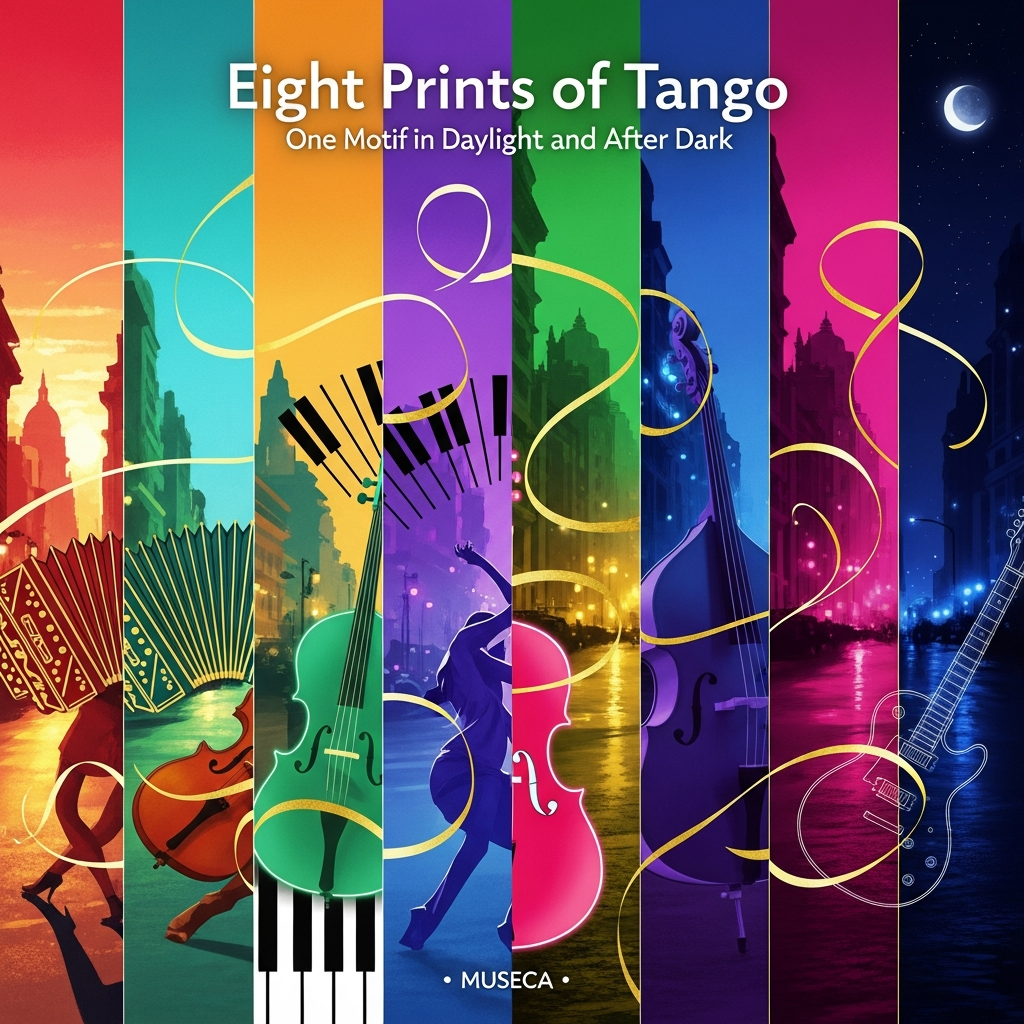
Eight Prints of Tango
One Motif in Daylight and After Dark
Tango was born in the Río de la Plata—Buenos Aires and Montevideo—where immigrant streets, local traditions, and Afro-Rioplatense rhythm met in the late nineteenth century and crystallized into a new musical language: bandoneón breath, string lament, piano bite, and a pulse built for bodies in close embrace. From its early forms to the Golden Age of the orquesta típica, tango became a discipline of phrasing as much as a genre—its drama carried not by volume, but by accent, pause, and the emotional geometry of the step.
Eight Prints of Tango is a single compositional idea—one recurring motif—viewed through eight lenses. The album is organized as two complementary halves, like the same city seen under different light.
Side A (Daylight) presents four “prints” that honor tango’s core dialects: the traditional orquesta típica engine, the circular lift of vals criollo, the quicksilver grin of milonga, and the sharpened architecture of nuevo tango. These tracks treat style as craft: instrumentation, articulation, and rhythmic grammar are the palette, and each print reveals what the motif becomes when the rules of the room change.
Side B (After Dark) does not depart from tango—it changes the atmosphere around it. Here, tango’s phrasing remains the spine, but it is set inside a Café del Mar sound-world: warm low end, soft percussion, nocturnal space, and a slower, more hypnotic gravity. The sequence follows a night’s progression—Vals at Dusk, Milonga at Sunset, Orquesta Típica as the bridge between street and shore, and Nuevo at Midnight—so the same motif feels progressively more intimate, more cinematic, and more psychologically close. Taken together, the eight prints form one suite: tango as tradition, tango as transformation, and tango as a single voice speaking fluently in two worlds.
Liner Notes
This album is a single motif—A–C–B–A–G#–A—recast eight times as if hung in a gallery under changing light.
Side A presents tango’s core dialects in their native rooms: the disciplined architecture of orquesta típica, the rotating lift of vals criollo, the quick grin of milonga, and the sharpened, concert-minded edge of nuevo tango.
Side B keeps tango’s phrasing intact but changes its air: Café del Mar warmth, softer percussion, and nocturnal space—so the motif becomes less “street performance” and more “night memory.”
Side A: Daylight Prints
1) Midnight on Corrientes (Orquesta Típica)
The album opens with tango in its most authoritative voice: bandoneón-led drama, tight accents, and a pulse designed for the floor. The motif is stated plainly and confidently—then immediately placed into the classic tango conversation: bandoneón speaks, strings answer, piano punctuates.
Listen for the deliberate stop-time breaths: tango’s power often lives in what it withholds, not what it floods.
2) Midnight Vals (Vals Criollo)
The same motif steps into 3/4 and learns to spin. Rather than floating like European ballroom, this vals keeps a tango backbone—weighted downbeats, little accent snaps, and phrases that lean forward as if pulled by the embrace.
Strings widen the horizon here, letting the motif feel less like a statement and more like a skyline line drawn in one unbroken stroke.
3) Corrientes After Hours (Milonga)
Milonga is tango’s playful cousin—quicker on its feet, more conversational, more willing to wink. The motif turns “chattier,” breaking into quick turns and repeated notes that feel like street banter.
The engine is rhythmic clarity without heaviness: bright articulation, tight pockets of silence, and forward motion that never turns into generic Latin wallpaper.
4) Glass & Asphalt (Nuevo Tango)
Here the motif is refracted. Harmony sharpens; form becomes more architectural; tension is allowed to stand uncovered. Nuevo tango thrives on contrast—lean textures, sudden turns, and moments where the music drops away to expose the nerve underneath.
This track is the end of daylight: the same city, now edged in glass, shadow, and intention.
Side B: After Dark Prints
5) Vals at Dusk (Tango Vals × Café del Mar)
The first “After Dark” print keeps true 3/4 (or 12/8 sway), but the room changes: warmth, space, and coastal glow. The motif returns as a lantern—softly lit in bandoneón and strings, supported by gentle pulse rather than pushed by it.
Rubato pickups and small hesitations preserve tango phrasing, ensuring this never becomes a generic chill waltz.
6) Milonga at Sunset (Milonga × Café del Mar)
This is terrace energy: lighter, perkier, and sun-warm—milonga attitude reimagined at mid-tempo so the groove can breathe. Guitar and piano create a clean rhythmic lattice while the bandoneón chats over it with playful precision.
The craft is in restraint: minimal percussion, crisp accents, and enough negative space for the motif to smirk.
7) Saltwater Bandoneón (Corrientes After Dark Mix) (Orquesta Típica × Café del Mar)
The bridge track—street to shore. Orquesta típica remains the identity (bandoneón forward, tango accents intact), but the production adds nocturnal air and a steady lounge undercurrent. The motif feels simultaneously older and newer: a classic phrase heard through modern night lighting.
The breakdown is the emotional hinge: the beat steps back, bandoneón confesses, then the groove returns like the tide.
8) Nuevo at Midnight (Nuevo Tango × Café del Mar)
The final print is the most cinematic-lounge: dark extended chords, sharp structural drops, and a minimal-but-serious groove that lets tension speak clearly. Café del Mar supplies warmth and atmosphere; nuevo tango supplies the edge—the sudden harmonic turns, the clean contrasts, the controlled drama.
The motif finishes not as a slogan, but as a thought you cannot quite dismiss—midnight’s last line, hanging in the air.
Playlist
- Traditional Orquesta Típica Tango Museca 2:20
- Tango Waltz (Vals) — “Midnight Vals” Museca 2:28
- Milonga at Sunset — Milonga × Café del Mar Museca 1:26
- Nuevo at Midnight — Nuevo Tango × Café del Mar Museca 2:42
- Vals at Dusk — Tango Vals × Café del Mar Museca 2:23
- Milonga at Sunset — Milonga × Café del Mar Museca 1:26
- Traditional Orquesta Típica Tango — “Midnight on Corrientes” Museca 1:35
- Nuevo Tango × Café del Mar Museca 2:44