
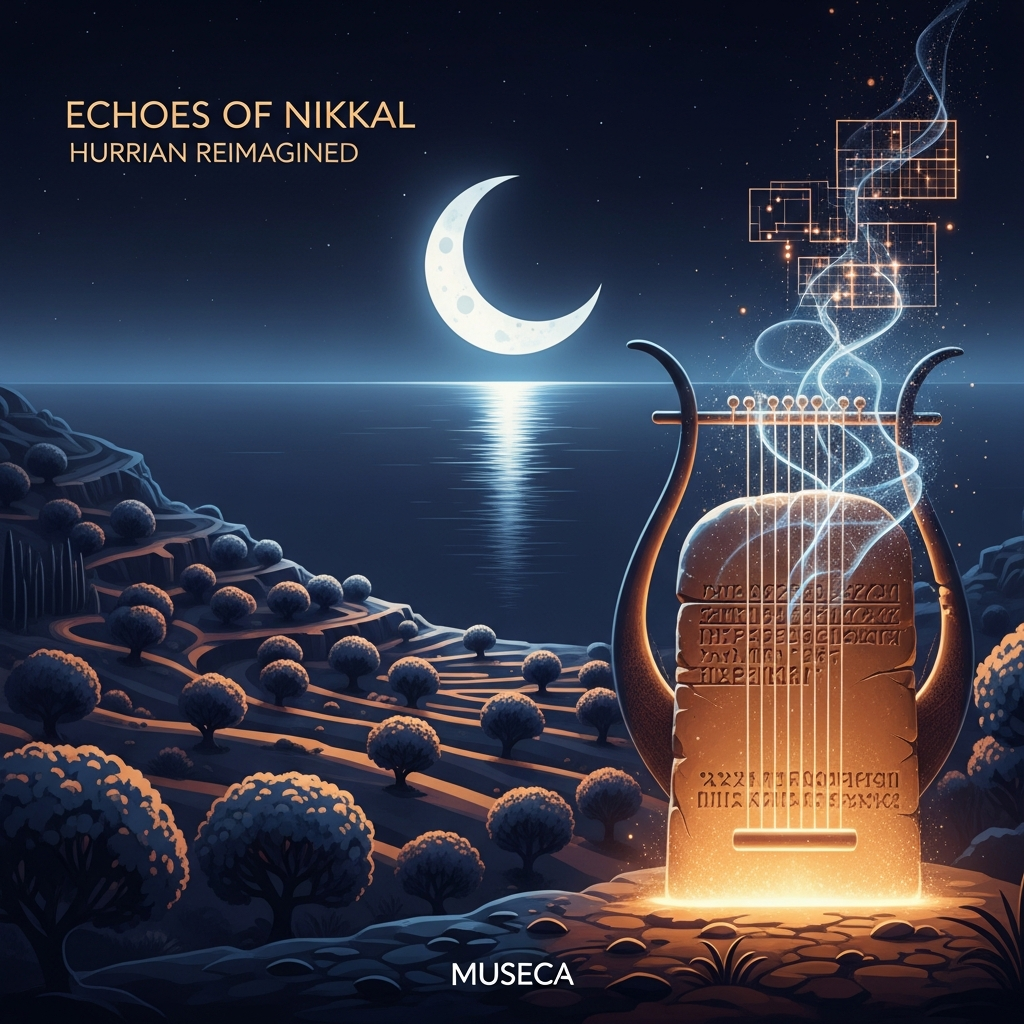
Echoes of Nikkal: Hurrian Reimagined is a four-track EP that listens backward in time and then answers forward. It is inspired by the Hurrian hymns of ancient Ugarit (modern Ras Shamra, Syria), among the oldest known notated songs in human history. The best-preserved of these, often called the Hymn to Nikkal, is a devotional song to Nikkal, goddess of orchards and fruit trees, written for voice and a nine-string lyre more than three thousand years ago. The clay tablets that preserved this music contain not only text, but also interval names and tuning instructions—early evidence that human beings were already thinking structurally about scales, strings, and the relationship between numbers and sound.
This EP does not attempt to reconstruct the original Hurrian hymn academically. Instead, it treats the surviving fragments—tuning concepts, modal flavor, ritual character, and the image of Nikkal herself—as creative starting points. Nikkal, Keeper of Orchards reimagines the hymn as a modern devotional song: modal harp, frame drum, and human voice renewing an ancient gesture of praise. String-Names (Hurrian Code) translates the tablet’s interval logic into a world of analog synths, drones, and pulse, turning the old lyre string-names into a contemporary electronic meditation. Nikkal Reborn fuses these two worlds, allowing harp and circuitry, ritual and cinema, to speak in one breath. Finally, Moon Over Ugarit closes the cycle with a lyric-less Café del Mar–style instrumental: an Afro-inflected groove that suggests the same stars, the same coastline, and the same quiet listening, separated only by millennia.
Across these four pieces, Echoes of Nikkal: Hurrian Reimagined treats the Hurrian hymns as a kind of ancestral tuning fork. The EP honors their age and mystery while accepting that the original melodies are partly lost to time. What remains is the gesture: a human voice, a plucked string, a pattern of intervals, an offering to a presence in the night sky. These tracks invite the listener to stand between past and present and hear how a very old song might continue, if it were allowed to keep evolving in our hands.
Liner Notes
Nikkal, Keeper of Orchards
This opening track approaches the Hurrian hymn not as a museum piece but as a living prayer. The voice stands where an ancient singer might once have stood: at the threshold between the human and the divine, addressing Nikkal, goddess of orchards and moonlit gardens. Modal harp figures and low percussion suggest the resonance of a nine-string lyre and frame drum, while the harmony deliberately resists modern cadential pull, hovering instead around drones, open fifths, and slowly turning intervals. The text speaks in images—roots, leaves, fig and vine—rather than doctrine, honoring the original hymn’s agricultural devotion. What results is a quiet invocation: a contemporary listener reaching back through millennia to offer the same gesture of gratitude for life, growth, and the mysterious light that comes after darkness.
Lyrics
[Verse 1]
[Moon-gardener, Nikkal, keeper of orchards,
Water the root, awaken the green.
Count us in leaves, name us in branches,
Breath to the seed, breath to the dream.]
[Verse 2]
[Daughter of silver light,
You walk among fig and vine.
Your veil is dew, your song the dawn—
O Nikkal, remember your shrine.]
[Refrain]
[Shine, keeper of orchards,
Shine through the grove of time.
Harp of the moon, string of the earth,
Sing where the rivers align.]
[Bridge]
[Drums of the soil, hearts in the clay,
Echo the pulse of your name.
Ancient hands on the strings of night,
Still pluck the eternal flame.]
[Outro]
[Nikkal, moon-gardener,
Keeper of orchards divine,
Breathe on the seed of tomorrow,
Until the roots entwine.]
String-Names (Hurrian Code)
Where the first track inhabits the ritual surface of the hymn, this piece moves inside the clay tablet itself. The “string-names” and interval instructions that once guided a lyre player are reimagined here as triggers for electronic motifs: each named span becomes a contour in analog synth lines, each numeral a subtle change in pacing or density. The human voice is present, but more as texture than storyteller—a chant-like layer dissolved into drones, delays, and polyrhythms. You hear the sense of coded information: something precise but partially lost, circling in the noise of time. Instead of reconstructing the original melody, the track asks a different question: if those intervals were rewritten in voltage and waveforms rather than gut strings, what kind of trance would they induce today?
Lyrics
[Verse 1]
[Išartum—straight string, light ascends.
Embūbum—reed breath through wire.
Nīd qablim—heart unstrung, falls inward.
Three names—three echoes—three fires.]
[Verse 2]
[Numbers on clay, rhythm in dust.
Intervals circle like moons of rust.
Each tone awakens a mirror of sky,
Each name a question that never will die.]
[Bridge]
[Strings shimmer through glass delay.
Electrons hum the ancient way.
Fourth, fifth, step and return,
Fire of tone, let the code burn.]
[Outro]
[Voices dissolve to wind.
The strings remember their names.
Silence tunes the earth again.]
Nikkal Reborn
This track is the bridge where the worlds finally touch—ancient devotion and modern circuitry sounding together without apology. Harp and synth share the same air; acoustic overtones and electronic drones lean into one another until the distinction blurs. The lyrics imagine Nikkal stepping through time into the digital age, her orchard now woven through data, wires, and light. Musically, motifs from the first two pieces are hinted at and recombined: the modal phrases of the hymn, the intervallic gestures of the “code,” now carried by a broader cinematic harmony. It is both an act of homage and a quiet assertion: the old gods never entirely disappeared; they simply change the instruments through which they are sung. “Nikkal Reborn” is that moment of recognition, when an ancient presence finds a new voice.
Lyrics
[Verse 1]
[Nikkal reborn, through wires and wind,
Your orchard breathes in code again.
Stone to signal, seed to spark,
The garden hums where data arcs.]
[Refrain]
[Ancient hand meets modern key,
Pulse of earth, pulse of machine.
Sing through the circuits, goddess of green,
Let old strings bloom in the unseen.]
[Verse 2]
[Harps of dust and silicon shine,
Notes remember the silver line.
Fourth and fifth, the timeless frame,
Melody whispers your hidden name.]
[Bridge]
[Lyre to laser, clay to cloud,
Echo of ages, bright and loud.
Human and code entwine again—
Music reborn from what has been.]
[Outro]
[Nikkal, keeper of orchards divine,
Breathe through the wires that intertwine.
Ancient to future, one design—
Your song forever, yours and mine.]
Moon Over Ugarit
The closing track sets aside words altogether and lets rhythm, color, and atmosphere speak on their own. It imagines a modern listener on a shoreline not unlike the one ancient Ugarit faced, hearing the same moon-flecked waves but with headphones on—Café del Mar groove, Afro-inflected pulse, bass and pads breathing in slow arcs. Modal hints from the earlier tracks appear as harp-like or guitar-like figures, floating over a laid-back beat that feels like a long exhale after the intensity of prayer and code. Without lyrics, the connections become more intuitive: a sense of distance and continuity, of being carried by something very old in a very contemporary body. “Moon Over Ugarit” is both epilogue and invitation—to imagine the stars above you as the same silent witnesses that heard the first Hurrian hymn, and to let that awareness soften the present moment into something timeless.
Playlist
- Nikkal, Keeper of Orchards Museca 3:55
- String-Names (Hurrian Code) Museca 2:49
- Nikkal Reborn Museca 4:34
- Moon Over Ugarit Museca 3:20