
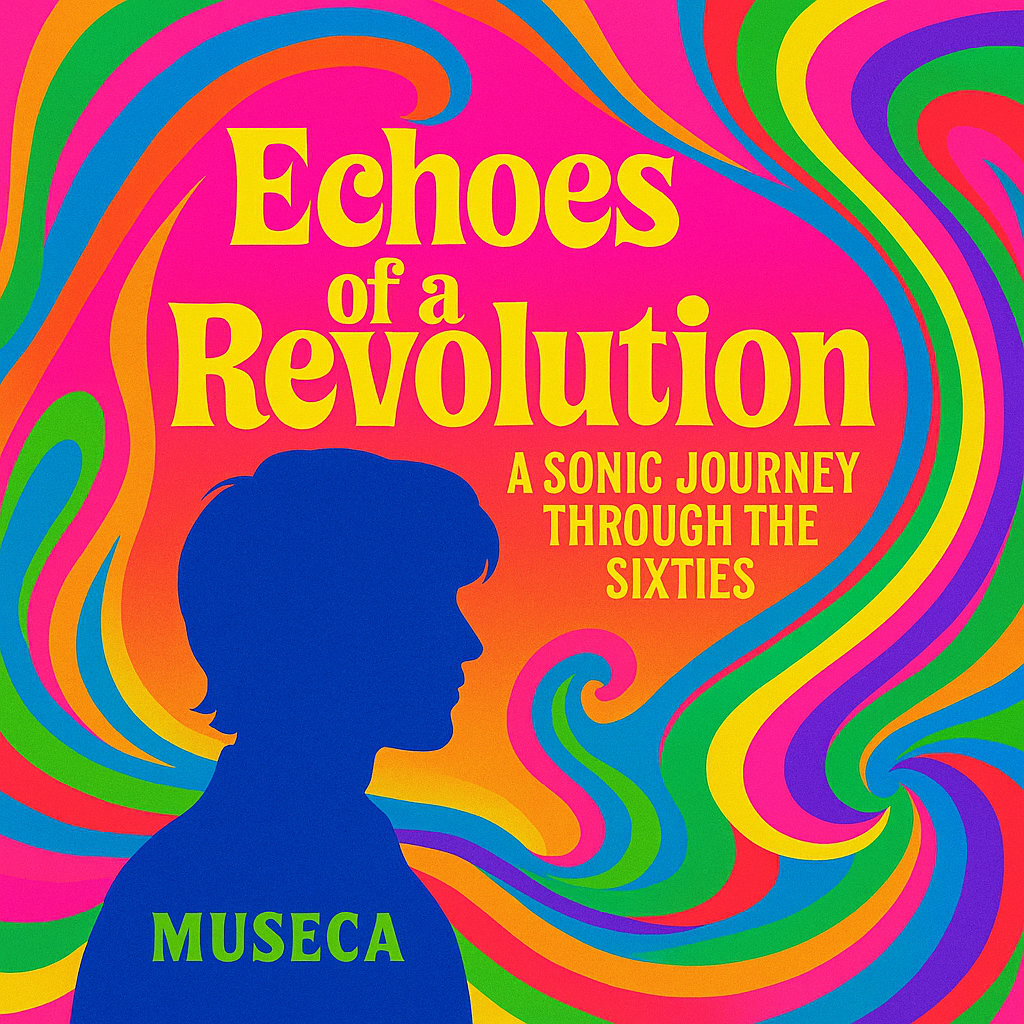
Echoes of a Revolution: A Sonic Journey Through the Sixties
The 1960s were not just a decade — they were a threshold. A turning point in sound, style, politics, and spirit. Music was no longer background; it became the voice of a generation, a mirror of cultural upheaval, and the pulse of protest, love, rebellion, and rebirth. It emerged from soda shops and war zones, from street corners and studio sanctuaries, from the crackling vinyl of jukeboxes to the psychedelic ether of smoke-filled clubs.
This album is a tribute and a time capsule.
Each track is an original composition inspired by a real moment in musical history, tracing the evolution of popular music from 1960 to 1969 — across both the United States and the United Kingdom.
What begins in innocence — leather jackets and jukeboxes — quickly unfolds into waves of folk activism, Motown soul, California dreams, and electrified revolutions. By the end, the songs echo with fuzzed-out fury and orchestral reflections, marking the decade’s close with the knowledge that music would never again be the same.
This is not a collection of impressions.
It is a narrative in sound — one decade, ten tracks, a thousand voices —
and it ends, as the sixties did, with the haunting certainty that tomorrow never waits.
Liner Notes
The Jukebox is Still King
(1960–1962 · Early Rock & Doo-Wop)
Opening with a nostalgic wink to America’s pre-invasion innocence, this track captures the sweetness of letter jackets, soda fountains, and vinyl spinning in neon-lit diners. Rooted in the sounds of early rock and doo-wop, it’s a celebration of the youth who danced before the cultural earthquake hit.
Merseybeat Sunrise
(1963 · British Invasion / Beat Music)
Across the Atlantic, Liverpool explodes with rhythm. This track reflects the sharp suits, chiming guitars, and unshakable optimism of 1963’s British Invasion — when bands like The Beatles redefined pop with a sound both infectious and enduring.
Blowin’ Through the Wires
(1963–1964 · Folk Revival / Protest Song)
A quieter storm, this acoustic ballad draws from the protest-folk traditions that took root in the early civil rights era. With stripped-down instrumentation and poetic clarity, it gives voice to a generation beginning to sing not just of love, but of justice.
Soul Assembly
(1964–1965 · Motown / Northern Soul)
The motor city roars to life with a groove that moves both body and spirit. This track channels the polished power of Motown, where gospel harmonies, melodic basslines, and radiant soul came together to uplift and unify across the airwaves.
California Waves
(1965–1966 · Surf Rock / Baroque Pop)
Bright, breezy, and tinged with longing, this piece rides the arc of the West Coast sound — from sun-drenched surf anthems to the orchestral introspection of baroque pop. The harmony is lush, but the horizon is already shifting.
Painted Skies and Liquid Light
(1966–1967 · American Psychedelic Rock)
The acid haze descends, and the American soundscape melts into color. This track dives into the kaleidoscopic core of psychedelia — echoing vocals, swirling textures, and metaphysical lyrics reflect the era’s plunge into altered states and inner revolutions.
The Underground Electric
(1967 · British Psychedelia / Art Rock)
Meanwhile, the U.K. responds with wit, satire, and studio experimentation. This track nods to the whimsical and surreal side of British psychedelia, where pop became art and the underground pulsed with strange beauty and baroque eccentricity.
March to the Fire
(1968 · Political Soul / Protest Rock)
A storm of grief, fury, and gospel fire, this soul-rock anthem channels the unrest of 1968. With marching drums, call-and-response vocals, and blues-infused power, it stands as a sonic protest to a world unraveling — and a demand for something better.
Fuzz and Fury
(1969 · Proto-Hard Rock / Blues Rock)
Distorted, defiant, and driven by guitar, this track erupts with the primal energy of blues-turned-hard rock. It captures the raw edge of the decade’s end — when the dream cracked, and the volume rose in rebellion.
Tomorrow Never Waits
(1969 · Orchestral Folk-Pop Epilogue)
Closing with reflection and grace, this folk-pop elegy says goodbye to the sixties with orchestral warmth and lyrical tenderness. It doesn’t resolve the decade’s contradictions — it honors them, in melody and memory, before fading into the future.
Postscript
“Echoes of a Revolution: A Sonic Journey Through the Sixties”
The 1960s was not just a decade—it was a musical metamorphosis. In both the United States and the United Kingdom, sound became a vessel for seismic change. A generation found its voice not only through lyrics, but through the recording studio itself, as production evolved from documentation to transformation. What began in the simple, driving rhythms of early rock ‘n’ roll erupted into a kaleidoscope of genres: folk revival, Motown soul, surf rock, psychedelia, art rock, blues-rock, and the first flickers of hard rock and metal.
In the U.S., artists like Bob Dylan, Aretha Franklin, and The Beach Boys expanded the emotional and sonic vocabulary of American music. Motown brought gospel-rooted soul into mainstream consciousness, while West Coast bands like Jefferson Airplane and The Doors gave form to the psychedelic underground. Meanwhile, the folk protest movement infused melody with meaning—using song as both weapon and balm during the civil rights era and Vietnam War.
Across the Atlantic, the British Invasion shifted the pop center of gravity. The Beatles and The Rolling Stones reinterpreted American sounds, only to evolve them into something wholly new. From Merseybeat to studio experimentation, U.K. artists like Pink Floyd, The Kinks, Cream, and Led Zeppelin fused innovation with imagination, giving birth to both concept-driven rock and heavy electric blues.
By decade’s end, lyrics had turned poetic and prophetic. Genres had splintered and recombined. Studios had become sanctuaries of experimentation. Music was no longer confined to entertainment—it was revolution, reflection, and refuge.
This album pays tribute not just to the sounds of the 1960s, but to their spirit: fearless, curious, and utterly transformative. These were songs born from the crossroads of youth and unrest, dreaming and defiance. And their echoes still shape the soundtrack of our world today.
Playlist
- The Jukebox is Still King Museca 2:26
- Merseybeat Sunrise Museca 1:57
- Blowin’ Through the Wires Museca 2:14
- Soul Assembly Museca 2:45
- California Waves Museca 3:35
- Painted Skies and Liquid Light Museca 5:38
- The Underground Electric Museca 2:40
- March to the Fire Museca 3:43
- Fuzz and Fury Museca 3:55
- Tomorrow Never Waits Museca 3:34