
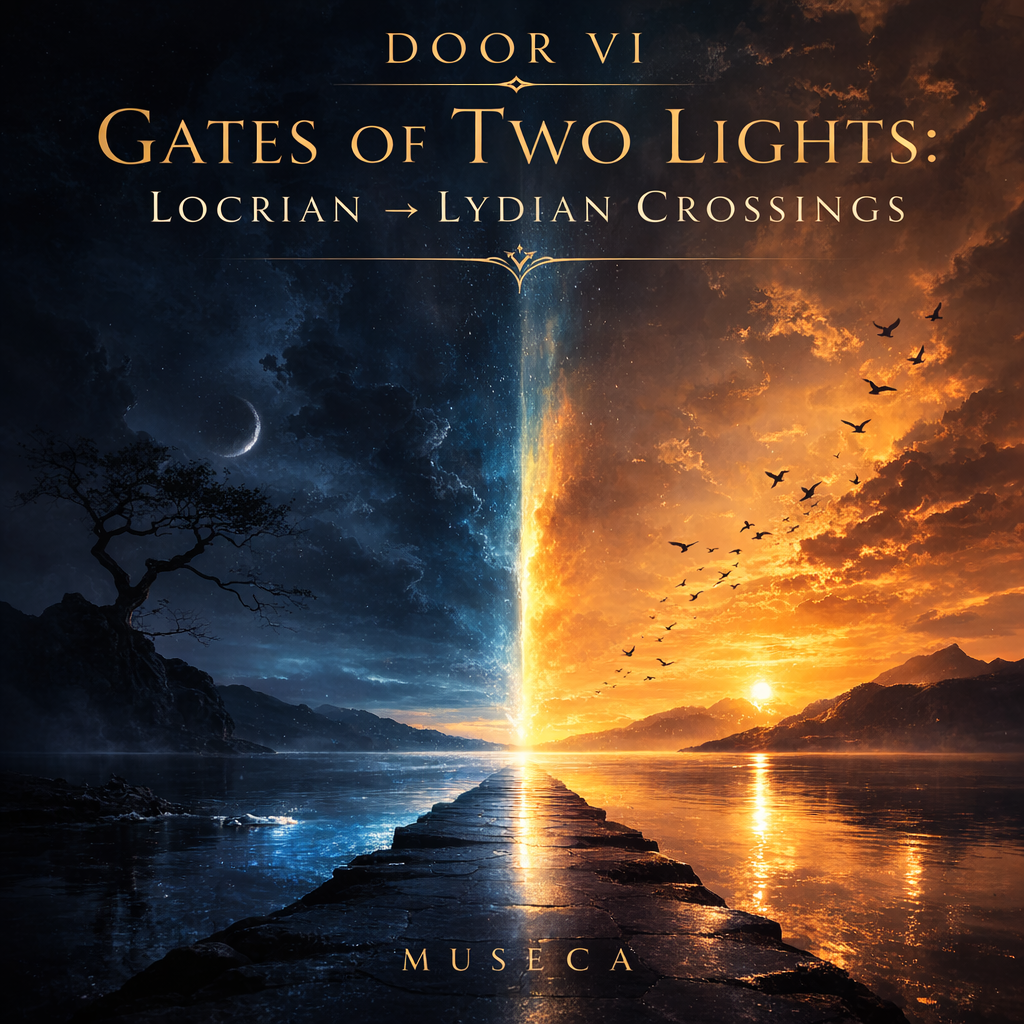
Door VI — Gates of Two Lights: Locrian → Lydian Crossings
Can Locrian transform into light without losing integrity?
This album is the hinge of the Locrian Lounge. Up to this point, the earlier doors have shown Locrian as atmosphere, narrative, system, intimacy, and timbre. Gates of Two Lights asks a more difficult question: what happens when instability does not disappear, but begins to open?
The journey from Locrian to Lydian is not a simple modulation. It is a structural repair. Locrian begins without the stabilizing authority of the perfect fifth; Lydian, by contrast, radiates from a fully established center and a heightened brightness. To move between them, the music must gradually rebuild what Locrian withholds—allowing intervals to clear, registers to widen, and harmonic pressure to release without betraying the mode from which the journey began.
That is the drama of this album. Darkness is not rejected here, and brightness is not treated as sentiment or escape. The two modes coexist for a time, overlap, question one another, and pass through a threshold where gravity is retained even as light enters. The result is not triumph in the conventional sense, but transmutation: a change in condition that can still remember its point of origin.
Gates of Two Lights stands at the center of the seven-door cycle because it reveals something essential about Locrian itself. Even the most unstable mode can become the beginning of ascent—if one listens closely enough to the space between tension and release.
Liner Notes
Light in the Tunnel
The album opens from within Locrian rather than outside it. Low-register harmony, restrained pacing, and suspended voicings establish an unstable field in which brightness is not yet present, only sensed. The title is important: this is not light reached, but light perceived at a distance. The music holds its diminished gravity while allowing the ear to imagine a direction beyond it.
Let It Diminish
This track does not brighten through assertion, but through subtraction. Locrian pressure begins to thin: textures open, density drops, and harmonic weight gradually loosens. The transformation is structural rather than emotional. Instead of driving toward a new mode, the piece quietly removes what prevents one from emerging.
Gate of Two Lights
The philosophical center of the album. Here, Locrian and Lydian are heard in tension and coexistence, not in sequence. One field remains shadowed and unresolved, while the other begins to radiate from within. The result is a threshold piece in the strictest sense: two tonal conditions occupying the same space, neither fully yielding, both audible at once.
Locrian to Lydian — Romantic Orchestral Version
The largest and most expansive statement in the cycle. Sweeping strings, broadened harmony, and widening register make the modal repair audible on a symphonic scale. Yet the transformation remains earned rather than decorative. This is not simply dark becoming bright; it is instability learning how to sustain light without erasing its origin.
Strong Locrian to Lydian Breakthrough
If the previous track unfolds the transformation gradually, this one declares it. Harmonic authority returns more decisively, intervals stabilize, and the music moves with greater forward energy. Even so, the breakthrough is not triumphalist. It carries the memory of Locrian pressure within its brightness, which gives the release its weight.
Light in the Tunnel (Cafe del Mar)
The album closes not with culmination, but with afterglow. The brightness that has emerged is now heard reflectively, at a distance, softened by atmosphere. The piece suggests horizon rather than endpoint: lighter, calmer, more open, but still non-cadential. It leaves the listener in a transformed space that remembers suspension rather than denying it.
Playlist
- 1) Gate of Two Lights Museca 3:50
- 2) Locrian to Lydian — Romantic Orchestral Version Museca 2:57
- 3) Light in the Tunnel Museca 3:06
- 4) Strong Locrian to Lydian Breakthrough Museca 3:11
- 5) Let It Diminish Museca 3:32
- 6) Light in the Tunnel (Cafe del Mar) Museca 2:09