
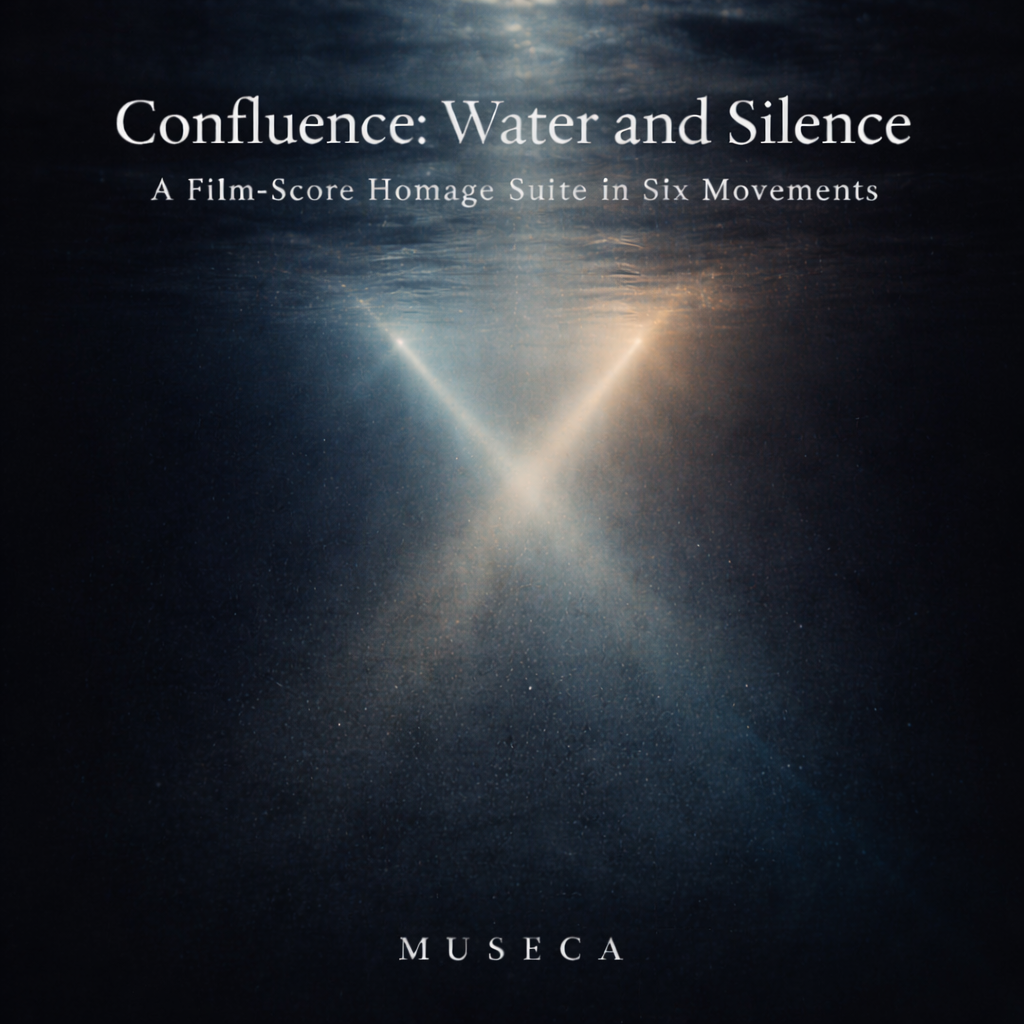
Confluence: Water and Silence — A Film-Score Homage Suite in Six Movements is a six-cue orchestral study inspired by the musical world of the 2005 film Memoirs of a Geisha and the extraordinary color logic of its score. The original soundtrack demonstrates a rare kind of cinematic artistry: a romantic Western symphonic language illuminated—never overwhelmed—by the symbolic presence of Japanese instruments. In that palette, timbre becomes character. A single breath of bamboo can carry memory; a shimmer of plucked strings can suggest discipline and cultivated grace; a ritual удар of percussion can announce forces larger than any individual life.
This suite adopts that same principle of “color as narrative.” It does not attempt to reproduce traditional Japanese repertoire. Instead, it follows the film score’s essential method: the Western orchestra provides continuity, harmonic clarity, and emotional architecture, while Japanese timbres appear as deliberate, sparing signifiers—inner life, ritual, environment, and destiny. The result is not pastiche, but cinematic impressionism: music written in the language of film, where restraint is as expressive as sound, and where silence itself is part of the orchestration.
Liner Notes
Silk Memory (Theme for an Inner Life)
The suite opens with an idea rather than an event. A lyrical cello line functions as the human camera—close, intimate, confessional—while the orchestra remains veiled, as if heard through paper walls. Japanese colors appear as momentary illuminations: a koto shimmer that suggests composure and discipline, and a breath-voiced wood timbre that reads as memory itself. The emotional posture is deliberate restraint: beauty held in check, longing placed carefully inside formal lines.
Lanterns at the Hanamachi Gate (Journey / Arrival)
A gentle pulse emerges without insistence—motion carried by strings and harp rather than by drums. The music suggests passage into a world governed by ritual, appearance, and intricate social choreography. Here, timbral fusion becomes the narrative technique: the koto does not “decorate” the orchestra so much as merge with it, doubling arpeggiations and blurring the boundary between cultures into a single cinematic surface. Short cello fragments appear like private thoughts beneath public movement.
Brushwork Discipline (Training as Art)
This movement is an étude in negative space. The sound world is reduced to essentials: plucked resonance, muted string halos, and brief percussive punctuation. Gesture matters more than volume. The materials are presented with the compositional ethos of ritual—careful entrances, clean exits, and a sense that each sound is chosen rather than merely played. A solitary breath-line arrives like an unspoken confession, then disappears, leaving silence to complete the phrase.
Waltz of the Paper Fan (Ideal / Elegance)
An idealized figure enters: the violin as a symbol of poise, gentleness, and unreachable clarity. The waltz is not ballroom display, but cinematic elegance—an implied three, softened by phrasing and luminous orchestral support. The cello, still the suite’s inward narrator, does not compete; it accompanies like a second voice reading the same letter differently. Japanese colors remain intentionally light, appearing at the edges of phrases, as if the room itself were singing.
Embers, Then War (Rupture / Fire)
The suite’s architecture turns outward. Where previous movements cultivated restraint, this one confronts inevitability. Low strings and percussion articulate a blunt “fate” cell—simple, weighty, unavoidable—while thematic material breaks into shards rather than melodies. The orchestration favors mass and gravity over detail: tremolo heat, dark pedals, punctuating gongs, and the sense of a world changing faster than the characters can adapt. Only in the aftermath does the human voice return, reduced to a wounded fragment.
Confluence: Water and Silence (End Titles / Resolution)
The final movement gathers the suite’s identities and allows them to coexist. The cello reclaims the principal theme in full, now less private and more accepting; the violin joins as an answering presence rather than an idealized distance. Japanese timbres are integrated as shared atmosphere—shimmer beneath the surface rather than ornament above it. The conclusion avoids triumph. It offers something rarer in film music: closure without conquest, and a final cadence shaped as much by quiet as by sound.
Playlist
- Track 1 — Silk Memory (Theme for an Inner Life) Museca 5:12
- Track 2 — Lanterns at the Hanamachi Gate (Journey / Arrival) Museca 3:39
- Track 3 — Brushwork Discipline (Training as Art) Museca 4:21
- Track 4 — Waltz of the Paper Fan (Ideal / Elegance) Museca 2:58
- Track 5 — Embers, Then War (Rupture / Fire Scene Analog) Museca 3:24
- Track 6 — Confluence: Water and Silence (End Titles / Resolution) Museca 3:56