
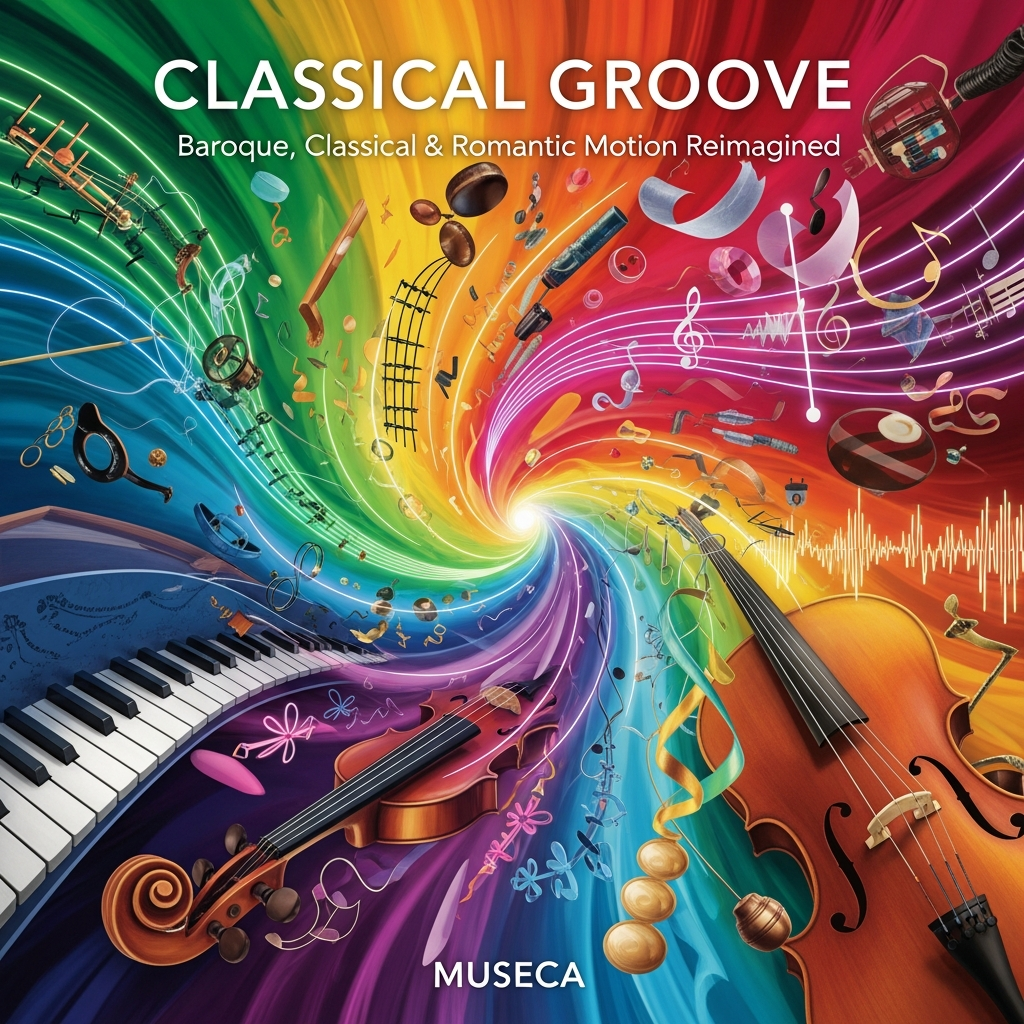
Classical Groove
Baroque, Classical & Romantic Motion Reimagined
Album Introduction
Classical Groove reimagines the rhythmic DNA of Western classical music by placing it in dialogue with groove, pulse, and contemporary rhythmic awareness. Rather than modernizing classical harmony or rewriting historical forms, this album preserves the internal logic of Baroque, Classical, and Romantic music—its phrasing, voice-leading, and formal balance—while allowing rhythm to step forward as an expressive engine.
Across these seven works, familiar classical devices are revealed as proto-grooves in their own right. The Baroque tactus becomes a steady kinetic force; the sarabande’s weighted second beat transforms into gravitational motion; compound gigues interlock like early polyrhythms; basso continuo and Alberti bass emerge as looping engines; Classical phrase symmetry becomes hook-like architecture; and Romantic long-line melody rides an ever-growing rhythmic surge.
The guiding idea of Classical Groove is not fusion for its own sake, but recognition: that Western classical music has always moved bodies as well as minds—just in subtler, more architectural ways. By introducing restrained percussion, modern pulse, and rhythmic reinforcement, these compositions illuminate what was already present beneath the surface.
The result is music that honors tradition without museum glass—elegant, structured, and emotionally grounded, yet unmistakably alive in time. Classical Groove invites listeners to hear the past not as something static, but as something that still knows how to move.
Liner Notes
Baroque Groove Gigue
A traditional gigue becomes the opening spark of the album: bright, motoric, and relentlessly alive. The Baroque engine is intact—running eighth-notes, crisp continuo logic, and a courtly sense of momentum—yet a modern rhythmic undercurrent quietly reframes the dance. Rather than overpowering the style, the beat functions like a magnifying glass, making the gigue’s inner pulse feel newly physical. This is the album’s thesis in miniature: the groove was always there.
Sarabande Gravity (Groove Edition)
The sarabande is built on weight, not speed—its famous “gravity” comes from the way time leans into the second beat. Here that gravitational quality becomes the track’s heartbeat, with soft percussion reinforcing the downward pull while strings and harpsichord sustain an aura of solemn elegance. The result is devotional in character: slow, measured, and quietly hypnotic, as if the dance has become a meditation on time itself.
Gigue Interlocks (Compound Groove Edition)
In compound meter, Baroque rhythm can behave like a lattice—threads crossing, accents shifting, motion interleaving. This track explores that hidden complexity by turning a 12/8 gigue into a web of interlocking parts: staggered entries, cross-accent patterns, and a groove that feels both courtly and contemporary. The percussion does not modernize the harmony; it simply clarifies the geometry of the meter. What emerges is a kind of “proto-polyrhythm,” where Baroque counterpoint starts to resemble modern rhythmic design.
Walking Bass Continuo (Ostinato Groove)
A four-bar walking basso continuo in A minor anchors everything, as in a passacaglia or chaconne—an unchanging foundation over which variation and personality accumulate. The repeating bass becomes a trance mechanism: familiar, inevitable, and strangely comforting. Above it, the upper voices unfold in layers—suspensions, sequences, and ornamental turns—while a subtle beat lends the loop an almost modern sense of inevitability. This track is the album’s bridge between eras: the moment where Baroque structure begins to feel like contemporary looping logic.
Mozartian Periods (4+4 Phrase Groove)
This track treats Classical phrase symmetry as a rhythmic superpower. Built on the clean architecture of 4-bar questions and 4-bar answers, the music unfolds in bright, balanced sentences—cadences arriving with the satisfying inevitability of a well-timed punchline. The melodic language stays intentionally Classical: triads, scales, graceful turns, and elegant repetition that feels conversational rather than dramatic.
What makes this version distinct is that the phrase design is not only harmonic—it is physical. A clear groove underlines the structure, quietly “counting” the form so the listener can feel the 4+4 grid as motion rather than analysis. Small rhythmic pushes at the ends of phrases function like Classical punctuation marks: commas at bar four, a period at bar eight. The result is a playful hybrid in which Mozart’s architectural clarity becomes modern propulsion—proof that Classical balance can still behave like a hook.
Alberti Pulse (Broken-Chord Engine)
Alberti bass is often treated as accompaniment, but it is secretly one of the Western tradition’s most effective rhythmic machines: low–high–middle–high, repeating with mechanical consistency, creating motion even when nothing “happens.” Here it steps into the spotlight as a proto-ostinato engine. The broken-chord pattern becomes the track’s main rhythmic identity, tightly interlocked with a modern beat that reinforces its grid. The result is crisp, kinetic, and almost minimalist in its insistence—Classical harmony riding a perpetual-motion groove.
Romantic Surge (Crescendo Groove Finale)
The finale turns rhythm into emotional propulsion. Romantic music often stretches time through long melodic lines and swelling crescendos; this track honors that tradition while adding an evolving groove that intensifies in layers. It begins restrained—pulse barely present—then gradually thickens: ostinati, timpani weight, expanding percussion, brass arrival, and harmonic brightening. The groove does not reduce the Romantic style; it amplifies its sense of inevitability, turning the crescendo itself into the rhythmic event. By the end, the album’s idea completes its arc: not only can the past move—it can surge.
Playlist
- Baroque Groove Gigue Museca 2:22
- Sarabande Gravity (Groove Edition) Museca 1:34
- Gigue Interlocks (Compound Groove Edition) Museca 1:35
- Walking Bass Continuo (Ostinato Groove)+ Museca 2:28
- Mozartian Periods (4+4 Phrase Groove) Museca 2:50
- Alberti Pulse (Broken-Chord Engine) Museca 2:52
- Romantic Surge (Crescendo Groove Finale) Museca 1:52