
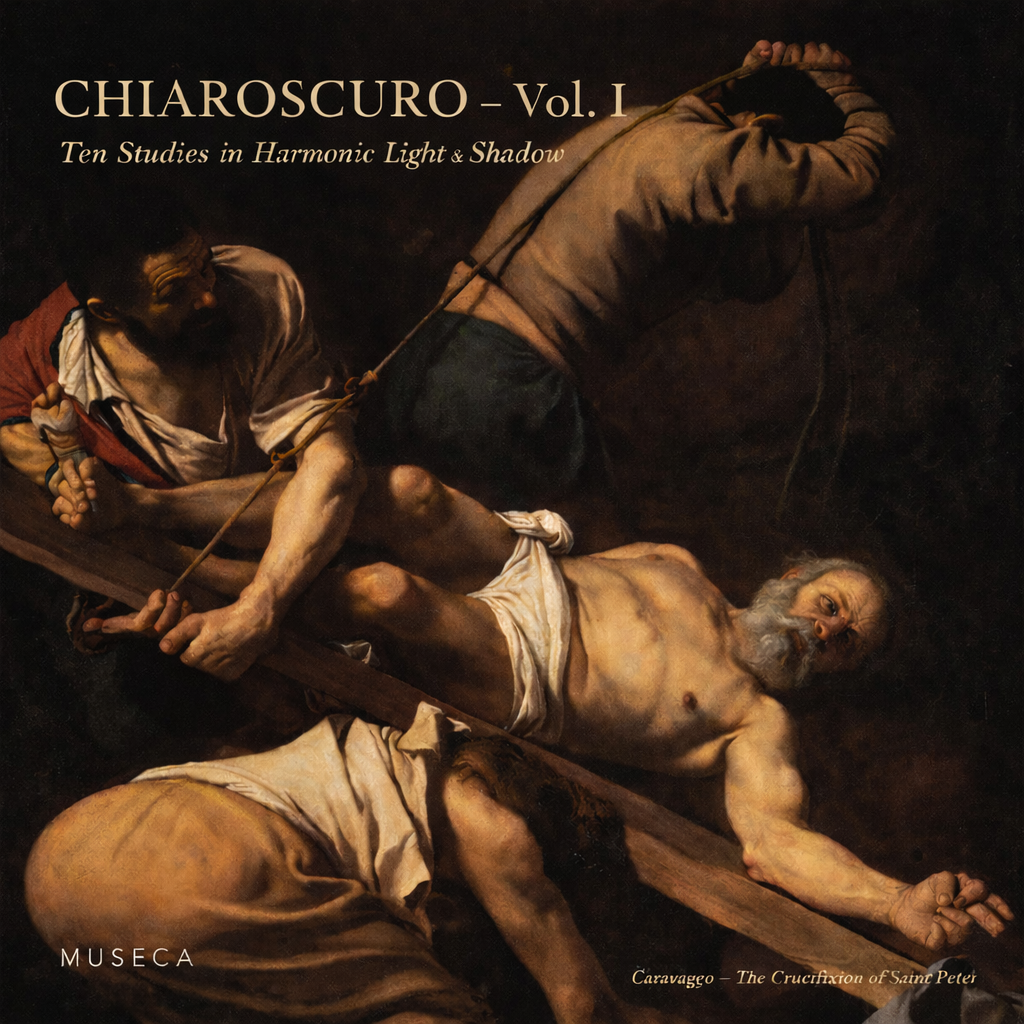
CHIAROSCURO — Vol. I
Ten Studies in Harmonic Light & Shadow
Chiaroscuro is a technique born in the visual arts, most famously associated with Renaissance and Baroque painting, where dramatic contrasts of light and darkness are used to create depth, focus, and emotional intensity. In the hands of painters such as Caravaggio, light does not merely illuminate—it interrupts, exposes, and carves form out of shadow. Darkness is not absence, but pressure. Meaning emerges from the tension between the two.
This album applies that same principle to music.
In sound, chiaroscuro is expressed through harmonic contrast: consonance set against dissonance, major against minor, stability disrupted by tension, sound framed by silence. A chord feels brighter when it emerges from shadow. Resolution feels more powerful when it has been delayed, distorted, or threatened. In music, as in painting, depth is created not by continuous brightness, but by opposition.
CHIAROSCURO — Vol. I explores chiaroscuro as a series of harmonic events. Each of the ten studies is built around a single chord progression designed to dramatize contrast in its most direct form—light interrupted by darkness, darkness pierced by light. These pieces are concise, focused, and intentional, treating harmony itself as the primary expressive force rather than melody or narrative development.
The harmonic language of Vol. I is often abrupt and architectural. Progressions descend, detour, fracture, recover, and sometimes fall silent altogether. The influence is distinctly Baroque in spirit: light arrives suddenly, shadows are deep and unapologetic, and contrast is foregrounded rather than softened. Silence is treated as a structural element, functioning as the deepest form of shadow against which sound gains clarity.
This volume is not about atmosphere or gradual transformation. It is about contrast in motion—how harmonic light and shadow interact through tension, rupture, and resolution. Each study functions as a focused canvas, revealing how even the simplest progression can acquire expressive power when brightness and darkness are allowed to confront one another.
Select a track below to explore these ten harmonic studies in light and shadow.
Liner Notes
Spotlight
Concept: Major vs. Diminished (Bright → Dark → Bright)
Progression: C – Cdim – C
Chiaroscuro Role: Instant illumination → shadow → restoration
Narrative Function: Opens the album by establishing contrast as the core language
This opening study establishes the album’s central premise: contrast as structure. The music is built on the immediate alternation between a stable major tonic and its diminished counterpart. By darkening the tonic without leaving it, the harmony behaves like a beam of light that is momentarily cut off rather than redirected elsewhere. Compositionally, the piece is conceived as a minimal-movement experiment: how little harmonic distance is needed to create a strong sense of chiaroscuro. The return to C is not a resolution earned through modulation, but a restoration created by the memory of darkness that briefly occupied the same harmonic space.
The Detour
Concept: Delayed Resolution (Shadow Before Light)
Progression: G7 – A♭7 – C
Chiaroscuro Role: Shadow before arrival
Narrative Function: Introduces suspense and narrative misdirection
Here, delayed resolution becomes the main source of shadow. Instead of allowing the dominant to resolve directly to the tonic, the harmony makes a chromatic diversion through a secondary dominant that temporarily obscures the approach. The ear anticipates the arrival on C, is diverted into a darker region, and then experiences the actual resolution as warmer and more satisfying. In compositional terms, the piece focuses on voice-leading continuity so that the detour feels inevitable rather than gratuitous. The chiaroscuro arises from expectation and denial: light appears more radiant because it was postponed and filtered through harmonic darkness.
Clouded Sun
Concept: Major to Parallel Minor (Shifted Illumination)
Progression: C – Am – F – G – C → C – A♭ – Fm – G – C
Chiaroscuro Role: Emotional shading
Narrative Function: First sustained emotional ambiguity
This study presents a familiar progression in two different emotional climates. The first pass is cast in bright major colors, while the second reinterprets the same structural path through parallel minor and borrowed harmonies. Nothing changes in the fundamental design—only the quality of light. The composition treats harmony as a filter laid over the same scene: what once felt open and optimistic now carries a muted, veiled quality. Technically, the piece highlights how substitution and mixture can re-color an identical framework, demonstrating that chiaroscuro in harmony often arises not from new material, but from a change in how existing material is illuminated.
Chromatic Descent
Concept: Chromatic Descent (Shadow Pulling Down)
Progression: C – C/B – Am – A♭ – G
Chiaroscuro Role: Gravitational darkness
Narrative Function: Marks the album’s descent phase
In this piece, the bass line itself becomes the agent of darkness. A chromatic descent, step by step, gradually pulls the harmony downward, even as the upper voices retain a lyrical or consoling character. The sense of inevitability is central: the listener feels the floor sliding lower with each chord, not through sudden shocks, but through an unbroken downward motion. Compositionally, the study is built around this gravitational pull, allowing tension to accumulate in the bass while the surface remains comparatively calm. The eventual lift back toward the dominant and implied resolution gains its poignancy from the journey’s depth rather than its length.
Black Slash
Concept: The Tritone Axis (Extreme Shadow)
Progression: C – F♯ – C
Chiaroscuro Role: Rupture / violent disjunction
Narrative Function: Album’s harmonic abyss and fulcrum
This is the album’s most extreme gesture of shadow. The relationship between C and F♯ is treated not as a passing dissonance, but as a structural axis across which the music violently pivots. There is almost no sense of travel, only impact: the harmony does not move through a progression, it is torn between two irreconcilable poles. The composition emphasizes this by using sharp rhythmic attacks, abrupt silences, and minimal intermediate material. Technically, “Black Slash” demonstrates how the tritone can function as a harmonic fault line, turning contrast into rupture. The chiaroscuro here is not shading but incision—a sudden cut of black across an otherwise stable field.
After the Storm
Concept: Lush Romantic Light Over Shadow
Progression: C – A7 – Dm – G7 – Cmaj7
Chiaroscuro Role: Radiance after violence
Narrative Function: Emotional and harmonic recovery following rupture
This study represents the return of light after the album’s most violent disruption—but a light tempered by what has preceded it. Secondary dominants introduce pockets of tension that recall earlier turbulence, yet they are voiced and paced to soothe rather than threaten. The harmonic motion leads toward a C major seventh sonority, whose extended consonance conveys warmth and openness without naïve simplicity. In composing this piece, the aim is to let dissonance serve as gentle shading around an essentially luminous center. Chiaroscuro takes the form of remembered pain: the storm is over, but its outline still softens the edges of the restored harmony.
Breath Arc
Concept: The Barber Arch (Tension → Release → Return)
Progression: Am – F – Dm – E – Am
Chiaroscuro Role: Controlled swell and retreat
Narrative Function: Intimate inward turn after recovery
“Breath Arc” is constructed as a single inhalation and exhalation in minor mode. The harmony rises cautiously from tonic toward greater tension around the dominant, then subsides back to its starting point without grand declaration. Dynamics, voicing, and pacing are carefully restrained so that nothing feels forced or rhetorical. The technical focus is on shaping a continuous curve rather than discrete events: chiaroscuro appears as gentle inflection, not contrast by shock. In this context, minor is not cast as despair but as introspection, with the arch form suggesting that emotional intensity can crest and recede without requiring a dramatic change of state.
Flicker
Concept: Oscillating Light and Shadow
Progression: C – E♭ – C – A♭ – C
Chiaroscuro Role: Unstable equilibrium
Narrative Function: Sustains tension without collapse
This piece explores harmonic chiaroscuro through repetition interrupted by shadow. The tonic C repeatedly re-establishes itself, but is continually visited by borrowed chords that temporarily darken the harmonic field. Rather than driving toward a destination, the music remains suspended in a cycle of reassurance and disturbance. Compositional emphasis is placed on pattern and pulse; the borrowed chords do not signal modulation, but momentary eclipses of the tonic’s brightness. The chiaroscuro here is that of a candle flame in a drafty room—always present, always threatened, never fully extinguished.
From One to Many
Concept: The Mahler Expansion (Texture-Driven Chiaroscuro)
Progression: C (solo line) → C – Am – F – G – C (tutti)
Chiaroscuro Role: Scale as illumination
Narrative Function: Expansion after instability; light grows by multiplication, not force
In this study, the harmonic language remains intentionally familiar while texture becomes the primary vehicle of contrast. The music begins as a solitary melodic voice, exposed and intimate, and gradually blossoms into a full ensemble treatment of the same underlying progression. The compositional challenge is to preserve clarity as the scoring thickens, ensuring that the listener can feel the growth in scale without losing the sense of origin. Chiaroscuro operates here through density: the journey is not from dark harmony to bright harmony, but from a small source of light to a broad field of illumination generated by many voices sharing the same harmonic space.
Negative Space
Concept: Silence as Shadow
Progression: C – (rest) – Fm – G – C
Chiaroscuro Role: Absence defining presence
Narrative Function: Philosophical closure — meaning revealed through what is withheld
The final piece treats silence as an active participant in the harmony. A sounded chord in C is followed not by another chord, but by a deliberate gap in which the listener’s ear continues the line internally. When the music returns, it does so in a darker hue with F minor and a gentle move toward G, before settling into a quiet C that feels more accepted than resolved. Compositionally, the focus is on restraint: dynamics remain low, textures sparse, and pacing unhurried. The chiaroscuro here is conceptual as much as sonic—negative space frames the remaining tones, reminding the listener that what is not heard can be as structurally significant as what is.
Playlist
- Spotlight Museca 3:19
- The Detour Museca 3:25
- Clouded Sun Museca 3:39
- Chromatic Descent Museca 4:59
- Black Slash Museca 3:39
- After the Storm Museca 3:30
- Breath Arc Museca 3:08
- Flicker Museca 3:46
- From One to Many Museca 3:13
- Negative Space Museca 2:10