Introduction
Ennio Morricone (1928–2020) stands among the most influential screen composers in the history of cinema—an artist whose music did not merely accompany images, but reshaped how audiences feel time, silence, landscape, and fate. Over a career spanning decades and an extraordinary volume of work across film and television, he proved that a score could be simultaneously popular and rigorous: memorable themes built with a composer’s discipline, orchestration that treated timbre as storytelling, and dramatic pacing that often made the music feel like a character with its own moral authority.
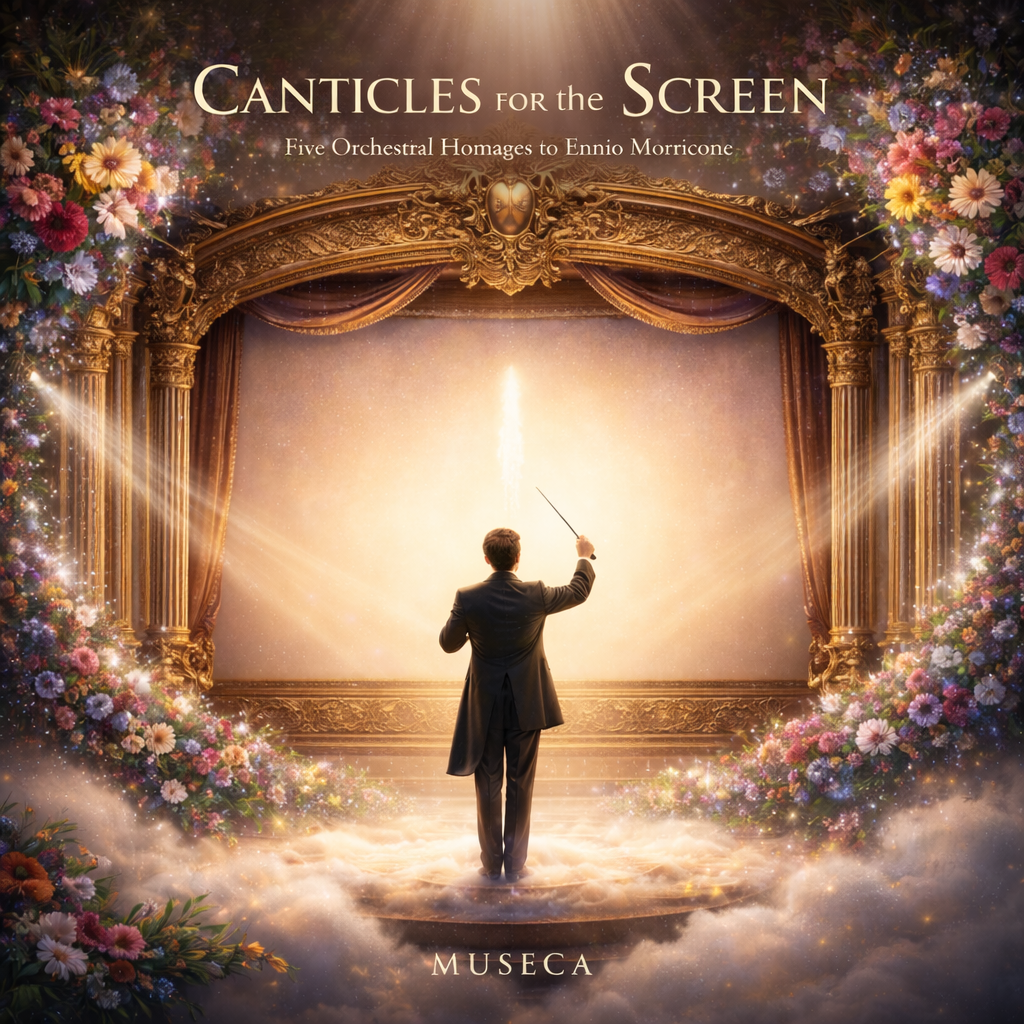
This EP, Canticles for the Screen, is an original, lyrical-orchestral homage to Morricone’s legacy—written in deep admiration and without quotation or replication. Its purpose is simple: to honor one of the greatest composers of all time by celebrating the craft principles that made his voice unmistakable—melody that feels inevitable, emotional clarity achieved through restraint, and a fearless willingness to let a single sound carry an entire world.
The five canticles are designed to travel through four essential areas where Morricone’s genius became definitive. First is the Leone Western cycle, the iconic public image of Morricone: stark horizons, ritual pacing, and unforgettable sonic signatures that turned minimal gestures into myth. Second is the sacred and lyrical tradition, where he elevated melody into something devotional—music that could feel like prayer, mercy, or transcendence. Third is his extraordinary gift for nostalgia and intimacy in the Tornatore collaborations, where the long melodic line becomes memory itself—tender, inevitable, and quietly overwhelming. Fourth is his command of international prestige scoring, where darker architecture, orchestral weight, and controlled tension demonstrated his ability to meet the highest cinematic scale without abandoning human vulnerability.
Across all of these worlds, Canticles for the Screen places the oboe at the center as the album’s narrator—an instrument capable of carrying the Morricone virtues of breath, fragility, and dignity. Each track is conceived as a self-contained scene, yet together they form a unified statement: a set of modern canticles written for the cinematic imagination, offered in gratitude to a composer whose work continues to define what film music can be.
Liner Notes
This EP is written as five cinematic “prayer-scenes” — not quotations, not recreations, but original compositions shaped by Morricone’s most enduring disciplines: melody that behaves like destiny, timbre that functions as character, and orchestration that understands silence as a dramatic instrument. Across the cycle, the oboe serves as the moral narrator — intimate, human, and unwavering — while strings, choir, guitar color, and brass architecture expand the frame around it. Each canticle occupies a different Morricone territory, yet all five share the same credo: a small motif can carry an entire world when it is voiced with conviction.
Canticle I: The Long Line (Main Theme)
The opening canticle establishes the EP’s signature language: a four-note idea delivered as a breath rather than a statement. The oboe enters alone, as if testing the air, and the orchestra answers gradually—strings first, then choir as a distant halo. The construction is deliberately ritualistic: each layer arrives like a character stepping into frame. The emotional center is not spectacle, but inevitability—music that does not chase the image, but becomes the image’s internal spine.
Canticle II: Dust and Mercy (Leone Cycle)
This is the wide landscape—Leone’s stark geometry—filtered through lyricism instead of swagger. A dry guitar pulse and restrained percussion create the horizon line, while the oboe confesses privately over the top, turning the “western” profile into something elegiac and human. The orchestration keeps negative space intact; the score breathes between gestures, allowing tension to accrue through restraint rather than density. It is less a duel than a memory of a duel.
Canticle III: Lumen of the Sanctuary (Sacred / Lyrical)
A prayer-piece in the strictest sense: melody first, resonance second, drama last. The oboe sings in long arcs, supported by warm strings that move with slow harmonic gravity. The choir is not theatrical—more like architecture—entering as a soft vault of sound above the orchestra. The harmonic motion favors gentle, devotional resolution: the feeling is not triumph, but consolation.
Canticle IV: The Projector Remembers (Tornatore Memory)
Here, the “room” is built from piano and strings—close, tactile, and warmly lit—while the oboe becomes the thread that ties one recollection to the next. The cue expands with quiet inevitability: not a sudden crescendo, but a gradual widening of the frame, as if nostalgia itself is opening the door. The orchestration prioritizes tenderness over grandeur, letting the melody feel discovered rather than performed.
Canticle V: The Engine of Fate (International / Prestige)
The darkest canticle of the set: a machinery of low strings and weighty brass, paced with architectural patience. An ostinato turns beneath the surface like gears, while the oboe insists on remaining human inside the system—an individual voice set against institutional momentum. The build is controlled and cumulative, and the release arrives not as sentimentality, but as a dignified chorale: gravity, not spectacle, in the final word.
Bonus Canticle: Paradiso Afterglow
A coda devoted to the radiance of memory—where melody is allowed to be unapologetically beautiful. Piano arpeggios and strings carry the emotional frame, with the oboe (and occasional violin color) acting as the inner narrator: the part of the self that remembers even when the picture fades. The ending lingers deliberately, as if refusing to close the album too quickly—because some stories, once re-lit, deserve to dim slowly.
Playlist
- Canticle I: The Long Line (Main Theme) Museca 4:19
- Canticle II: Dust and Mercy (Leone Cycle) Museca 2:45
- Canticle III: Lumen of the Sanctuary (Sacred / Lyrical) Museca 3:22
- Canticle IV: The Projector Remembers (Tornatore Memory) Museca 2:15
- Canticle V: The Engine of Fate (International / Prestige) Museca 2:34
- Bonus Canticle: Paradiso Afterglow Museca 3:20