
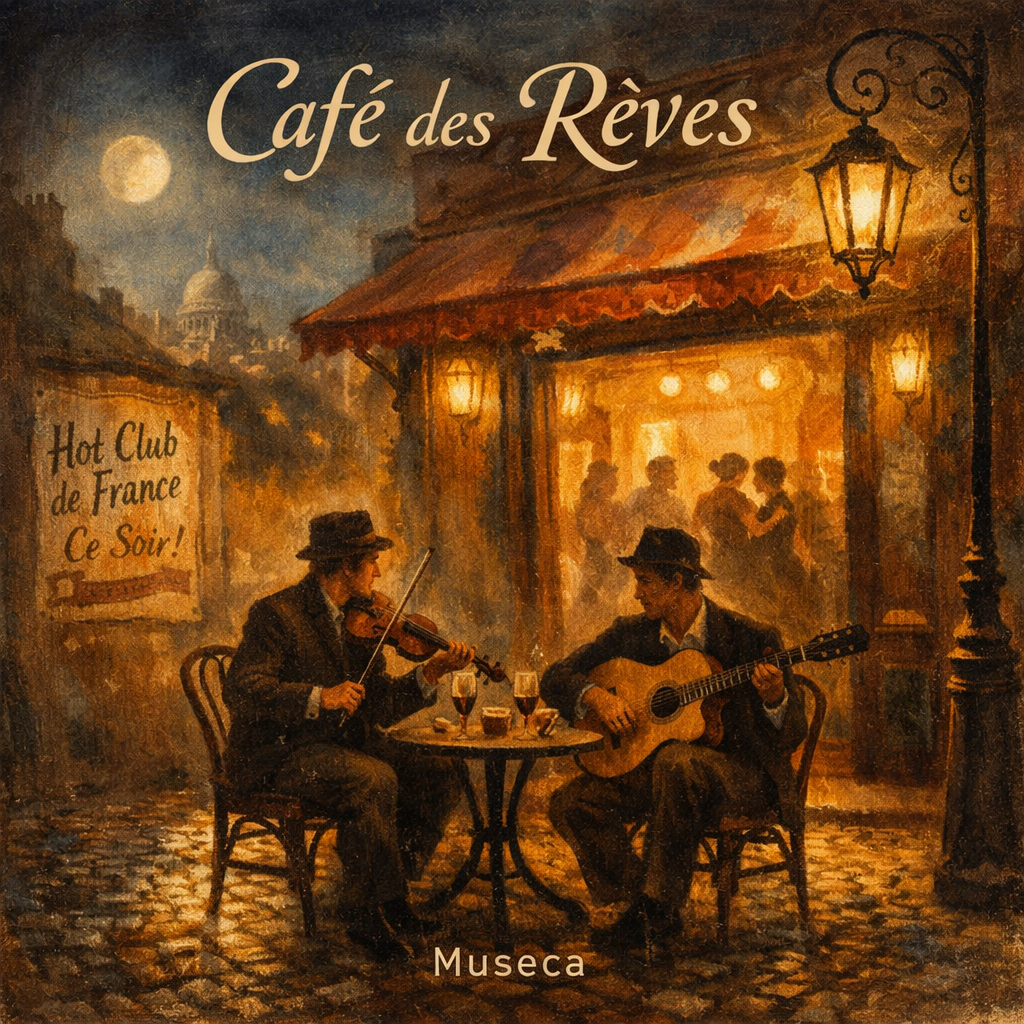
Café des Rêves
A Tribute to Django Reinhardt, Stéphane Grappelli, and the Golden Age of Parisian Swing
In the glow of a Parisian café, somewhere between cigarette smoke and candlelight, a new kind of music was born. It was 1934, and two musical visionaries — Django Reinhardt, a Romani guitarist with only two functional fingers on his left hand, and Stéphane Grappelli, a classically trained violinist with the soul of a jazzman — came together to form the Quintette du Hot Club de France.
It was one of the first all-string jazz ensembles in history. No drums. No horns. Just pure rhythmic fire and lyrical elegance. Their sound — gypsy jazz, or jazz manouche — defied the conventions of American swing, blending Django’s Romani roots and dazzling guitar technique with Grappelli’s Parisian finesse and improvisational violin.
What they created wasn’t just music. It was conversation, seduction, rebellion. It was Paris itself — sultry, syncopated, full of life and shadow.
Café des Rêves is a love letter to that sound.
Six of its tracks are written in the authentic style of Django and Grappelli: fast-paced waltzes, smoky nocturnes, and playful exchanges between violin and guitar. Two final tracks take that spirit into the modern day, fusing gypsy jazz with ambient textures and cinematic echoes — proof that this music, though rooted in the past, still dances forward.
These are songs for street corners and stairwells, for midnight cafés and long walks after heartbreak. Songs for dreams — light ones, dark ones, Parisian ones.
So pour a glass. Dim the lights.
And let Café des Rêves carry you to a place where the music never ends — it simply lingers in the air.
Liner Notes
Rue de Minuit
A swinging dialogue beneath crooked lamplight. The violin wanders, the guitar responds. It’s midnight in Montmartre, and the city is quiet except for this gentle conversation. Footsteps fade into melody.
Brume sur la Seine
A waltz wrapped in fog, drifting slowly across the water. The violin leans into each note like a question left unanswered. Melancholy and motionless — a memory the river refuses to carry away.
Pompe d’Or
The rhythm itself becomes the melody. La pompe — crisp, golden, alive — dances with joyous precision. This is the heart of the gypsy swing engine, and it pulses like laughter at a crowded table.
Valses sans Voix
A song with no lyrics and nothing more to say. The violin whispers through its bow, tracing emotion into the air like smoke rings. A waltz for what couldn’t be spoken, only felt.
Tzigane du Marché
A playful rush through a lively market square. Melodies dodge and weave between stalls, flirt between string lines, and tumble over fruit baskets and laughter. Music with one foot off the ground.
Lune à Travers les Cordes
Moonlight filtered through strings. The notes move slowly, cautiously, as if they’re remembering rather than performing. It’s a nocturne that leaves more space than sound — and somehow says more.
Nuages Digitales
A modern echo of Django’s most poetic work. Ambient textures shimmer behind a suspended melody. Electric violin and soft delay stretch the clouds across time. The gypsy spirit reimagined, not replaced.
Echoes of Montmartre
The last cup of coffee, the last turn down a familiar street. This farewell doesn’t resolve — it drifts. Notes flicker like candlelight in an empty café, while Paris continues just beyond the frame.
Playlist
- Rue de Minuit (Midnight Street) Museca 2:55
- Brume sur la Seine (Mist on the Seine) Museca 3:25
- Pompe d’Or (Golden Rhythm) Museca 3:04
- Valses sans Voix (Waltzes Without Words) Museca 5:07
- Tzigane du Marché (Gypsy of the Market) Museca 2:39
- Lune à Travers les Cordes (Moon Through the Strings) Museca 3:55
- Nuages Digitales (Digital Clouds) Museca 4:57
- Echoes of Montmartre Museca 3:14