
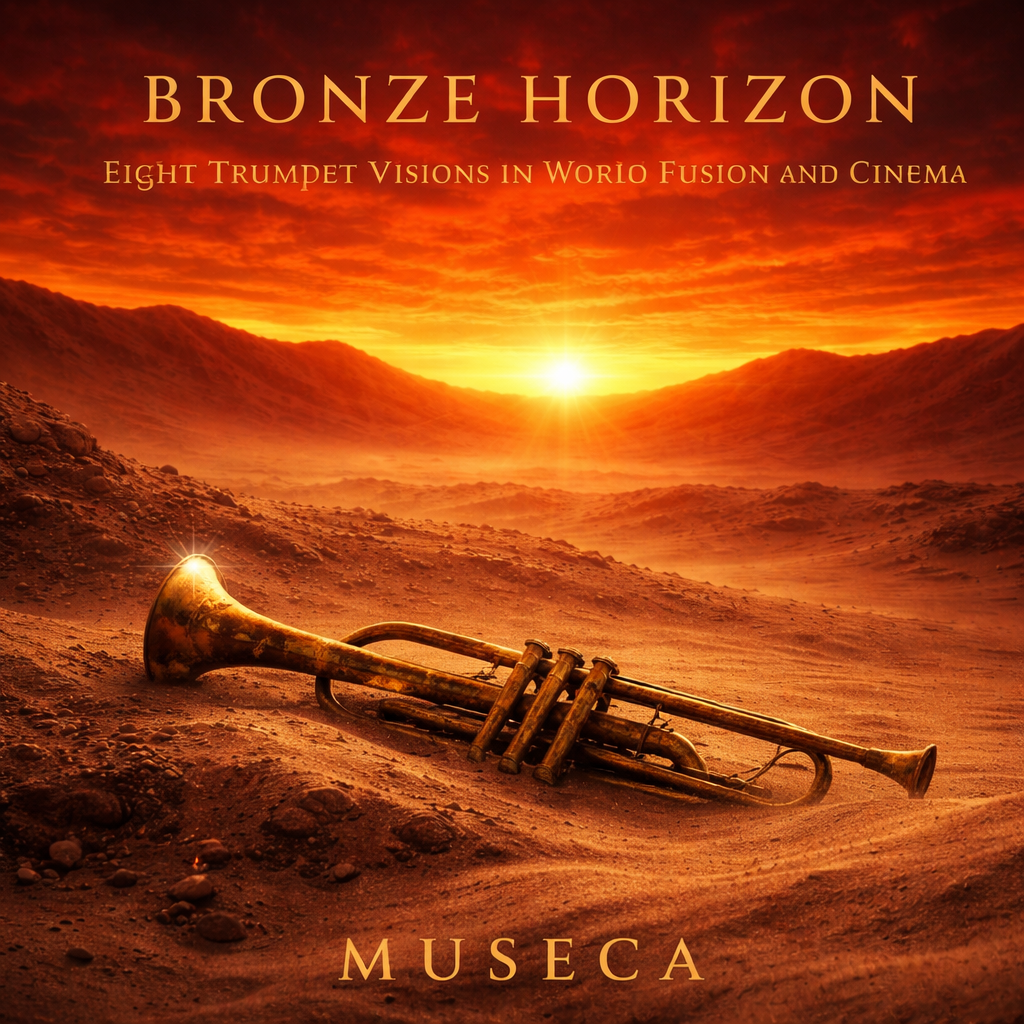
Bronze Horizon is built upon the meeting of two musical worlds: world fusion and cinematic instrumental music. These were chosen not as surface styles or passing colors, but as the architectural foundations of the album itself. World fusion gives the music its ritual depth, modal atmosphere, hand-played percussion, and ancient earthbound pulse. Cinematic music gives it breadth, emotional scale, modern resonance, and the feeling of landscape, distance, and revelation. Together, these two genres create a language spacious enough for grandeur, yet intimate enough for prayer.
At the center of that language stands the trumpet as the solo instrument. The trumpet was chosen because it can inhabit both worlds with unusual authority. It can sound ceremonial, mournful, radiant, solitary, or exalted. It can rise like a call across desert air, sing like a human voice in meditation, or expand into a broad cinematic line that seems to open the sky. In this album, the trumpet is not treated merely as a brilliant brass instrument, nor simply as a heroic lead voice. It serves instead as the album’s traveler, witness, and guide: the single voice moving through changing spaces of earth, light, memory, and ascent.
The supporting world around the trumpet reflects that dual foundation. From the world-fusion side come oud, ney, frame drum, darbuka, modal bass patterns, and drone-based textures that root the music in ritual and elemental atmosphere. From the cinematic side come piano, synth pads, ambient guitar, deep percussion, and expansive harmonic space, allowing the music to widen beyond the intimate and into the visionary. The result is not a split album of two unrelated genres, but a unified sound world in which each track leans differently while remaining part of the same emotional and sonic continuum.
A useful way to understand the album is as a narrative arc:
Gate → Prayer → Journey → Horizon → Crossing → Distance → Elevation → Crown
This is the inner design of the record. It is not merely a sequence of tracks, but a progression of states. The album begins at the threshold, in enclosed ritual space: the gate. It then turns inward toward stillness and devotion: the prayer. From there it begins to move, gathering rhythm, dust, fire, and intention: the journey. The horizon marks the first great opening, where the music begins to look outward and upward. Crossing is the moment in which the two musical worlds fully merge. Distance introduces breadth, perspective, and radiant remoteness. Elevation becomes the spiritual ascent of the voice itself. And Crown is the final arrival: not conquest, but illumination.
In that sense, Bronze Horizon should be heard as a single unfolding form. Each piece has its own atmosphere, but each also prepares the next. The album moves from earth into sky, from enclosed bronze and sand into vastness and light. Its drama is not symphonic in the traditional classical sense, but architectural all the same: a carefully shaped ascent in which world fusion provides the ground, cinematic writing provides the horizon, and the trumpet carries the listener through both.
This is what gives the album its identity. It is neither a classical trumpet concerto nor a collection of genre studies. It is a sustained hybrid vision: a trumpet-centered journey through ritual earth and cinematic sky, where ancient pulse and modern scale meet in a single expressive arc.
Liner Notes
Bronze Gate
Genre: World fusion
The album opens at the threshold. This track establishes the first element of the record’s architecture: the Gate. World-fusion language dominates here through modal writing, hand percussion, drone, and an earthbound ceremonial pulse. The trumpet does not arrive as a conquering voice, but as a summoning one—measured, watchful, and slightly veiled. This is the sound of entering sacred ground. The emotional arc begins in enclosure, mystery, and bronze-colored ritual.
Sand Prayer
Genre: World fusion
This is the album’s inward turn, the stage of Prayer. The world-fusion palette remains central, but the energy softens into stillness and devotion. The trumpet becomes more intimate here, less declarative and more human, singing over sparse modal support and suspended atmosphere. The emotional movement is not forward in a physical sense, but deeper inward. If the first track opens the gate, this one kneels just inside it.
Version 1
Version 2
Caravan of Embers
Genre: World fusion with cinematic lift
Here the album enters Journey. Rhythm becomes more pronounced, the pulse more directional, and the trumpet more active and searching. The world-fusion foundation is still primary—percussion, modal color, and ritual motion—but the piece begins to widen at the edges, hinting at cinematic scale to come. Emotionally, this is the first track of movement and resolve. The traveler has risen from prayer and begun to walk.
Horizon of Brass
Genre: Cinematic instrumental music
This track marks Horizon, the first major opening of the album. The architecture shifts outward. The cinematic genre takes the lead, giving the trumpet broader air, greater emotional lift, and a panoramic sense of space. The solitary ritual world of the first tracks now expands into distance and possibility. The trumpet grows nobler here, not abandoning its earlier depth, but allowing its line to widen toward light. The emotional arc moves from contained motion into vision.
The Line Between Earth and Sky
Genre: World fusion and cinematic instrumental music in full merger
This is the album’s hinge and its moment of Crossing. Here the two chosen genres fully meet. World-fusion texture and modal grounding remain present, but cinematic breadth now enters the same frame without separation. The trumpet stands exactly at that boundary—between dust and radiance, ritual and expanse, earth and sky. Emotionally, this is the record’s central transformation: the point at which the album ceases to alternate between two worlds and reveals that both were always moving toward union.
Version 1
Version 2
City of Distant Suns
Genre: Cinematic instrumental music with world-fusion color
This track embodies Distance. The cinematic language now leads more clearly, though the modal and world-fusion traces remain underneath the surface. The trumpet becomes more elevated and far-seeing, as though no longer traveling through immediate terrain but beholding something luminous from afar. The emotional tone is one of wonder, separation, and expanding perspective. This is not the intimacy of prayer, nor the heat of the journey, but the wide emotional field that opens after crossing.
Version 1
Version 2
Pillar of Wind
Genre: Cinematic world fusion
This is the stage of Elevation. The two genres remain fused, but everything becomes lighter, quieter, and more refined. The trumpet rises here as if carried rather than propelled, supported by atmosphere more than by weight. The piece feels spiritual, lifted, and nearly weightless. Emotionally, this is the album’s most suspended state: not arrival yet, but ascent itself. The music no longer presses forward so much as it hovers upward.
Crown of the Last Light
Genre: Cinematic world fusion finale
The album closes in Crown. This is the final radiance toward which the earlier stages have been moving. The cinematic dimension reaches its fullest breadth, but the world-fusion roots are still audible, preserving the album’s original earth-born identity even at its brightest point. The trumpet achieves its most open and exalted voice here, no longer calling from within the gate, but sounding above the horizon it has crossed. Emotionally, the ending is not triumph in a martial sense, but revelation—an arrival in light that feels earned, sacred, and complete.
Playlist
- Track 1 - Bronze Gate Museca 4:51
- Track 2 - Sand Prayer (Version 1) Museca 3:50
- Track 2 - Sand Prayer (Version 2) Museca 3:13
- Track 3 - Caravan of Embers Museca 3:24
- Track 4 - Horizon of Brass Museca 3:24
- Track 5 - The Line Between Earth and Sky (Version 1) Museca 5:01
- Track 5 - The Line Between Earth and Sky (Version 2) Museca 4:35
- Track 6 - City of Distant Suns (Version 1) Museca 3:39
- Track 6 - City of Distant Suns (Version 2) Museca 2:55
- Track 7 - Pillar of Wind Museca 5:25
- Track 8 - Crown of the Last Light Museca 4:25