
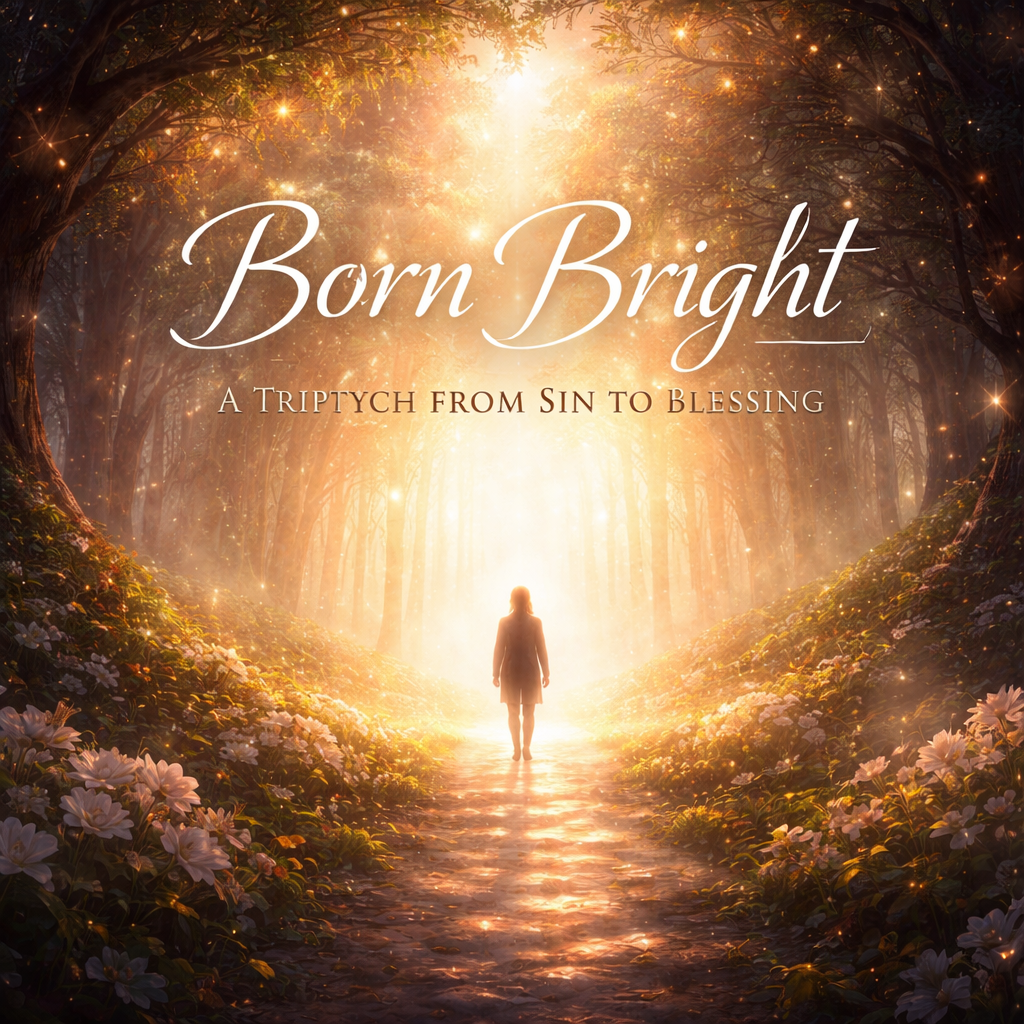
Introduction — Born Bright: A Triptych from Sin to Blessing
Born Bright is a short, four-track suite built around a single question: What changes in a life when you assume you began “wrong,” versus when you assume you began “worthy”? In the Conversations with God framework, the doctrine of original sin is less a theological detail than an operating system—one that teaches suspicion of the self, chronic unworthiness, and the idea that love (from others, from God, from life) must be earned through correction. In that story, mistakes become proof of defect. Desire becomes suspect. The inner voice turns into a courtroom.
By contrast, original blessing begins with a different premise: human beings are not fundamentally broken, but fundamentally alive, connected, and capable of returning to truth. This does not deny harm, failure, or accountability. It simply changes the emotional gravity of them. Instead of “I fell because I’m flawed,” the reframe is “I fell because I’m learning—and I can stand again without self-hatred.” Responsibility becomes clearer, not weaker, because it is no longer powered by shame. Growth becomes an act of remembering rather than a desperate attempt to become “good enough.”
The album expresses that shift without preaching by letting the music do the argument. The same musical identity appears in all three movements, but it is heard through different lenses:
Sin is constricted and vigilant—tight intervals, uneasy pulse, and harmony that feels like rules.
Turning is the moment the inner judge steps down—tension doesn’t vanish, but it becomes intelligible; the music starts moving forward.
Blessing is expansion—wider space, warmer light, and resolution that feels like arrival rather than victory.
A single motif travels through the entire triptych, gradually “retuned” from shadow to clarity. This is the point: the self is not replaced; it is reinterpreted. The bonus vocal track, “Born Bright,” gathers the whole arc into one statement—human, intimate, and direct—so the suite can be felt as both a journey and a conclusion.
If the triptych is the experience, the message is simple: you may have lived for years under the wrong light—yet nothing essential about you was ever missing. The turning is not becoming worthy. The turning is coming home.
Liner Notes
Track 1 — Sin (instrumental)
The opening movement lives inside the “accusation lens”: the subtle belief that something is wrong at the root. A low tonal gravity holds the music close to the ground, while tense intervals and an uneasy pulse suggest a life measured by rules, verdicts, and self-surveillance. The motif appears like a question that cannot be answered cleanly—because the question itself is framed to condemn. Rather than depicting evil, Sin depicts constriction: the psychological and spiritual compression that happens when worth feels conditional.
Track 2 — Turning (instrumental)
Turning is the sound of the inner courtroom emptying out. The music does not “win” against darkness; it simply stops feeding it. You hear the same motif return, but it is re-harmonized and allowed to breathe—an audible sign that identity is not changing, only the interpretation of it. The rhythm steadies, warmth enters, and forward motion becomes possible. This movement carries the album’s central idea: the shift from “prove you’re worthy” to “be honest, and choose again.” It is remorse without shame, clarity without self-punishment.
Track 3 — Blessing (instrumental)
The final movement opens like a window. The motif brightens—not by becoming “different,” but by revealing what was always latent inside it. Wider voicings, lifted motion, and luminous harmonies embody the original blessing premise: that the self begins with value, connection, and capacity. Blessing is not triumph music; it is arrival music—the feeling of returning to a home you never truly lost, and discovering that the door was never locked. What once sounded like tension becomes color; what once sounded like judgment becomes depth.
Track 4 — Born Bright (bonus vocal)
This song is the album’s thesis spoken in a human voice. The lyrics trace the emotional logic of “original sin” as lived experience—mistakes as evidence, perfection as survival, approval as a moving border—then gently undo it without argument or doctrine. The chorus lands on the album’s essential reframe: not “I became worthy,” but “I remembered what I am.” Chamber-pop intimacy keeps the message personal rather than religious, while the cinematic build mirrors the triptych’s arc in one continuous ascent: constriction, turning, release. The final lines do not claim that life is easy; they claim something quieter and stronger—that you can be accountable without cruelty, and you can come home to yourself without earning the right.
Lyrics
Verse 1
I learned to read my shadow like a sentence
To call my heartbeat evidence of fault
I wore my mistakes like heavy little medals
And held my breath to earn what I already bought
Pre-Chorus 1
But quiet has a way of telling truth
When the noise runs out of reasons to accuse
Chorus
I wasn’t born broken
I was born bright
I only forgot it
In the wrong light
So I’m laying down the gavel
I’m untying every knot
I’m not climbing into worthiness—
I’m coming home to what I’ve got
Verse 2
I chased approval like a moving border
A finish line that kept moving back
I tried to love myself by perfect posture
While fear kept writing rules across my back
Pre-Chorus 2
Then I heard my own name without the blame
And something in me softened, not ashamed
Chorus
I wasn’t born broken
I was born bright
I only forgot it
In the wrong light
So I’m laying down the gavel
I’m untying every knot
I’m not climbing into worthiness—
I’m coming home to what I’ve got
Bridge
If I fall, it doesn’t mean I’m failing
It means I’m human, learning how to stand
I can be honest without being cruel
I can be gentle, and still take my life in hand
And every breath is a turning—
From “prove it” to “be”
From “what’s wrong with me?”
To “what’s real in me?”
Final Chorus (bigger, lifted)
I wasn’t born broken
I was born bright
I only forgot it
In the wrong light
So I’m laying down the gavel
I’m untying every knot
I’m not climbing into worthiness—
I’m coming home to what I’ve got
Yes, I’m coming home to what I’ve got
Outro
Born bright…
Coming home.
Playlist
- Track 1 — Sin Museca 3:48
- Track 2 — Turning Museca 3:56
- Track 3 — Blessing Museca 3:05
- Bonus Track - Born Bright Museca 3:53