
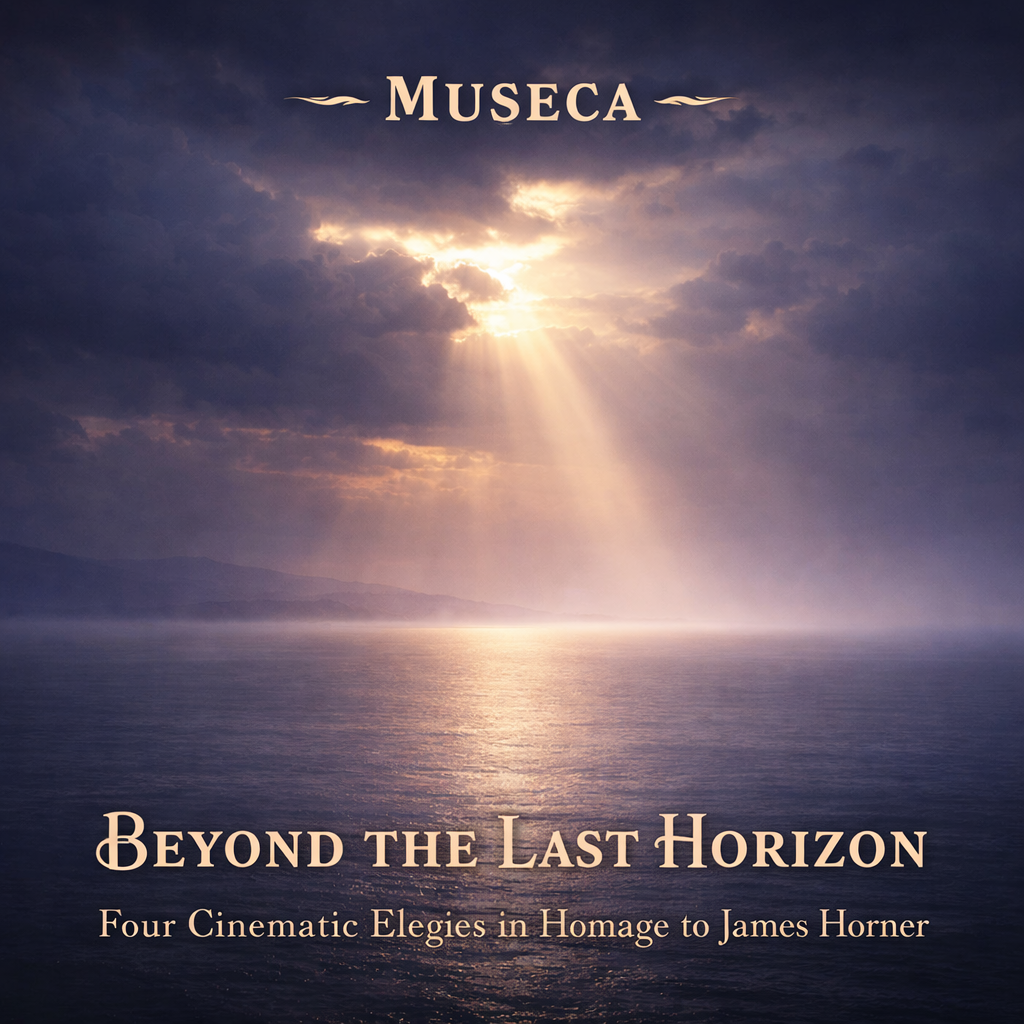
Beyond the Last Horizon: Four Cinematic Elegies in Homage to James Horner is a tribute to one of the most beloved and emotionally resonant film composers of the modern era. James Horner wrote the music for more than one hundred films across a career that stretched from the late 1970s to 2015, leaving an extraordinary legacy through scores such as Star Trek II: The Wrath of Khan, Aliens, Braveheart, Apollo 13, A Beautiful Mind, Avatar, Legends of the Fall, and Titanic. His achievement was recognized with ten Academy Award nominations, two Oscar wins for Titanic, multiple Golden Globe and Grammy awards, and, more recently, the preservation of his professional archive at UCLA for scholars and musicians to study.
Horner’s music endures because it joined symphonic sweep to emotional immediacy. He could write with grandeur, but beneath the scale there was always something deeply human: longing, tenderness, grief, wonder, memory. His scores often fused orchestra with distinctive timbral colors—voice, synth, folk instruments, choir, and carefully chosen solo lines—creating musical worlds that felt both intimate and vast. That combination made him not merely a successful film composer, but one of the defining emotional architects of cinema.
This album is especially inspired by two of Horner’s most cherished scores: Legends of the Fall and Titanic. Legends of the Fall is a sprawling, theme-rich work associated with open landscapes, familial destiny, noble sorrow, and the grandeur of the natural world; commentators have emphasized its sweeping orchestral writing and the warmth added by featured solo colors such as fiddle, panpipes, and shakuhachi-like flute. Titanic, by contrast, is remembered for its intimate blend of voice, synth, piano, and orchestra, and for Horner’s own deliberate use of wistful modal sadness rather than a conventional “period epic” sound. Together, these two scores reveal the two emotional poles that shape this homage: earth and water, inheritance and memory, sweep and intimacy.
The structure of Beyond the Last Horizon follows that dual inspiration. The four main tracks are conceived as a continuous emotional arc: land, love, loss, and transcendence. The opening track draws from the expansive pastoral nobility associated with Legends of the Fall—the sense of distance, family, and destiny carried by broad lyrical themes and warm orchestral color. The second turns toward the more intimate world associated with Titanic: tenderness, suspended longing, and the feeling of memory floating above water. The third deepens into tragedy, reflecting Horner’s gift for turning sorrow into something immense and dignified rather than merely dark. The fourth rises into remembrance and light, offering the kind of emotional release for which his finest finales are so admired. The bonus track then serves as a private postlude: a soft piano-and-strings elegy inspired by the intimate tenderness listeners so often associate with Titanic. This track-by-track design is an original interpretive homage rather than a reproduction of Horner’s themes.
Above all, this album is offered in gratitude. James Horner understood that film music could be majestic without losing vulnerability, and beautiful without losing seriousness. He wrote melodies that seemed to remember us before we heard them. Beyond the Last Horizon is therefore not only a tribute to his style, but to his deeper gift: the ability to make music feel like memory, loss, love, and wonder all at once.
Liner Notes
The Distant Ridge
The album opens with distance, land, and inheritance. This piece was shaped in the spirit of the broad emotional landscapes that James Horner so often painted with such dignity: wide melodic arches, warm strings, noble brass, and a sense that the horizon itself is carrying memory. The music suggests a place older than the listener, a place marked by family, loss, and endurance. It is not meant to describe one scene, but rather the feeling of standing before a vast landscape and realizing that the heart has its own geography.
Version 1
Version 2
Heart Upon the Water
Here the album turns inward. The scale becomes more intimate, more suspended, more tender. Wordless voice, gentle piano, soft synth, and transparent strings create a floating emotional world in which longing is more powerful than declaration. This track draws inspiration from the oceanic sadness and lyrical restraint associated with Horner’s most beloved romantic writing. It is about love remembered through distance, as though the music itself were drifting across water toward something it can no longer hold.
The Sinking of Stars
This is the album’s darkest movement, though not its most hopeless. Low strings, restrained brass, and a slow-building orchestral weight give the music a sense of catastrophe unfolding with tragic inevitability. Yet the aim is not spectacle. The grief here is meant to feel immense, dignified, and human. In keeping with the finest tradition of Horner’s dramatic writing, sorrow is never reduced to noise. It becomes something solemn, almost sacred, as if the heavens themselves were falling silently into the sea.
Beyond the Last Horizon
The title track serves as the culmination of the journey. After land, love, and loss, this final main piece seeks light—not bright triumph, but a luminous acceptance. The music gathers the emotional threads of the earlier tracks and lets them rise into a more spacious, transcendent world. Voice, strings, harp, and piano open outward together, as though memory were no longer a burden but a radiance. This is the album’s answer to grief: not erasure, but transformation.
A Memory on Still Water
The bonus track is offered as a private farewell. Where the earlier pieces speak in wider cinematic gestures, this one returns to the simplest and most intimate language: flowing piano, soft strings, and quiet breath between phrases. It was conceived as a final remembrance in the spirit of Horner’s most delicate and tender writing, where beauty seems almost too fragile to touch. The piece closes the album not with grandeur, but with gentleness, as though one last image were resting undisturbed on the surface of the water.
Playlist
- Track 1 - The Distant Ridge (Version 1) Museca 2:47
- Track 1 - The Distant Ridge (Version 2) Museca 2:55
- Track 2 - Heart Upon the Water Museca 2:35
- Track 3 - The Sinking of Stars Museca 2:49
- Track 4 - Beyond the Last Horizon Museca 3:04
- Bonus Track - A Memory on Still Water Museca 2:29