
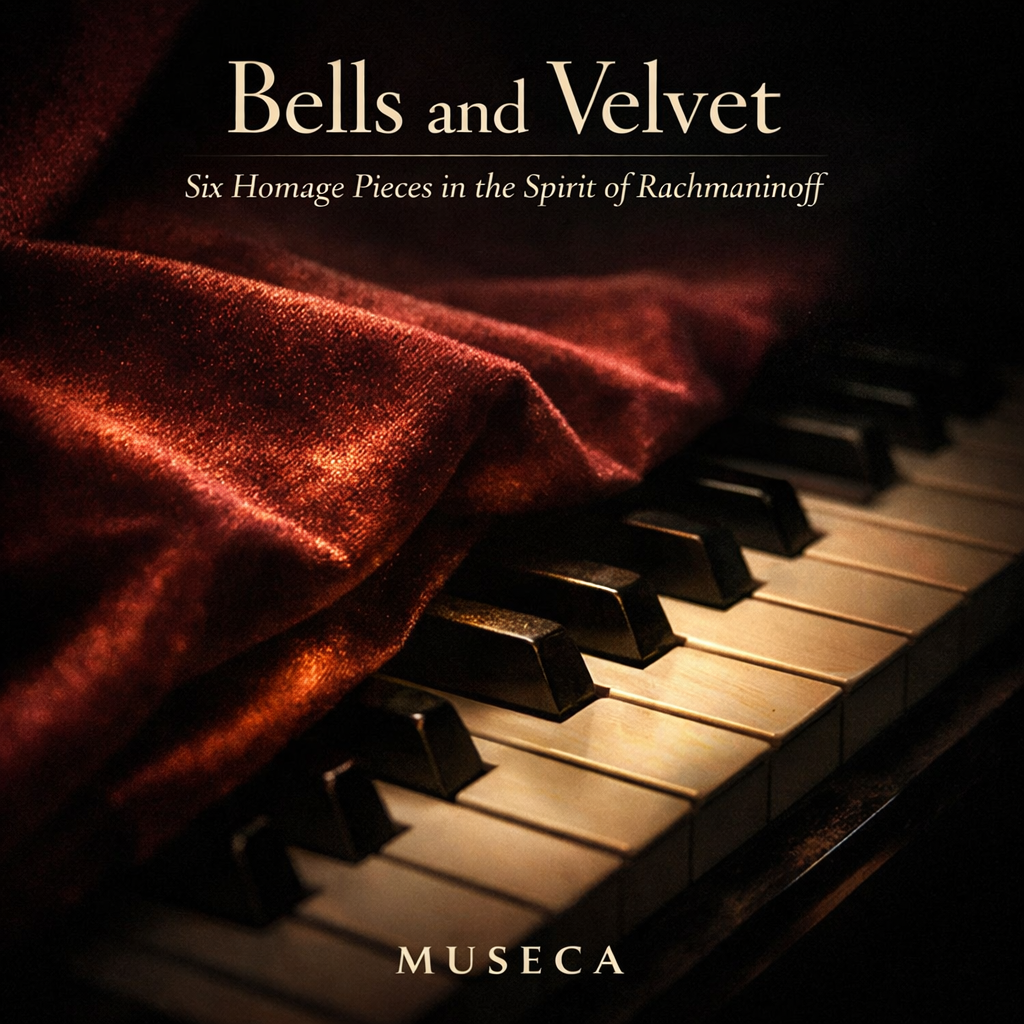
Sergei Rachmaninoff’s music is often described as “romantic,” but that word is far too small for what he actually engineered. His art is a disciplined architecture of emotion: long melodic arcs that breathe like a human voice, harmony that remains tonal yet constantly deepened by chromatic inner motion, and climaxes that feel inevitable because they are structurally earned. This homage album is built on that same premise—music that does not merely sound lush, but is constructed to carry longing, memory, and radiance across time.
Rachmaninoff’s signature begins with melody. His themes are rarely short hooks; they unfold in extended phrases, often rising in slow waves before yielding to a downward “sigh” resolution—appoggiaturas and suspensions that delay closure until the listener has fully leaned into the tension. Underneath those melodies sits his harmonic genius: functional progressions with relentless voice-leading craft. Chords change not by abrupt novelty but by semitone shifts inside the texture, allowing the ear to feel both stability and ache at once. This album adopts that method—clear tonal centers, but saturated with suspensions, modal mixture, and pivoting diminished harmonies that turn corners without breaking the emotional line.
Equally essential is Rachmaninoff’s concept of sonority. As a pianist-composer, he treated the piano as a cathedral instrument: bell-like bass tolling, wide-spanned chord towers, and layered voicing where a singing top line floats above inner counter-melodies and a destiny-heavy bass. The piano-led tracks here honor that “three-layer” craft, using resonance and register as orchestration. In the orchestral pieces, the same principle expands outward: strings become an ocean of sustained feeling; clarinet and horn carry the human voice; brass is reserved for coronation moments rather than constant force. This is especially aligned with the expressive world of the Second Symphony—warmly blended orchestral color, patient pacing, and climaxes built by accumulating layers rather than simply turning up volume.
Finally, this album embraces one of Rachmaninoff’s most profound techniques: the delayed truth. His music often withholds its fullest statement until late—returning a theme in transformed harmony or brighter mode, as if the piece has traveled through grief to earn its light. Several tracks here follow that same dramaturgy: a minor-key gravity that gradually opens into hard-won radiance, with codas that do not “end” so much as release. The result is not imitation, but a respectful continuation of a language—one where craftsmanship and vulnerability are inseparable, and where the listener is carried, wave by wave, into the only kind of resolution Rachmaninoff truly trusted: the kind that has been suffered into being.
Liner Notes
Track 1 — Piano Solo Prelude: Bells in the Snow
The album opens in the most unmistakable Rachmaninoff terrain: the piano as cathedral. A low-register bell toll anchors the piece while the upper voice sings in long-breath phrases, shaped by sighing appoggiaturas and delayed resolutions. The harmony remains firmly tonal, yet constantly “wounded” and colored by chromatic inner motion—semitone shifts inside sustained chords that keep the listener suspended between stability and ache. The climaxes arrive in waves rather than jolts, building density, register, and harmonic pressure until the music briefly turns toward major light, then returns to silence as if the sound itself were a memory fading into snow.
Track 2 — Orchestral Adagio: Sea of Strings
This movement is an homage to the emotional engine of Rachmaninoff’s Symphony No. 2: long melodic arcs carried by warm strings, with lyrical wind lines that feel like private speech. Instead of constant drama, the writing relies on patience—slow harmonic rhythm, deeply voiced consonance, and suspensions that resolve only after the ear has fully committed to the tension. Orchestration grows by layering: strings first, then clarinet warmth, then horn nobility, culminating in a climax that feels inevitable because it has been prepared with restraint. The ending releases rather than concludes, letting resonance do the final storytelling.
Track 3 — Piano + Orchestra Concerto Homage: Cathedral in Motion
Here the album steps into the psychological world of Piano Concerto No. 2—not by quotation, but by adopting its emotional mechanics. The piano enters with bell-like proclamations, broad and weighted, as if summoning the entire orchestra from silence. A sweeping theme unfolds with the characteristic Rachmaninoff blend of melancholy and lift, while the harmony travels through long dominant corridors—sustained tension that intensifies through inner suspensions and sequential drive. A cadenza-like passage turns inward, allowing the soloist to speak in layered voicing and rolling resonance before the orchestra returns in a vast surge. The arrival in major is cathartic, not celebratory—a release earned through architecture.
Version 1
Version 2
Track 4 — Vocalise-Style Lyric Center: Wordless Radiance
At the heart of the album is a piece that treats the orchestra as a single singing body. The melody is designed like a human voice—stepwise, tender, and inevitably rising toward a single radiant crest. Strings carry the line with operatic patience while the piano supplies an arpeggiated halo, turning harmony into light rather than argument. The technique here is pure Rachmaninoff: beauty built from suspensions, warmth achieved through voicing, and emotion sustained by long phrases that refuse to fragment. The final measures fade like a benediction, leaving only the afterglow.
Track 5 — Orchestral Tone Poem: The Iron Bell
This is the album’s darkest orchestral statement: a pure instrumental narrative shaped by bell tolls, deep bass gravity, and an austere motif passed between strings and clarinet. The motion comes from voice-leading rather than spectacle—chromatic inner lines threading through functional harmony, tightening the emotional coil without breaking tonal clarity. Climaxes are constructed in Rachmaninoff’s preferred way: repeated surges, each larger than the last, achieved by expanding register, thickening orchestration, and intensifying harmonic rhythm. The coda does not resolve triumphantly; it settles into solemn glow, as though the music has reached acceptance rather than victory.
Track 6 — Concerto-Style Finale: Coronation After the Storm
The closing track gathers every dialect spoken earlier—piano resonance, orchestral ocean, bell gravity, and the earned radiance that defines Rachmaninoff’s greatest endings. The piano drives surging rhythmic energy while horns introduce a noble theme that feels both public and intimate, supported by sweeping strings and richly voiced harmony. The climax is a coronation moment in the Rachmaninoff sense: not bombast, but grandeur made unavoidable by long preparation and controlled release. In the final pages, a quiet minor-memory passes through the glow, reminding us that in this musical world, light is never naïve—it is always hard-won, and therefore true.
Playlist
- Track 1 — Piano Solo Prelude (D minor → D major halo) Museca 2:58
- Track 2 — Orchestral Adagio (Symphony No. 2 string ocean) Museca 4:18
- Track 3 — Piano + Orchestra (Concerto No. 2 mood centerpiece) (Version 1) Museca 3:48
- Track 3 — Piano + Orchestra (Concerto No. 2 mood centerpiece) (Version 2) Museca 2:20
- Track 4 — “Vocalise” Centerpiece Museca 3:33
- Track 5 — Pure Orchestral Tone Poem Museca 2:12
- Track 6 — Concerto-Style Finale Museca 3:38