
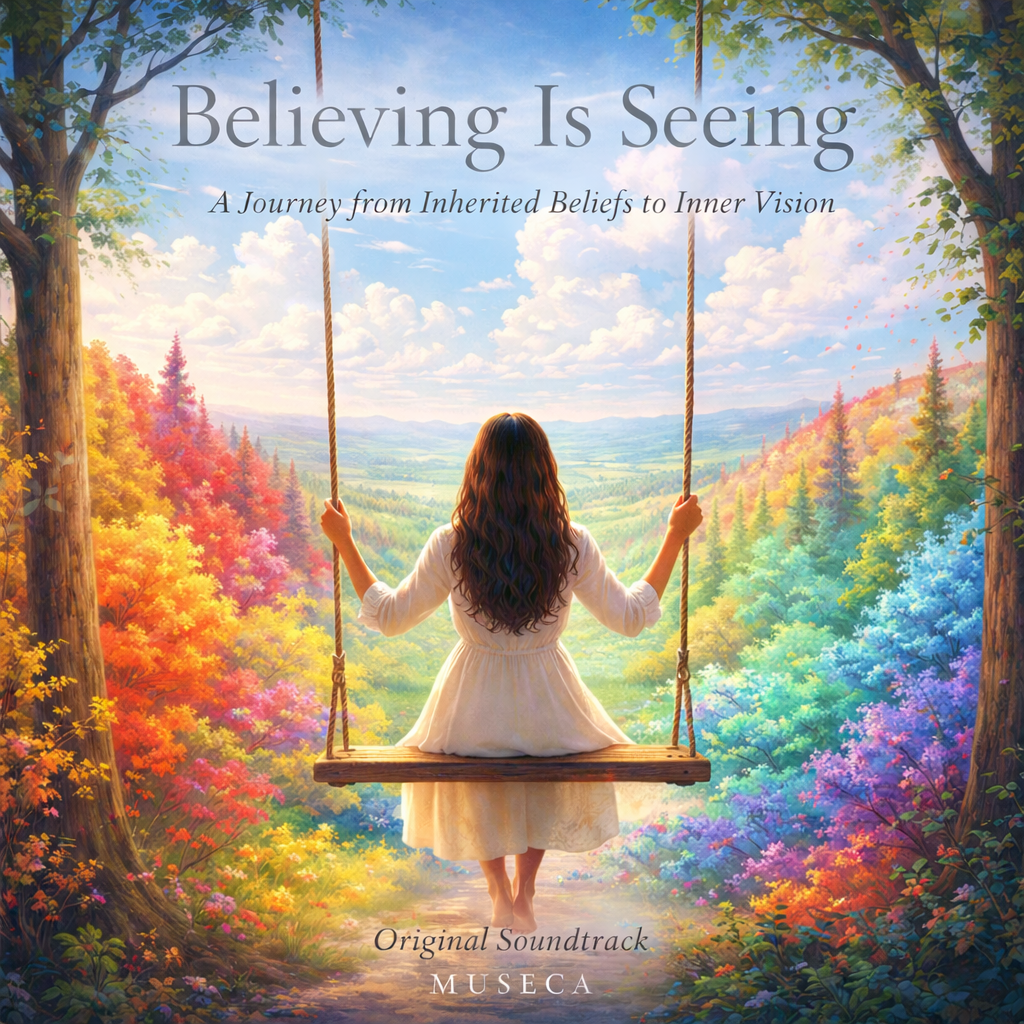
This soundtrack accompanies Believing Is Seeing by P. A. Rallax, a reflective, practice-oriented book built on a single governing premise: our experience of reality is filtered through belief. What we call “seeing” is not a neutral camera—it is a lens shaped by early conditioning, social mirroring, and the quiet stories we repeat until they harden into identity. Across the book’s progression—moving through symbolic inner “rooms” and turning points (the blank canvas, the whispering walls, the mirror room, the gate of glass, the shattering, and the unseen garden)—the reader is guided from unconscious inheritance toward conscious authorship. The narrative sections frame the emotional truth of these stages, while the reflective sections and re-authoring practices invite a practical shift: not to fight the world, but to revise the lens through which the world is interpreted.
The album is designed as a modern, restrained orchestral film score—not an external “plot soundtrack,” but an internal one: the sound of perception reorganizing itself. We chose a cello-centered voice because the cello can carry intimacy and gravity without melodrama. It speaks like an inner narrator: human, vulnerable, and honest. Around it, flowing strings form the psychological atmosphere—continuous, evolving, capable of holding tension and release in a single breath. Warm horns serve as the album’s “field”: a stable, compassionate presence that never becomes triumphant or declarative. The result is orchestral in scale, but personal in proximity—full ensemble, modern film-score intimacy, and a deliberate avoidance of dramatic tropes.
Harmonically, the soundtrack follows the book’s transformation as a brightness arc anchored to a single tonal home: E (Museca-consistent). Each track is a different modal lens on E, so the listener experiences not a sequence of unrelated keys, but one identity moving through changing perception. Early cues lean into darker modal colors—E Aeolian, E Phrygian, and a carefully “gentled” E Locrian—to reflect inherited belief, constraint, and the internalization of “should.” As the narrative turns toward agency, the harmonic language opens into E Dorian and E Mixolydian, emphasizing motion, choice, and grounded forwardness. The final chapters step into clarity—E Lydian and E Ionian—not as “victory,” but as clean seeing: a quiet confidence that the world is not merely encountered, but interpreted—and that interpretation can be rewritten.
In this way, the soundtrack functions as a musical analogue to the book’s central invitation: the same life, newly perceived. The themes introduced in the overture recur throughout the album in two forms—a contained motif (belief) and an opened motif (seeing)—undergoing gradual transformation rather than sudden conversion. The music does what the book asks the reader to practice: it returns again and again to the same material, and each time, it hears it differently.
You can download a PDF copy of Believing Is Seeing by P. A. Rallax directly from this page so you can follow along as you listen to the soundtrack. Reading the chapters alongside the music highlights how each track reflects the book’s progression—from inherited beliefs and inner “rooms” to clarity, choice, and inner vision.
Liner Notes
Overture: Believing Is Seeing
The album opens by presenting the score’s two thematic identities: a contained belief-motif introduced by the solo cello in a narrow range, then an “opened” variant that breathes wider intervals and longer phrases. Flowing strings enter in soft paragraphs rather than rhythmic figures, while warm horn chorales form a steady atmospheric field. The harmony stays anchored to E, with subtle modal shading that foreshadows the album’s gradual brightening. If piano appears, it functions as translucent harmonic glue—never a lead voice—clarifying the overture’s architectural cadence without adding drama.
The Blank Canvas
A close-mic cello speaks first, almost unaccompanied, in E Aeolian—intimate, inward, and unfinished. The motif is deliberately constrained: stepwise motion, gentle suspensions, and cadences that refuse to “lock.” Violas provide the softest possible bedding, with high strings as a halo (sul tasto) rather than a melody. Horns remain distant and warm, more like breath than statement. The track’s key gesture is the smallest expansion—one widened interval—hinting that seeing begins as space, not certainty.
The Blank Canvas (Version 2)
The Whispering Walls
E Phrygian colors the orchestra with a quiet ache: the flattened second degree becomes a psychological tint rather than a dramatic alarm. Low strings create a sense of “architecture,” sustaining slowly shifting sonorities as the cello’s motif is shaded by inherited tension. Horns support with soft suspensions and unresolved warmth, and woodwinds appear like half-spoken thoughts—brief doublings at phrase edges, never foregrounded. The theme is still contained, but the arrangement starts to “listen back,” allowing faint echoes of the opened motif to appear behind the walls.
The Leash of Should
This cue uses a carefully gentled E Locrian palette to depict constraint without aggression. The cello motif is compressed and interrupted by small rests, creating the feeling of self-editing—thoughts arriving already filtered. A bowed viola pulse supplies inward pressure without percussive drive, while muted horns hold a dim, stable field that refuses triumph. Harmonic ambiguity is the point: the music attempts to widen into the opened theme, but the cadence is intentionally denied, leaving the listener inside the rule.
The Mirror Room
In E Dorian and set in a quiet 3/4, the music turns reflective—literalized through canonic writing and antiphonal string responses. The cello states the motif and the violins answer at a slight distance, as if identity is formed by echo. Horns mirror the contour through chorale-like blocks, lending warmth without declaring resolution. Here the opened theme finally arrives as a complete two-phrase idea—still restrained, but now structurally real—suggesting agency emerging from reflection rather than performance.
The Garden of Shouldn’t
Beginning in E Dorian and subtly lifting toward E Mixolydian, this track shifts from pruning to growth. Harp patterns—quiet, page-turn-like arpeggios—introduce gentle motion while strings form long legato sentences. The cello’s contained motif grows more confident in register and breath, and the harmonic field relaxes as Mixolydian warmth appears in the horns. The central transformation is elegant: the note that used to end the belief-motif becomes a pivot—reframed as the doorway that launches the opened theme.
The Gate of Glass
E Phrygian returns, but now as translucence rather than confinement. The orchestration becomes airy: sul tasto strings, faint harmonics, and occasional shimmer from harp (and, if used, a single celesta glint at phrase turns). Horns remain the constant field—soft, patient chorales that stabilize the “lens” effect. The cello introduces the opened theme with unusual clarity after a brief thinning of the texture, and the orchestra re-enters around it with simpler harmony, as though the glass has been wiped clean and the world has not changed—only the seeing.
The Shattering
Anchored in E minor with chromatic fractures, this cue depicts rupture through orchestration and form rather than volume. The motif breaks into shards—short fragments traded among cello, strings, and muted horn blocks—creating discontinuity without violence. Harmonic cracks appear as chromatic inner voices and unstable suspensions; percussion remains breath-like, never striking. The emotional center is the reassembly: the cello gathers the fragments into one continuous line, and the opened theme emerges as an act of recomposition—meaning rebuilt from the same materials.
The Wanderer
E Mixolydian arrives as grounded forward motion, set in a gentle 12/8 gait that feels like walking rather than marching. The cello carries the opened theme in long arcs, while violas weave the older motif quietly underneath—belief integrated, not fought. Horns broaden into a horizon field, warm and pastoral without fanfare, and strings flow in steady paragraphs. The track’s quiet achievement is its steadiness: a sense of direction that is not driven by urgency, but by presence.
The Library
In E Lydian, possibility becomes audible. The harmony brightens through lifted scale color and luminous voicing, while the writing turns subtly contrapuntal—order, selection, and intelligence rendered as gentle interlocking lines. Harp gestures suggest pages turning, and horn chorales provide a calm radiance that never becomes heroic. The opened theme generates variations: first intimate in the cello, then shared across strings, then cradled by horns. Brief echoes of the belief-motif appear only to be recontextualized as supportive counterpoint—old pattern becoming useful material.
The Window Within
E Ionian is presented with deliberate simplicity. In a quiet 3/4, the cello states the opened theme plainly, with transparent strings and a minimal, close mix that feels almost unadorned. Horns cushion the harmony softly, and woodwinds appear only as breath at phrase ends. The belief-motif returns as a memory—brief, tender, and small—then resolves naturally into the opened cadence. This is the album’s cleanest “truth cue”: not triumphant, but unmistakably settled.
The Unseen Garden
The finale returns to E Lydian as luminous integration—full orchestra, restrained temperament. Strings form broad, continuous paragraphs; horns offer their richest warmth as an enveloping field; harp adds subtle light without sparkle. The cello sings the opened theme at its widest, most spacious, and a single noble swell rises and releases without spectacle. The closing transformation is the album’s final statement: the belief-motif appears once, harmonized in the same radiant language, and merges seamlessly into the opened theme—perception and identity aligned, and the story continuing beyond the last chord.
Believing Is Seeing (Bonus Track)
This bonus song distills the book’s central premise into a single lyrical statement: perception is not passive—it is authored. Built on a neo-soul pocket, the track lets warmth and clarity do the storytelling: Rhodes chords voice extended harmonies (maj9s, m9s, gentle suspensions) while a deep, round bass and brush-kit groove keep the pulse human and unforced. Over that ground, the vocal delivers the narrative arc in plain language—inheritance, mirroring, “should,” the quiet shattering, and the decision to choose again—while soft female echoes function like the book’s reflective “Seeing” sections: not a second character, but the inner voice repeating the truth until it becomes lived.
The orchestral layer ties the bonus track back to the score. Flowing strings move in long paragraphs rather than rhythmic patterns, and warm horn chorales provide the same compassionate “field” heard throughout the album. A solo cello countermelody subtly quotes the soundtrack’s opened theme, weaving beneath the chorus as if the orchestral world is remembering itself in a new form—no longer instrumental introspection, but sung conviction. The arrangement avoids dramatic climaxes; instead, it evolves by gentle widening—more air in the voicings, slightly higher register, and a single restrained bloom near the final chorus—mirroring the album’s modal brightening from constraint to clarity. The result is a closing statement that feels contemporary and intimate, yet unmistakably part of the same journey: the same life, seen through a kinder lens.
Lyrics
[Intro]
[Rhodes chords + soft strings; cello hints the “seeing” motif]
Mmm… mm…
[Verse 1]
I thought my eyes were telling me the truth
But I was only watching what I knew
Old stories in the wallpaper and frame
Calling every silence by my name
I wore a thousand “shoulds” like Sunday clothes
Smiling through a door that never closed
[Pre-Chorus]
Then something in me cracked—no sound, no scene
Just space where all my certainty had been
And in the quiet, I could finally hear:
The world is not the wound I’ve been afraid of
[Chorus]
Believing is seeing
(Seeing… seeing…)
That’s the lens I live through
(Live through…)
If I change the meaning
(Meaning… meaning…)
The sky turns different blue
(Different blue…)
I’m not what mirrors give me
(Not what they give…)
I’m not what fear designed
(Fear designed…)
I open the window within me
(Window within…)
And let the light decide
(Let it decide…)
[Verse 2]
I walked the rooms I built when I was small
Whispering walls, a mirror down the hall
A garden where I cut my colors back
So I could fit the love I thought I lacked
But every time I chose to breathe again
The glass got clearer on the way I am
[Pre-Chorus 2]
And I don’t have to fight what I can bless
I don’t have to prove what I can confess
I can be the author, not the ink
I can see the world the way I think
[Chorus]
Believing is seeing
(Seeing… seeing…)
That’s the lens I live through
(Live through…)
If I change the meaning
(Meaning… meaning…)
The sky turns different blue
(Different blue…)
I’m not what mirrors give me
(Not what they give…)
I’m not what fear designed
(Fear designed…)
I open the window within me
(Window within…)
And let the light decide
(Let it decide…)
[Bridge]
[Drop to voice + piano/Rhodes; cello and strings slowly rise underneath]
There was a gate of glass in my mind
And I kept mistaking it for sky
But the day it shattered, I survived
I found a garden on the other side
So I choose again—softly, slowly
I choose again—and I come home
[Final Chorus]
[Strings + horns bloom gently; keep it soulful, not epic]
Believing is seeing
(Seeing… seeing…)
So I’m learning to choose
(Learning to choose…)
A kinder meaning
(Kinder meaning…)
A more honest view
(Honest view…)
I’m not what mirrors give me
(Not what they give…)
I’m not what fear designed
(Fear designed…)
I open the window within me
(Window within…)
And let the light decide
(Let it decide…)
[Outro]
[Ad-lib softly; fade with cello motif]
I choose again… (choose again…)
I see again… (see again…)
I’m home inside… (home inside…)
Playlist
- Overture: Believing Is Seeing Museca 2:42
- Track 1 — The Blank Canvas Museca 3:43
- Track 1 — The Blank Canvas (Version 2) Museca 2:38
- Track 2 — The Whispering Walls Museca 3:02
- Track 3 — The Leash of Should Museca 2:55
- Track 4 — The Mirror Room Museca 3:17
- Track 5 — The Garden of Shouldn’t Museca 3:15
- Track 6 — The Gate of Glass Museca 3:33
- Track 7 — The Shattering Museca 4:45
- Track 8 — The Wanderer Museca 3:02
- Track 9 — The Library Museca 3:30
- Track 10 — The Window Within Museca 3:05
- Track 11 — The Unseen Garden Museca 3:13
- Believing is Seeing Museca 5:13