
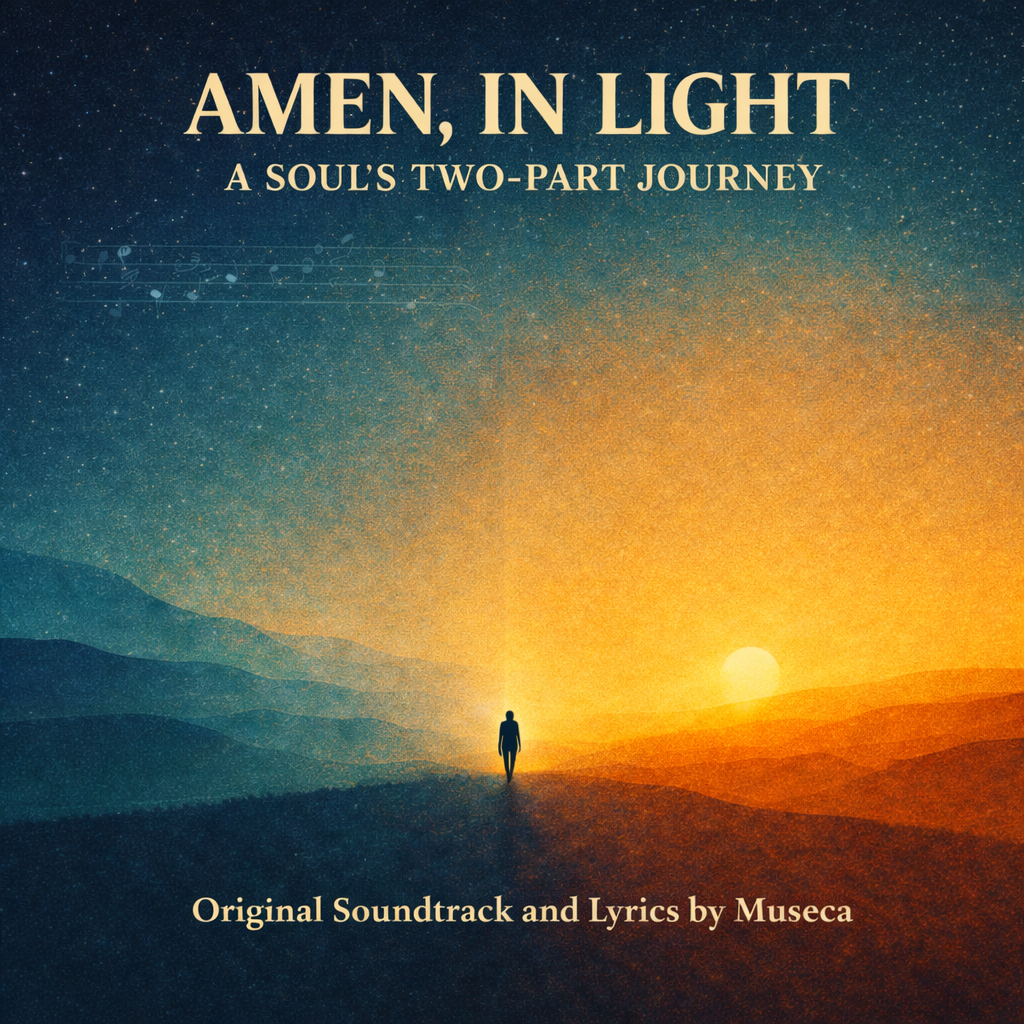
Amen, In Light is a two-part soundtrack album and live-performance concept that reclaims one of history’s most powerful musical symbols—Dies Irae—and transforms what it has traditionally meant. Written to commemorate the 800th anniversary (1225–2025) of the medieval chant Dies Irae (“Day of Wrath”), this project honors the extraordinary music the chant inspired across centuries, while releasing the fear-based theology that traveled with it: the belief that death is judgment, punishment, or divine condemnation.
At the heart of Amen, In Light is a spiritual inversion: what if the day of death is not wrath… but reunion? Drawing on modern metaphysical teachings—especially Neale Donald Walsch’s view that the day you die is the most remarkable and glorious day of your life—this soundtrack reframes death as return, recognition, and homecoming, not trial or terror. The result is not a rejection of tradition, but a transfiguration: a requiem not for the soul, but for an inherited error.
The Premise and Content
The album is designed as one continuous arc presented in two sections:
Part I — Dies Irae: Requiem for the Fallacy (Six Movements)
This is an orchestral/choral ceremonial work with narrator, soprano, and tenor. It begins inside the historical “spell” of Dies Irae, quoting the ancient text and confronting the emotional architecture of fear that shaped centuries of funeral music and cultural memory. Across the movements—The Fracture, The Questioning, The Silence Between, Dies Amoris, Return to the Light, and Amen, In Light—the work gradually breaks the old myth open and replaces it with a new truth: that the “Judge” is love, and that death is a return into light.
Part II — The Light Path (Five Songs)
Where Part I is the dismantling of fear, Part II is the soul’s remembered ascent. These songs unfold in a flowing, contemplative modern style—radiant grooves, warm textures, melodic intimacy—allowing the listener to feel the emotional reality of the new story: joy, remembrance, homecoming, inner flame, and final benediction. The cycle moves through Dies Laetitiae Maximae, Memoria Limen (Threshold of Remembering), Return to the Light, The Soul Is a Flame, and Amen, In Light (Reprise)—ending not with finality, but with peace.
What This Album Is Meant to Do
Amen, In Light is intended to function simultaneously as:
A commemoration of an 800-year musical legacy
A theological and emotional reframe of death (from judgment to reunion)
A performable ritual—narrated, staged, and experienced as a single journey
A listener’s soundtrack for fear-release, reflection, and spiritual reassurance
In short: this is music that respects where we came from—without remaining trapped there.
It is a requiem for fear.
A remembering of truth.
A ceremonial act of love.
You may download a complimentary digital copy of Amen, In Light: A Soul’s Two-Part Journey to follow the full narrative, lyrics, and performance script alongside the soundtrack. The booklet includes the complete text for both Dies Irae: Requiem for the Fallacy and The Light Path, offering historical context, theological reflection, and the guided arc of the soul’s transformation. Listening while reading allows the music and meaning to unfold together as a unified experience.
Liner Notes
Part I — Dies Irae: Requiem for the Fallacy (Six Movements)
Dies Irae (The Fracture)
The opening movement begins inside the spell. The ancient Dies Irae motif appears almost as we know it—stern, modal, descending—but its world is subtly cracked. Orchestral voices disrupt the chant with harmonic fractures and rhythmic displacements, suggesting that something in the inherited story no longer holds. This is the sound of an 800-year idea beginning to tremble under its own weight: fear still present, but no longer unquestioned.
Lyrics
Dies irae, dies illa
(The day of wrath, that day)
Solvet saeclum in favilla
(Will dissolve the world in ashes)
Teste David cum Sibylla
(As foretold by David and the Sibyl)
Quantus tremor est futurus
(How great the trembling will be)
Quando iudex est venturus
(When the Judge shall come)
[Choir layering begins – SATB entries – phrases overlap and pulse slowly]
Judicandus homo reus
(The accused man shall be judged)
[Whispered English voices begin, spaced out between chants:]
Who said this was truth?
Why wrath?
Who declared us guilty?
[Music fragments, cello breaks apart Dies Irae intervals – whisper returns:]
What if the accusation…
…was never true?
The Questioning
Here the theology beneath the melody is placed under a quiet but relentless light. Instead of thunder, the movement unfolds in introspective lines: strings and solo voice ask, rather than proclaim. Harmonies hover between resolution and suspension, mirroring an interior dialogue: Who told us death was judgment? Who benefits from a wrathful God? The chant is no longer an unassailable decree; it becomes an object of inquiry. Musically, this is where the old certainty loosens and spiritual curiosity becomes a force of its own.
Lyrics
[Whispers – scattered and layered]
Who said this was truth?
Why wrath?
Who declared us guilty?
Dies irae…
Quantus tremor est…
Tremor… tremor…
Where did the fear come from?
Was it given… or chosen?
[Quiet choral fragments in Latin – barely sung, mostly intoned:]
Judicandus homo…
…reus…
(reus… reus…)
[Return to whispered English, spread across stereo field:]
What if this story…
…was never mine?
What if it was never yours?
Why are we trembling?
What are we waiting for?
[One final question, spoken alone:]
What if the Judge…
…was love?
The Silence Between
This movement is built as much from what is not heard as from what is. Long, sustained tones, choral breaths, and generous rests create a feeling of suspended time. It is the sonic equivalent of closing the book, putting it aside, and simply listening. Between dogma and discovery there is always a silence in which the soul can hear itself again. Here, the orchestra thins, the choir withdraws into hums and overtones, and silence itself becomes the principal instrument.
Lyrics
[Female voice enters wordlessly:]
Ahh…
(10 seconds of silence)
Ooooh…
Aahhh…
(whisper of wind texture)
Hmmm…
[Cello sustains low open fifth]
[Echoed breath sounds layered gently: inhale… exhale…]
[Choir of distant vowels fades in, like memory:]
Ooo… aah… mmm…
(very soft, long-held tones)
[Silence again — 15 seconds]
[Final vocal breath:]
(Almost silent)
Ssshhh…
[Everything fades into light]
Dies Amoris (The Day of Love)
The turning point of the Requiem, this movement inverts the original text: from Dies Irae (Day of Wrath) to Dies Amoris (Day of Love). The music responds by shifting into warmer tonal centers, more open voicings, and a gentler rhythmic pulse. Melodic contours rise instead of fall. Harmonic light surrounds the voices as they proclaim a different message: death is not a verdict but a reunion. This is where the chant is not discarded but redeemed, re-tuned to the frequency of welcome instead of threat.
Lyrics
Dies amoris, dies vitae
The day of love, the day of life
Non iudicium… sed reditus
Not judgment… but return
Non timor… sed lumen
Not fear… but light
Non ultio… sed amplexus
Not vengeance… but embrace
Non solitudo… sed memoria
Not loneliness… but remembrance
Dies amoris… dies pacis
The day of love… the day of peace
In lumine tuo, redit anima
In your light, the soul returns
In voce tua, fit silentium
In your voice, there is silence
In morte… vita
In death… life
In amorem… totus reditus est
In love… the whole return is made
Return to the Light
Having released the belief in divine wrath, the soul begins to move. The groove is subtle but unmistakable—an undercurrent of motion that suggests walking, returning, remembering. Themes from earlier movements reappear, now transformed; motifs that once sounded ominous are reharmonized into something tender and clear. The music breathes like someone realizing, with relief, that they are not on trial. This movement is both journey and recognition: the soul turning toward the light it never truly left.
Lyrics
Return… to the light
No fear… no night
Only love
Only light
You are not judged
You are remembered
You are not lost
You are returning
Return… to the light
Let go… rise slow
The soul knows… the way home
In amorem redit anima
(In love, the soul returns)
In lumine… it is free
In light… you are free
Return… to the light
Amen, In Light
The final movement is not a climax of tension but a widening of space. Choir and orchestra join in a luminous, slowly unfolding affirmation. The word “Amen” here is not a signature under a sentence of fear; it is a soft declaration that the spell has been broken. Traces of the original Dies Irae intervallic shape may flicker at the edges, but they dissolve into consonance and resonance. The piece closes not on darkness or ambiguity, but on a quiet, confident radiance—the sound of a universe that has always been rooted in love.
Lyrics
Amen… in light
No fear remains
Only love
Amen… in light
The soul is whole
The soul is home
Amen… in light
No judgment
Only joy
Amen… in light
You are seen
You are safe
You are free
Amen… in light
Amen… in light
Part II — The Light Path (Five Songs)
Dies Laetitiae Maximae (Day of Greatest Joy)
Where the Requiem ends in radiance, this song begins in celebration. A flowing, contemplative groove supports a lyrical blend of Latin and English text that names death not as catastrophe, but as the “day of greatest joy.” The melodic writing is clear and singable, the harmony warm and open. This track reimagines what a “great and terrible day” could mean when viewed through the lens of reunion rather than reckoning.
Lyrics
Dies laetitiae maximae
The day of greatest joy
Non luctus, non iudicium
No sorrow, no judgment
Non tremor… sed exsultatio
No trembling… but exultation
Gaudium aeternum… lux perpetua
Eternal joy… everlasting light
Amen… amen… in lumine
Amen… in the light
Dies laetitiae maximae
Dies… laetitiae…
Maximae…
Memoria Limen (Threshold of Remembering)
This song inhabits the delicate moment when forgetting starts to give way to remembrance. Harmonically, it moves with gentle inevitability, like stepping stones across water. A solo voice leads, supported by soft keyboards and understated percussion, evoking the sense of standing at a threshold—not of a gate guarded by judgment, but of an inner room you have always known. The refrain turns the idea of “memory” into a spiritual act: remembering who you were before fear.
Lyrics
You are not lost
Only dreaming in the light
A soul wrapped in shadow
But still burning bright
[Pre-Chorus]
The silence you carry
Is older than time
It waits for your voice
To become its rhyme
[Chorus]
Threshold of remembering
Open like the morning sky
You are more than you believed
You were never left behind
Threshold of remembering
Where the veil becomes the wing
You are waking, you are singing
You remember everything
[Verse 2]
The ache is a calling
From what you used to know
The wound is a doorway
Where the light begins to grow
[Pre-Chorus]
No need to go searching
For what never left
You are standing at the border
Between silence and breath
[Chorus Repeat]
Threshold of remembering
Open like the morning sky
You are more than you believed
You were never left behind
Threshold of remembering
Where the veil becomes the wing
You are waking, you are singing
You remember everything
[Outro – Spoken Whisper or Sung Softly]
Not the end…
Not the fall…
But the moment
You remembered it all.
Return to the Light
Paired thematically with the fifth movement of the Requiem, this rendition is more intimate and song-centered. The arrangement leans into spacious textures and a steady, comforting pulse. Vocals ride above a bed of soft harmonies, carrying the feeling of calm acceptance rather than struggle. If the Requiem’s version represents the collective soul, this one feels personal and direct: a private acknowledgment that the journey home is already underway.
Lyrics
Return… to the light
No fear… no night
Only love
Only light
You are not judged
You are remembered
You are not lost
You are returning
Return… to the light
Let go… rise slow
The soul knows… the way home
In amorem redit anima
(In love, the soul returns)
In lumine… it is free
In light… you are free
Return… to the light
The Soul Is a Flame
Here the imagery shifts from light as environment to light as identity. The soul is not a frail flicker at the mercy of the wind, but a steady flame, quiet and enduring. Musically, this is expressed through gently undulating patterns, overlapping vocal lines, and a sense of inner heat in the harmony. The song affirms that whatever stories have been told about sin, guilt, or unworthiness, there remains something untouched at the core—an ember that never goes out.
Lyrics
The soul is a flame… not a shadow
The soul is a flame… it remembers
Born of light… it cannot die
Born of love… it only flies
No fear… no veil
No night… no end
The fire is you
You are the flame
The soul is a flame… not a whisper
The soul is a flame… not a wound
The soul is a flame… forever dancing
The soul is a flame… it sings of you
Amen, In Light (Reprise)
The closing track of The Light Path returns to the central phrase of the entire project, but in a more restrained, personal frame. Where the Requiem’s “Amen, In Light” is orchestral and communal, this reprise is intimate—almost like a final whispered blessing. Sparse accompaniment leaves room for breath and silence between phrases. It feels less like an ending and more like a door left gently ajar: a reminder that the journey described by this album is not confined to the concert hall, but continues in the listener’s own life, choices, and quiet moments of remembering.
Lyrics
Amen… in light
No fear remains
Only love
Amen… in light
The soul is whole
The soul is home
Amen… in light
No judgment
Only joy
Amen… in light
You are seen
You are safe
You are free
Amen… in light
Amen… in light
Playlist
- Dies Irae: Requiem for the Fallacy - Movement I – The Fracture Museca 3:30
- Dies Irae: Requiem for the Fallacy - Movement II — The Questioning Museca 3:22
- Dies Irae: Requiem for the Fallacy - Movement III — The Silence Between Museca 3:44
- Dies Irae: Requiem for the Fallacy - Movement IV — Dies Amoris (The Day of Love) Museca 4:18
- Dies Irae: Requiem for the Fallacy - Movement V — Return to the Light Museca 3:20
- Dies Irae: Requiem for the Fallacy - Movement VI — Amen, In Light Museca 3:32
- Dies Laetitiae Maximae (The Day of Greatest Joy) Museca 4:44
- Memoria Limen - Threshold of Remembering Museca 5:47
- Return to the Light Museca 4:35
- The Soul is a Flame Museca 4:06
- Amen, In Light (Reprise) Museca 4:01