
Album Introduction
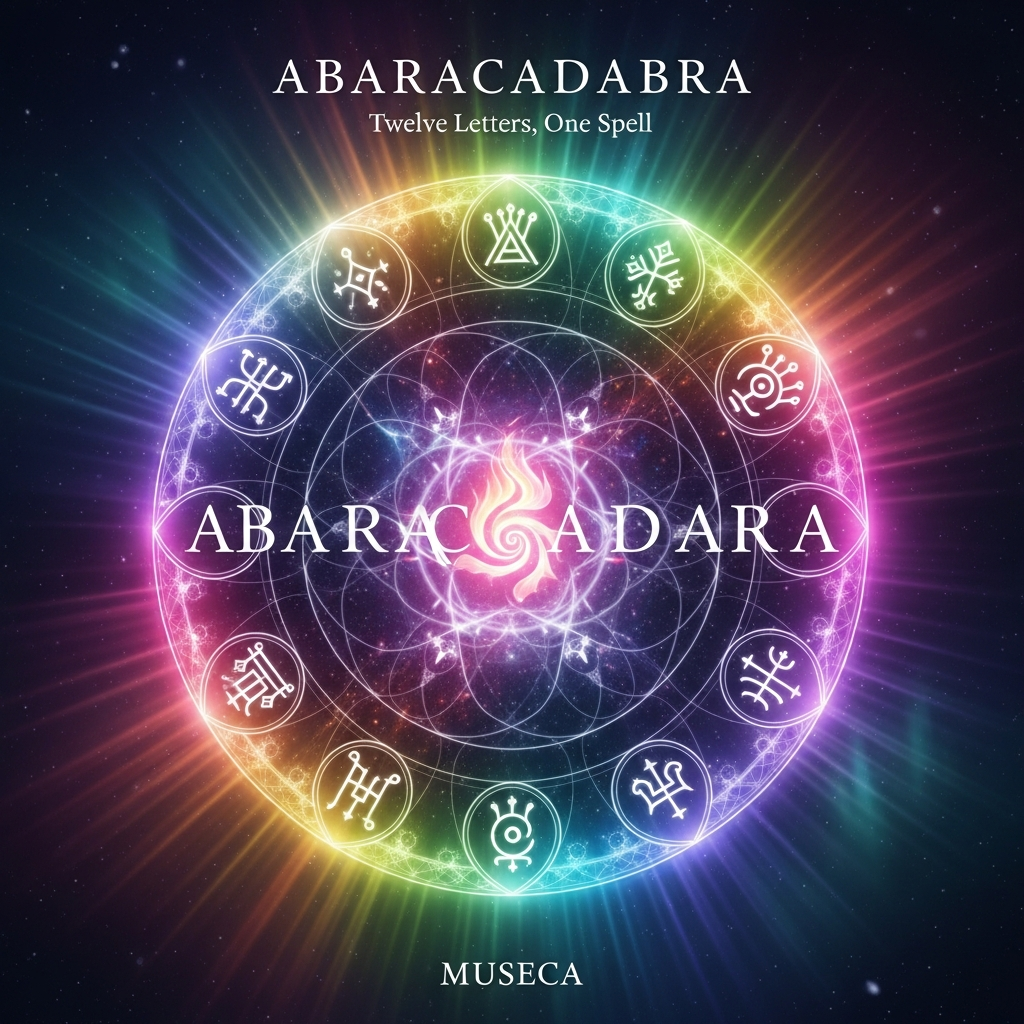
Abaracadabra: Twelve Letters, One Spell was created as an experiment in turning language into music—not symbolically, but structurally. The album begins with a single premise: if a word can function as a charm, it can also function as a score. By treating ABARACADABRA as a 12-step sequence, each letter becomes a musical event—pitch, duration, emphasis, or texture—and the word itself becomes a repeatable ritual form. What unfolds across the album are different manifestations of that same spell: melodic, harmonic, percussive, chanted, droned, and ceremonial.
Long before it became a stage magician’s cliché, abracadabra carried serious weight. It was used as a protective and healing formula, often written or spoken repeatedly as a way to diminish illness, fear, or disorder. Its exact origin is uncertain, and that uncertainty is part of its power. The word survives not because of a definitive meaning, but because of repetition, belief, and form. It is a reminder that humans have always used pattern—spoken, written, or sung—to impose coherence on chaos.
This album leans into that idea. Rather than attempting to “explain” the word linguistically, Abaracadabra explores what happens when its structure is honored musically. The recurring A becomes a mantra-tone, a home point the music continually returns to. The two R moments act as pillars—places where time stretches, harmony deepens, or percussion strikes—shaping the ritual’s flow. From there, the same twelve-note sequence is allowed to breathe in different environments: a pure incantation, a string ensemble, a fire ritual with drums, a dark subterranean drone, and a vocal chant.
The album traces an arc from talisman to ceremony, from inward focus to communal ritual. It is not asking the listener to believe in magic. Instead, it demonstrates how intention, repetition, and structure—the oldest tools humans have used to make meaning—can still feel transformative when expressed through sound. In that sense, Abaracadabra is less about illusion and more about attention: how listening itself can become a kind of spell.
Liner Notes
The Twelve-Letter Incantation
The opening track presents the core idea of the album in its purest form: the word ABARACADABRA mapped as a twelve-note melodic sequence centered around A. Every letter becomes a single musical event, and the melody unfolds without ornament or disguise. There is no percussion, no grand orchestration—only a deliberate, chant-like line that returns again and again to A as a mantra.
This piece functions like a key turning in a lock. The listener hears the spell for the first time as a simple incantation, defined by repetition and contour rather than harmony. It establishes the blueprint from which every other track on the album is derived.
The Twelve-Letter Incantation (String Spell)
In this version, the same incantation is entrusted to a solo line and gently enveloped by a string ensemble. The melody remains unchanged, but its emotional world deepens as sustained chords in violas, cellos, and basses provide warmth and resonance.
The harmonic language stays close to A minor and its modal shades, allowing each return to A to feel like a breath. Subtle swells and inner-voice motion transform the incantation into something luminous and intimate, revealing the spell not just as structure, but as atmosphere.
The Two Pillars of the Spell
This piece introduces the idea of the two R letters in ABARACADABRA as structural pillars. Musically, they become two tones—C and G—where time stretches and the flow of the music pauses to listen.
The twelve-note sequence is slowed and reshaped into ceremonial cycles. At each pillar, the strings sustain and deepen, giving the listener the sensation of passing through marked thresholds. The track explores how repetition gains meaning when certain moments are allowed to expand, turning the spell into architecture.
Pillars of Drum and Spell
Here, the pillar concept is given physical weight through percussion. Deep frame drums and ceremonial hand drums mark the two structural tones, while low strings hold the harmonic ground.
The slow 3/4 pulse suggests a processional movement around a central fire. Each cycle of the melody returns to the same two emphasized points, reinforcing the sense of ritual repetition. The piece balances space and impact, evoking spellwork as a communal, embodied act rather than a private invocation.
Abaracadabra: The Black Drone
This track shifts the album into a darker, subterranean space. The twelve-letter system is still present, but the melody dissolves into long, sustained tones embedded within a continuous drone.
Low strings and sub-bass layers hover around A, C, and G, while fragments of the motif surface like distant echoes. The music becomes environmental rather than linear, suggesting the spell carved into stone rather than spoken aloud. It is an exploration of weight, resonance, and the slow movement of sound through shadow.
Abaracadabra: The Black Drone (Pillar Variant)
The pillar variant sharpens the drone concept by emphasizing C and G as gravitational centers. Instead of hovering evenly, the texture slowly shifts between these anchor points and A, creating the sense of immense forces pulling the sound from one center to another.
The twelve-note logic remains hidden beneath the surface, guiding the transformations without revealing itself directly. This version feels less like a statement and more like a pressure field—an interior space where the spell exists as mass and energy.
Abaracadabra: Fire Circle
Fire Circle brings the system back into the body. Hand drums, low toms, and shakers drive a slow ceremonial rhythm while strings support with drones and fragments of the motif.
The two pillar tones are marked by heavier drum strikes, intensifying the sense of ritual passage. The music suggests movement, heat, and repetition—participants circling a flame, each turn bringing them back to the same thresholds. It is the album’s most elemental expression of the spell.
Abaracadabra Invocation Theme
This track presents the twelve-note sequence as a fully lyrical theme. Carried by a solo instrument and supported by warm strings, the melody unfolds in three gentle arcs: a call, an ascent, and a return.
The harmony remains rooted in A minor but allows for subtle brightness through modal shifts, giving the theme a sense of openness and emotional clarity. It is the point in the album where the spell feels most like a song—memorable, expressive, and quietly radiant.
Abaracadabra Chant of Twelve
The album closes with the human voice. The twelve-note sequence becomes a vocal chant, sung on open syllables chosen for resonance rather than meaning.
Unison voices, slow pacing, and subtle drones turn the melody into a living ritual. Over repetitions, the chant deepens in texture but never breaks its ordered sequence. As the final A fades, the spell is gently released, leaving silence not as an ending, but as completion.
Playlist
- The Twelve-Letter Incantation Museca 3:29
- The Twelve-Letter Incantation (String Spell) Museca 4:13
- The Two Pillars of the Spell Museca 4:17
- Pillars of Drum and Spell Museca 3:04
- Abaracadabra: The Black Drone Museca 4:06
- Abaracadabra: The Black Drone (Pillar Variant) Museca 6:20
- Abaracadabra: Fire Circle Museca 6:37
- Abaracadabra Invocation Theme Museca 4:08
- Abaracadabra Chant of Twelve Museca 3:18