
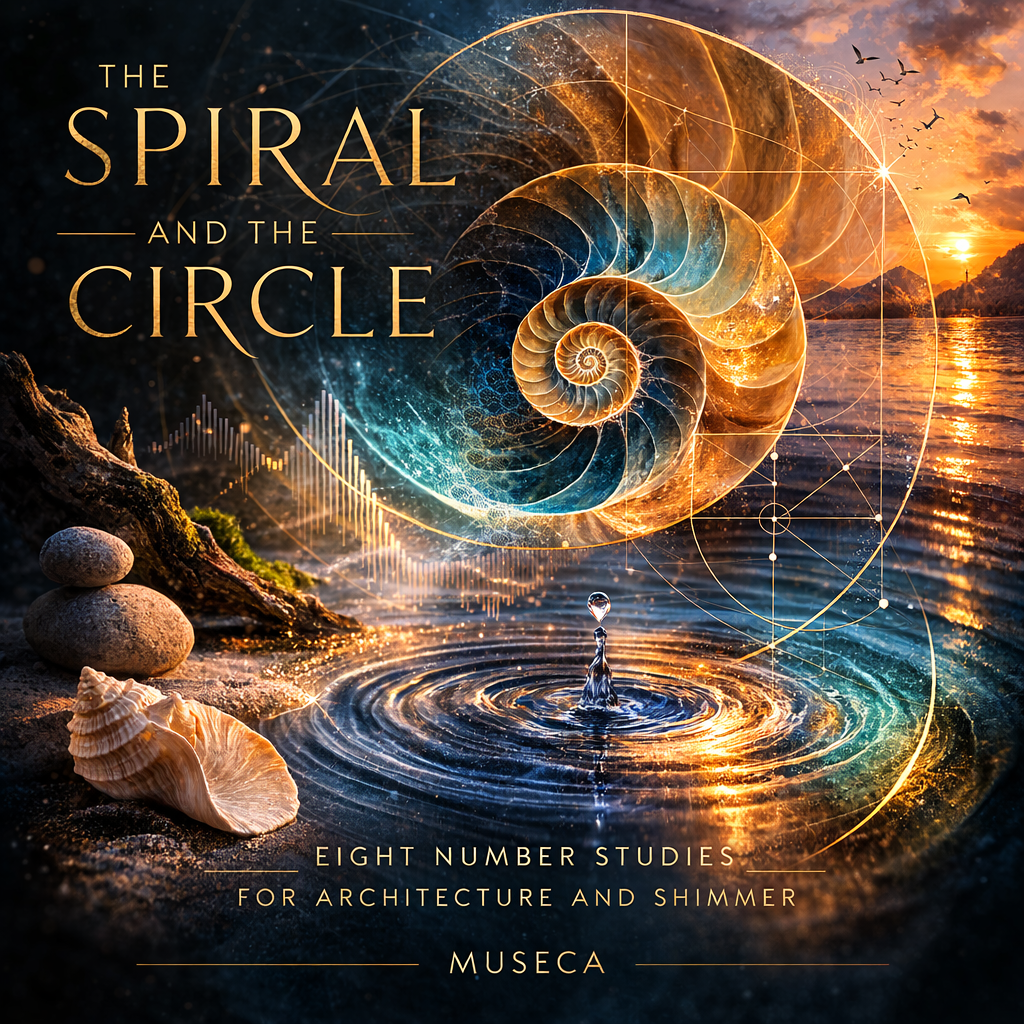
The Spiral and the Circle is conceived as a musical companion to the textbook of the same name: not merely an album inspired by its ideas, but a listening demonstration of them. The book presents composition as a meeting point between hidden structure and audible beauty, where numbers are not dictators but tools, and where the ear remains the final court of appeal. Its central vision is that music lives through two complementary motions: the spiral, which grows, expands, and develops; and the circle, which returns, loops, and restores center. This album translates that philosophy into sound. Each track takes one of the book’s core systems or methods and turns it into a finished musical study, so that the listener can hear the principles of the textbook at work rather than only read about them.
Across the tracklist, the album moves through the book’s major compositional engines: Fibonacci growth, golden-ratio proportion, harmonic-series resonance, the flowing non-repetition of π, prime-number asymmetry, Euclidean rhythm, and finally the integrated capstone approach. Just as the textbook teaches that strong music depends on architecture beneath shimmer, these pieces are built on clear tonal centers, loops, motifs, rhythmic grids, and density arcs, while allowing number-driven detail to animate the surface. Some tracks lean toward lyrical modern classical writing, others toward chamber minimalism, overtone meditation, or hypnotic electronic rhythm, but all of them are designed as audible demonstrations of the same underlying method.
In that sense, this album is an extension of the book’s pedagogy. The Spiral and the Circle teaches that understanding grows most fully through making, and these pieces embody that principle. They are studies, but they are also works of listening: music that shows how mathematical design can become expressive, human, and alive when guided by taste. Read the chapter, then hear its echo. Follow the concept, then hear it breathe. This album is the book in motion.
Liner Notes
Architecture and Shimmer
This opening piece is drawn from the book’s core hybrid principle: music needs a stable architecture underneath ornamental detail. Its construction begins with the six architectural elements the textbook identifies as foundational—tonal center, harmonic loop, form template, rhythmic grid, motif, and density arc—while the surface is animated by shimmer: timbral bloom, gentle register movement, and algorithmically flavored detail that never breaks the frame. In album terms, this track functions as the book’s thesis stated in sound: first the skeleton, then the light that moves across it.
Fibonacci Spiral
This track comes directly from the Fibonacci chapter and is built as a true spiral piece. The book describes Fibonacci as a growth system that produces melodies that feel flowing and organic, especially when rendered through digit-stream mapping rather than blunt term-by-term reduction. That is the logic here: a stable harmonic anchor supports a melody that gradually expands in contour, density, and energy, echoing the way Fibonacci phrases and section lengths create natural proportion. The piece is less about arithmetic display than about audible growth—an unfolding line that feels alive because its engine is recursive expansion.
Golden Cut
This cue is shaped by Chapter 4’s central proposition: the golden ratio is not mainly a pitch tool but a proportion tool, most powerfully used for climax placement. The track is therefore designed around an emotional peak arriving near 61.8% of the full duration, with the opening material and closing release calibrated to make that moment feel inevitable rather than forced. In practice, the piece behaves exactly as the textbook recommends: it uses proportion as destiny, giving the listener a sense that the climax arrives neither too early nor too late, but at the point where the musical argument feels naturally fulfilled.
Nature Resonance
This track grows out of the harmonic-series chapter and the book’s “Nature Resonance” template. Rather than relying on conventional functional harmony, it draws its sonority from overtone logic: fundamental plus partials, natural interval emergence, and resonance that feels discovered rather than imposed. The result is intentionally less cadential and more acoustic in spirit, because the textbook presents the harmonic series not as an invented system but as an expression of sound’s physical reality. This is the album’s most elemental piece: a study in how nature itself can be treated as compositional architecture.
Pi River
This piece is constructed according to the π chapter’s idea of endless variation within circular return. The book contrasts π with Fibonacci by noting that Fibonacci grows with internal structural logic, while π wanders without repeating exactly, making it ideal for flowing, non-repeating melodic or harmonic behavior over a stable center. The track follows that concept closely: its melodic line feels continuously drifting, its accenting is irregular, and its broader design implies the circular A–B–C–A return pattern the chapter recommends. In other words, the music keeps changing locally while remaining cyclic globally—precisely the paradox that makes π musical in this system.
Prime Beauty
This movement is based on the chapter on prime numbers as “irregular beauty.” The textbook argues that primes are musically useful because they resist predictability: prime phrase lengths, prime-spaced harmonic changes, and prime-based accents create asymmetry that feels alive. This track follows that model by using uneven spans, off-balance arrivals, and tension curves shaped through prime logic, but it also obeys the chapter’s crucial warning that prime systems need cadential anchors or else they risk sounding arbitrary. That balance—irregular surface, clear arrival points—is what gives the piece its particular kind of elegance.
Circle Engine
This is the album’s clearest application of the book’s “Circle Engine” template and its Euclidean-rhythm chapter. The harmonic content is intentionally reduced so that rhythm becomes the true architecture. The groove is built from evenly distributed hit-patterns across cycles—exactly the Euclidean principle the textbook describes—layered into a texture that sounds both mechanical and organic. The chapter emphasizes that these patterns feel natural because they are mathematically even under constraint, and that is the core of this track’s design: repetition without stasis, cycle without monotony, momentum without harmonic complexity.
Spiral and Return
The finale is built from Chapter 14’s integrated “Spiral and Circle Method.” Here the individual systems stop functioning as isolated studies and begin working together inside one compositional workflow: one driver shapes form, another harmony, another melody, another rhythm, and then all of it is humanized and refined by ear. This track therefore combines growth and return, structure and surface, system and taste. It is the album’s capstone because it embodies the book’s final claim that number systems are tools, not dictators, and that the finished piece must remain coherent, intentional, and human.
Playlist
- Track 1 - Architecture and Shimmer Museca 2:55
- Track 2 - Fibonacci Spiral Museca 2:50
- Track 3 - Golden Cut Museca 2:18
- Track 4 - Nature Resonance Museca 2:25
- Track 5 - Pi River Museca 2:45
- Track 6 - Prime Beauty Museca 2:02
- Track 7 - Circle Engine Museca 3:26
- Track 8 - Spiral and Return Museca 4:28