
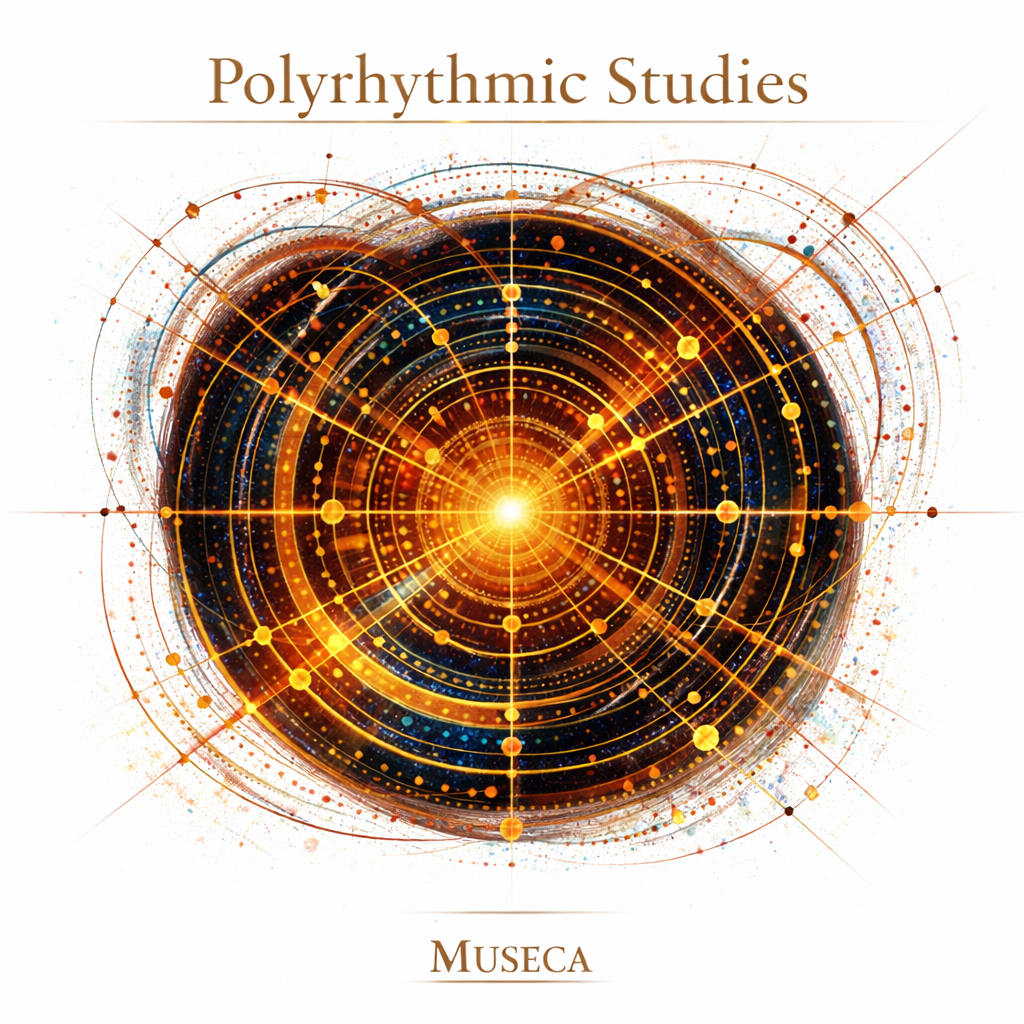
Polyrhythm opens the door to a more dimensional experience of musical time. When multiple rhythmic layers coexist—different subdivisions, different accent paths, different internal logics—the ear no longer hears rhythm as a single surface, but as a field of interacting motions. Tension arises, but so does richness: one layer may anchor, another may challenge, another may seem to float above or cut across the rest. In this way, polyrhythm creates not confusion, but depth.
This page is devoted to that multidimensional world. The works gathered here explore simultaneous rhythmic layers, competing subdivisions, cross-accentuation, friction, resolution, and the expressive possibilities that emerge when more than one time-feeling is active at once. Some studies are subtle, others overtly complex, but all are shaped by the idea that rhythm can be plural. These pieces invite the listener to hear time not as a line, but as a living weave of forces moving together.
Liner Notes
4:3 Lyrical Polyrhythm Study (Chopin-Inspired)
This opening piece introduces polyrhythm not as a technical display, but as a form of expressive breathing. Inspired by the lyrical cross-rhythms of Chopin, the track places a singing duple melody above a flowing triplet undercurrent, creating the classic sensation of four moving against three. The result is not mechanical conflict, but emotional layering: one voice seems to speak plainly while another drifts beneath it, unsettled and tender.
The piece establishes one of the album’s central ideas: that polyrhythm can function as narrative. Here, time does not simply proceed; it bends inward. The melody remains poised and human, while the accompaniment suggests the deeper current of feeling beneath conscious thought. In that sense, this study serves as both an introduction to 4:3 and a gateway into the album’s broader exploration of rhythmic duality.
Polyrhythmic Storytelling (Ballade No. 4 Engine)
This track expands the lyrical cross-rhythm of the opening into a larger dramatic form modeled on the idea of the Romantic ballade. Inspired by the narrative elasticity of Chopin’s Fourth Ballade, it allows several rhythmic identities to emerge and collide over the course of a single musical arc. Duple and triple layers interact, widen, fracture, and regroup, as if different emotional voices were struggling to occupy the same timeline.
Rather than treating polyrhythm as a repetitive groove, this piece uses it as evolving dramaturgy. At times the cross-rhythms are gentle and almost hidden; elsewhere they intensify into a storm of layered motion. The effect is that of memory, conflict, and recollection unfolding through rhythm itself. It stands at the meeting point of classical expressivity and modern structural thinking, translating the ballade’s inward drama into the language of temporal counterpoint.
Polyrhythmic Storytelling (Ballade Engine) — Instrumental
The instrumental variant reveals the architecture of the previous track in a more exposed form. Without text or vocal implication, the listener hears more clearly how the rhythmic strands themselves carry the narrative. Piano and orchestral textures assume the full burden of expression, and the shifting layers of 3:2, 4:3, and more complex cross-accent patterns become the principal means of storytelling.
What emerges is a purer encounter with the idea of the ballade as rhythmic form. The emotional shape remains, but its language is now entirely musical: theme, intensification, turbulence, recollection, and release all arise through the interaction of pulse layers and harmonic motion. This version highlights how polyrhythm can function not only as decoration or propulsion, but as the very grammar of a dramatic instrumental work.
3:2 Narrative Pulse Study
With this track, the album turns from Romantic rubato toward a more explicit rhythmic engine. The 3:2 relationship is one of the most foundational polyrhythms in world music, and here it is presented with clarity and momentum. A stable duple pulse grounds the piece, while triplet figures move above it in steady opposition, producing a groove that feels both balanced and unsettled.
What makes this study distinctive is its narrative intention. Rather than looping the cross-rhythm as a static pattern, the music gradually reveals how each layer can assume leadership, retreat, and return. The listener becomes aware of how 3 and 2 coexist, not as abstract numbers, but as two modes of moving through time. The piece serves as a bridge between the album’s more lyrical opening works and the darker modal experiments that follow.
Locrian 3:2 Pulse Engine
Here the album enters a more unstable harmonic world. By combining the 3:2 cross-rhythm with the Locrian mode, the track joins temporal friction to tonal fragility. The diminished fifth and flattened degrees of the mode deny any easy sense of home, while the simultaneous duple and triple layers deny a single rhythmic center. The result is a dark, controlled groove that feels suspended between forward motion and collapse.
This piece demonstrates how polyrhythm can intensify modal character. In a major or minor setting, 3:2 often feels earthy or dance-like; in Locrian, it becomes tense, ritualistic, and psychologically charged. The groove remains clear, but its harmonic atmosphere is permanently unsettled. The track stands as one of the album’s clearest statements that instability in pitch and instability in pulse can reinforce one another to powerful effect.
Locrian 4:3 Suspended Atmosphere
This track slows the pulse and allows polyrhythm to become spatial rather than percussive. Long harmonic fields move in broad four-part spans while delicate triplet activity drifts within them, producing a suspended 4:3 relationship that feels less like conflict than like freezing and thawing within time. The Locrian mode contributes its characteristic unease, but the music does not press forward; it hovers.
The atmosphere is intentionally cold and unresolved. Rather than relying on dramatic gestures, the piece creates tension through patience: slowly shifting clusters, distant upper-register motion, and the persistent sensation that the music cannot fully settle into either pulse or tonality. It is one of the album’s most ambient works, showing that polyrhythm can shape not only groove and narrative, but stillness itself.
Locrian 5:4 Labyrinth
The final track moves into the most cerebral terrain of the cycle. A repeating five-note rhythmic cell unfolds against a stable 4/4 framework, creating a 5:4 relationship that constantly slips against the bar line. In Locrian, this effect becomes especially disorienting: the harmony offers no secure tonic, and the rhythm offers no stable alignment except at larger intervals. The listener is invited into a maze of recurrence, displacement, and gradual transformation.
Yet the piece is not chaotic. Its power lies in controlled repetition and slow revelation. As the layers accumulate and separate, the ear begins to perceive the logic of the labyrinth, not by counting, but by inhabiting it. This track closes the set by showing polyrhythm at its most architectural: time becomes a structure one moves through, and Locrian supplies the shadowed walls. The result is a study in instability that feels both rigorous and haunting.
Polyrhythmic Studies — 6-Track Overview
| Track | Polyrhythm Ratio | Subdivision Structure | Style / Mode | Pedagogical Focus |
|---|---|---|---|---|
| 1. 4:3 Lyrical Polyrhythm Study | 4:3 | Duple melody over triplet subdivision | Romantic / Neoclassical (Chopin-inspired) | Understanding expressive cross-rhythm; lyrical independence of hands; emotional counterpoint |
| 2. Polyrhythmic Storytelling (Ballade Engine) | 3:2, 4:3, 5:3 (evolving) | Layered and shifting subdivision systems | Romantic–Cinematic Narrative | Polyrhythm as narrative structure; evolving rhythmic identities across a large-form composition |
| 3. 3:2 Narrative Pulse Study | 3:2 | Triplet layer over steady duple grid | Cinematic / Hybrid Groove | Core polyrhythm foundation; feeling 3 against 2 in a groove context; pulse layering |
| 4. Locrian 3:2 Pulse Engine | 3:2 | Duple bass/kick vs triplet melodic layer | Locrian / Dark Cinematic Groove | Combining modal instability with rhythmic tension; Locrian harmonic environment with groove-based polyrhythm |
| 5. Locrian 4:3 Suspended Atmosphere | 4:3 | Long 4-beat harmonic cycles with internal triplet motion | Locrian / Ambient Cinematic | Polyrhythm in slow time; spatial and textural cross-rhythm; suspended harmonic fields |
| 6. Locrian 5:4 Labyrinth | 5:4 | 5-note repeating cells over 4/4 framework | Locrian / Minimalist Modern Classical | Advanced polyrhythm; additive rhythmic cells vs metric grid; hypnotic displacement and phase perception |
Playlist
- Track 1 – “4:3 Lyrical Polyrhythm Study (Chopin-Inspired)” Museca 3:33
- Track 2 – “Polyrhythmic Storytelling (Ballade No. 4 Engine)” Museca 4:27
- Track 2b – “Polyrhythmic Storytelling (Ballade Engine) – Instrumental” Museca 4:09
- Track 3 – “3:2 Narrative Pulse Study” Museca 4:32
- Track 4 – “Locrian 3:2 Pulse Engine” (groove) Museca 4:40
- Track 5 – “Locrian 4:3 Suspended Atmosphere” Museca 3:15
- Track 6 – “Locrian 5:4 Labyrinth” Museca 3:25