
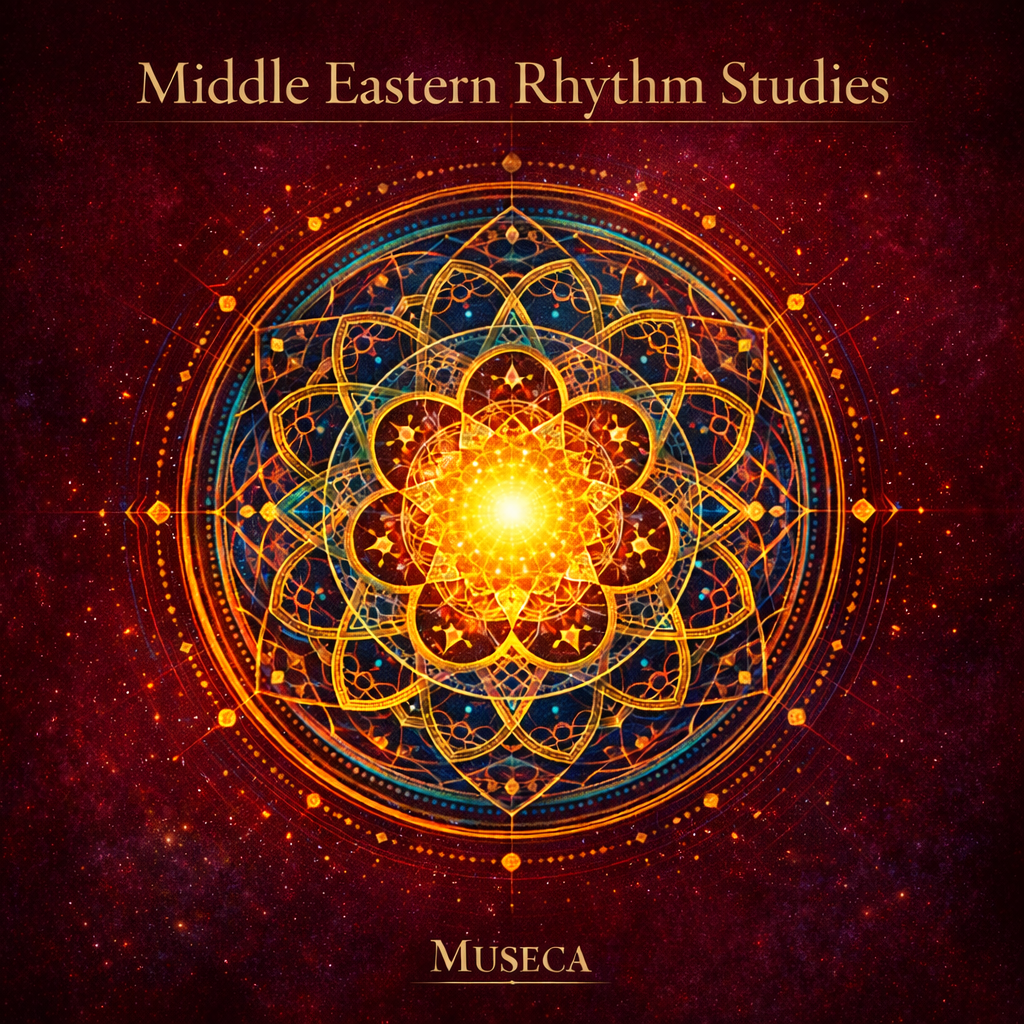
Middle Eastern rhythm is a world of patterned return, refined accent, and expressive pulse. Rather than relying only on simple metric repetition, many traditions in this broad musical sphere organize time through named rhythmic modes and recurring cycles shaped by strong and weak beats, ornamental motion, silence, and variation. Rhythm here often feels both grounded and fluid: precise in design, yet supple in execution; structured, yet breathing.
This page explores that rhythmic world through studies inspired by cyclical form, accent hierarchy, ornamented motion, and the balance between force and repose. Some pieces draw on the sensation of recurring patterned frames, while others focus on the lyrical and almost architectural way rhythm can shape musical space. Together, these works offer a tribute to the elegance, gravity, and subtle propulsion of Middle Eastern rhythmic thought.
Liner Notes
Maqsūm Voyage — (4/4, Arabic Iqa‘a)
Maqsūm is one of the most widely recognized rhythms in the Arab world, a pulse heard in classical ensembles, folk celebrations, and modern pop alike. Its balanced 4/4 structure, built from the interplay of dum and tek, forms the gentle threshold of this album. Maqsūm Voyage opens the journey with warm oud lines and spacious house textures, evoking the sense of setting out across familiar land before entering the asymmetrical territories ahead.
Sa‘īdī Dust Roads — (4/4, Upper Egypt)
Sa‘īdī introduces the earthy, unmistakable double-dum accent that defines Upper Egyptian folk music. Traditionally connected with tahtīb (stick dancing) and rural festivities, Sa‘īdī carries a dusty, sun-baked kinetic energy. The track reimagines this robust rhythm through a modern lens—where the constant forward thrust becomes a kind of ritual road-song guiding the listener deeper into the desert.
Masmūdī Horizon — (8/4, Arabic Classical)
Masmūdī kebīr is a long, majestic cycle that invites melodic expansion. This rhythm often accompanies ceremonial or expressive passages in classical takht ensembles. Here, its broad eight-beat carriage unfolds like a panoramic horizon—a slow procession across open terrain. The deep pulse of the darbuka anchors the piece while shimmering qanun textures outline a vast musical landscape.
Ten Steps of the Moon — (10/8, Samā’ī Thaqīl)
Samā’ī Thaqīl is a pillar of Arabic and Ottoman art music. Its distinctive 10/8 pattern—3+2+2+3— creates an elegant and noble gait, like walking in measured steps across a moonlit courtyard. In this track, the classical form is framed within a contemporary atmospheric groove, blending tradition and modernity. The melody seems to take “ten steps” before returning to its starting point, forming a graceful musical orbit.
Seven Lanterns — (7/8, Dawr Hindī)
The shift into asymmetry begins here. Dawr Hindī’s 7/8 (3+2+2) pattern flickers like lanterns hanging from narrow streets—uneven but hypnotic. Each phrase feels off-balance in a way that compels forward motion. The track paints a small nocturnal scene: dim alleys, warm light, and the gentle lilt of oud and clarinet weaving through a rhythm that never quite walks in a straight line.
Ottoman Spiral — (8, Düyek Usûl)
Düyek is one of the most fundamental usûl—Ottoman rhythmic modes central to classical art music. Unlike the shorter 4/4 iqa‘āt, Düyek’s eight-beat cycle carries a ceremonial poise. Here, it spins in a slow spiral, framed by bendir and ney, evoking the calm dignity of a palace courtyard. The ornamental textures of Ottoman tradition are subtly interwoven with modern production to preserve the rhythm’s architectural grace.
Aksak Caravan — (9/8, Turkish Aksak)
Aksak—literally “limping”—is the heartbeat of Anatolian asymmetry. Its 2+2+2+3 pattern mirrors the uneven gait of a caravan crossing rolling hills. This track captures that motion with a sense of resilient forward movement: steady yet irregular, determined but wandering. Saz motifs and Turkish percussion create a sonic landscape that sways between ruggedness and hypnotic calm.
Circle of Arūż — (Elastic 6/8, Persian Poetic Meter)
Persian rhythm often flows from the poetic system of arūż, where long and short syllables determine the musical contour. Unlike fixed drum cycles, arūż encourages elasticity—phrases breathe, expand, and contract like calligraphic lines on a page. Circle of Arūż follows this poetic arc, with setar and kamancheh tracing melodic curves that feel more spoken than counted. The result is a gentle dance between meter and meaning.
Tombak Echoes — (Microtimed 6/8 Étude)
The tombak is one of the most expressive hand drums in the world, capable of astonishing nuance through finger rolls, snaps, and subtle micro-timings. This track functions as an étude—a study in texture and articulation. Instead of locking into a rigid grid, the rhythm flows with the natural rubato of a master drummer, revealing how Persian percussion uses silence, breath, and small deviations to create emotional depth.
Zeibekiko Fire — (9/8, Greek Dance)
Zeibekiko is traditionally a solo dance—intensely personal, often improvised, and deeply emotional. The 2+2+2+3 rhythm gives it a swirling inward spiral, mirroring the dancer’s introspection. Zeibekiko Fire captures the smoky midnight atmosphere of an old taverna, where one person stands up, clears a small circle, and dances out their memory. The music honors that intimate ritual with restrained intensity and soulful bouzouki lines.
Karsilama Steps — (9/8, Greek Social Dance)
Karsilama transforms the same 9/8 subdivision into a social dance—face-to-face, joyful, often performed at weddings and island festivals. Where zeibekiko is solitary, karsilama is communal. This track brims with light: bright bouzouki, dancing violin, hand drums that sparkle like firelight, and a rhythmic buoyancy designed to lift the spirit. It is one of the album’s most festive moments.
Eastern Crescent — (7/8 + 9/8 Fusion Finale)
The closing piece unites two rhythmic worlds: 7/8 from the Arab and Eastern Mediterranean traditions, and 9/8 from the Greek and Turkish sphere. The music shifts between them like a crescent traveling across two night skies. This fusion embodies the album’s central idea: these rhythms are not isolated systems but interconnected expressions of a shared cultural continuum. The finale brings them into dialogue, forming a luminous arc that completes the journey.
Middle Eastern & Mediterranean Rhythm Studies — 12-Track Overview
| Track | Rhythm / Meter | Subdivision Structure | Style / Region | Pedagogical Focus |
|---|---|---|---|---|
| 1. Maqsūm Voyage | Maqsūm (4/4) | Dum–tek–tek–dum–tek pattern | Arabic (Levant / Egypt) | Foundation of iqa‘āt; dum vs tek hierarchy; adapting traditional groove into modern context |
| 2. Sa‘īdī Dust Roads | Sa‘īdī (4/4) | Dum–dum–tek–dum–tek | Upper Egypt (Folk) | Strong accent placement; driving rhythmic identity; folk dance translation into groove |
| 3. Masmūdī Horizon | Masmūdī Kebīr (8/4) | Extended 8-beat cycle | Arabic Classical | Long-form phrasing; expanding beyond short loops; ceremonial rhythmic pacing |
| 4. Ten Steps of the Moon | Samā’ī Thaqīl (10/8) | 3+2+2+3 | Arabic–Ottoman Art Music | Additive meter awareness; mapping accents across 10 beats; melodic phrasing over asymmetry |
| 5. Seven Lanterns | Dawr Hindī (7/8) | 3+2+2 | Arabic / Eastern Mediterranean | Internalizing 7/8; asymmetrical phrasing; linking movement to accent structure |
| 6. Ottoman Spiral | Düyek Usûl (8) | Balanced 8-beat cycle | Ottoman–Turkish Classical | Understanding usûl as structural framework; ornamentation within cyclical stability |
| 7. Aksak Caravan | Aksak (9/8) | 2+2+2+3 | Turkish / Anatolian | “Limping” rhythm feel; uneven groove; translating asymmetry into forward motion |
| 8. Circle of Arūż | Poetic Meter (~6/8) | Elastic, text-driven phrasing | Persian Classical (Ghazal) | Mapping poetry to rhythm; flexibility vs strict meter; phrasing as linguistic flow |
| 9. Tombak Echoes | Microtimed 6/8 | Elastic with internal ornamentation | Persian Percussion | Micro-timing, finger technique, ghost notes; expressive timing beyond grid quantization |
| 10. Zeibekiko Fire | Zeibekiko (9/8) | 2+2+2+3 | Greek Urban / Rebetiko | Solo dance phrasing; emotional pacing; internalizing asymmetry through movement |
| 11. Karsilama Steps | Karsilama (9/8) | 2+2+2+3 | Greek Social Dance | Contrasting social vs solo rhythm use; articulation and buoyancy in shared dance |
| 12. Eastern Crescent | 7/8 + 9/8 Fusion | 3+2+2 → 2+2+2+3 | Pan-Eastern Fusion | Switching between additive meters; integrating regional systems; large-form rhythmic synthesis |
Playlist
- Maqsūm Voyage Museca 3:41
- Sa‘īdī Dust Roads Museca 3:54
- Masmūdī Horizon Museca 3:35
- Ten Steps of the Moon Museca 4:19
- Seven Lanterns Museca 4:43
- Ottoman Spiral museca 3:11
- Aksak Caravan Museca 3:27
- Circle of Arūż Museca 2:42
- Tombak Echoes Museca 1:54
- Zeibekiko Fire Museca 3:18
- Karsilama Steps Museca 2:43
- Eastern Crescent Museca 3:18