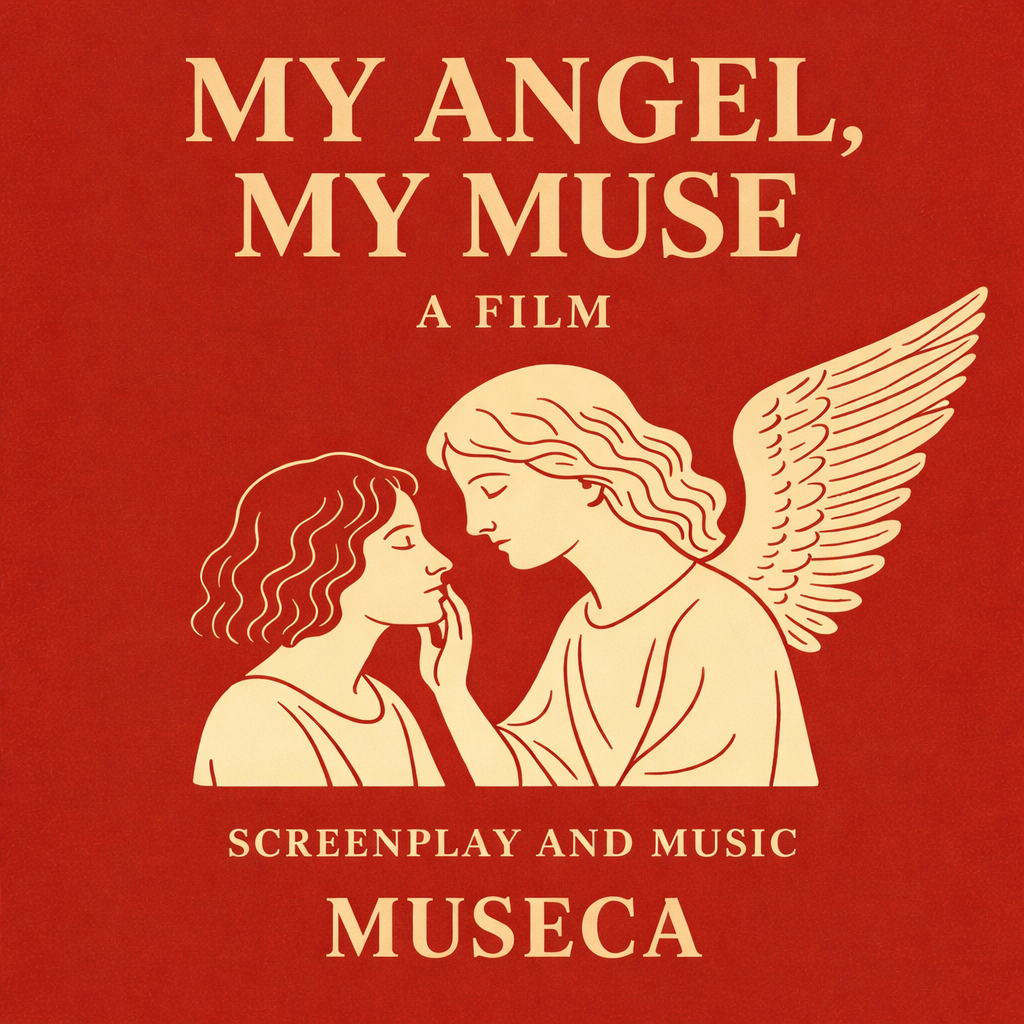
My Angel, My Muse
A Musical Screenplay in Two Acts
Written and composed by MUSECA
Some stories begin with a wound so early and so deep that the person carrying it cannot remember a time before the pain. My Angel, My Muse is one of those stories — and it is also, at its heart, a story about the love that was present even before the wound arrived.
Set in 19th-century Russia, the screenplay follows Mikhail Volkonsky, a composer of extraordinary natural gift, from childhood through crisis and — in the end — into a freedom he has never been able to imagine. The journey takes forty years of his life and, in the hands of the story, something close to a lifetime of the audience’s feeling.
Mikhail’s world is shattered at eight years old when his father Wilhelm, a man whose grief has curdled into rigidity, destroys the boy’s makeshift instrument — a row of porcelain water glasses filled to different levels, each one singing a different note — and delivers the blow that will define the next fifteen years: your mother died bringing you into the world. Her music died with her. What you are doing is noise. What you are is the reason she is gone.
This is a lie dressed as a fact. But to a child, there is no difference.
The only warmth in Mikhail’s world comes from Lisel, the family’s French governess, who presses his dead mother’s music box into his hands that same night and tells him the truth: you are not her destroyer. You are her greatest song. Then Wilhelm dismisses her from the household, and Mikhail is alone.
What neither he nor anyone around him can see is that he has never been alone. Celestine — his guardian angel and muse — has been present since before his birth. She dances when he plays. She holds the lamp when the room is dark. She is the breath before the note, the hush before the sound. He cannot see her. But she has never once looked away.
The first act follows Mikhail from childhood through the hollow triumph of his adult career. Technically brilliant, emotionally dead, celebrated in the glittering salons of St. Petersburg, he seeks the love Lisel and his mother represented in three women who cannot give it: Tatiana the diva, who offers fame dressed as nurturing; Natasha the dancer, who offers sensation dressed as warmth; Countess Volkonskaya, who offers control dressed as safety. Each of them is a mirror of his wound rather than a cure for it. The act ends in his private studio, surrounded by empty manuscript pages, the music box broken in his hands, playing three notes and then silence.
The second act is the journey home.
Celestine draws Mikhail’s sleeping spirit into a garden of memory where the healing the waking world could never offer becomes possible. He encounters Lisel as she truly is — radiant, unhurried, freed from mortality — and she repairs the music box and blesses him forward. He meets the children he used to be at every age he abandoned himself. He sees his father as his father truly was: not a monster but a drowning man, holding his dead wife’s music box in the dark, unable to wind the key. And in the most nakedly quiet moment of the entire story, Mikhail forgives himself — for surviving, for needing love, for losing his way — and Wilhelm’s ghost nods once and dissolves into light.
What remains is the music. Mikhail returns to his piano and plays the symphony he could never write — all the motifs of his life woven together and transformed. Celestine dances beside him, not rescuing but answering. And when the full company gathers in the finale, every soul who ever loved him returns in their healed form: Lisel radiant, his mother Maria visible at last, even Wilhelm reconciled. The music box plays one final time — no longer a lament but a promise — and the stage empties into gold.
My Angel, My Muse is a story about the love that waits without condition and the unbearable human difficulty of receiving it. It is about the difference between technique and truth, between the music we make to be heard and the music that lives in us whether anyone is listening or not. And it is, finally, about the particular mercy of realising — late, imperfectly, with considerable damage along the way — that the thing you have been searching for was never absent. It was only waiting for you to become quiet enough to hear it.
Listen the Original Soundtrack to My Angel, My Muse
Licensing and Production Inquiries
My Angel, My Muse is a fully protected original work. The manuscript, score, and all associated materials are available exclusively for review by qualified producers, theatrical companies, and licensing professionals with demonstrated experience in musical theatre production.
The work is not available for download, public distribution, or informal review. This is intentional. What has been built here deserves the right room, the right voices, and the right team.
If you are seriously interested in licensing or producing My Angel, My Muse, please send a direct inquiry to:
Your inquiry should include a brief introduction to yourself or your organisation, your background in theatrical production or licensing, the type of production you are envisioning, and the context in which you encountered this work.
All serious inquiries will receive a personal response.
© 2025 Museca. All rights reserved. No portion of this work may be reproduced, performed, adapted, or distributed without the express written permission of the author.