
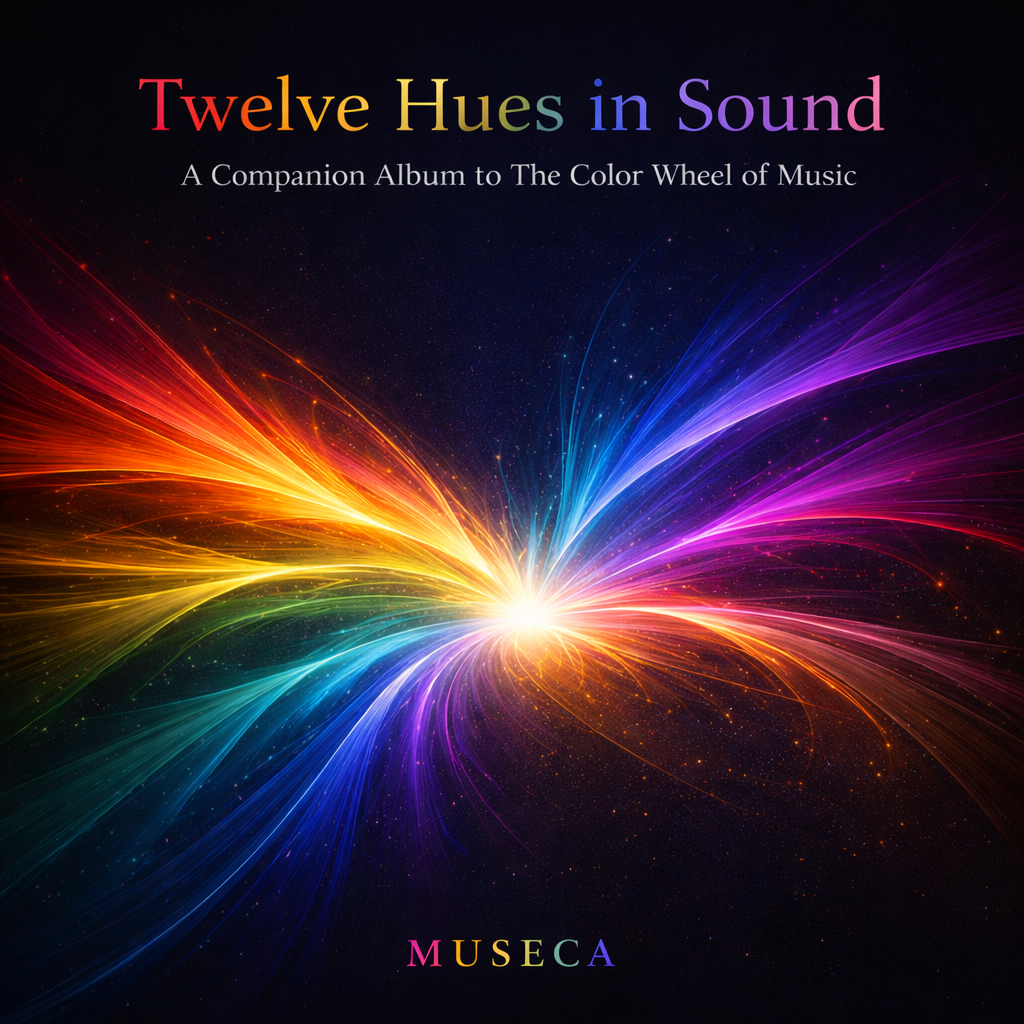
Twelve Hues in Sound is a listening companion to the textbook The Color Wheel of Music: A Practical Guide to Composing with Hue, Mood, and Sound. The book presents a practical system for translating color into musical decisions; this album allows that system to be heard. It is not merely inspired by the book. It is, in effect, the book rendered as sound: twelve concise instrumental studies, each built to embody one hue of the Museca color spectrum through key center, mode, intervallic emphasis, harmonic behavior, timbre, texture, register, pacing, and formal contour.
The central premise of The Color Wheel of Music is simple: color can function as a compositional language. Just as painters organize visual experience through hue, temperature, contrast, and saturation, composers can organize musical experience through comparable perceptual forces. In this system, each hue is paired with a tonal center and a characteristic modal world. Those choices are then reinforced through orchestration, chord design, melodic contour, rhythmic energy, and textural density. Color, in other words, is not treated as decoration or metaphor alone. It becomes an actual musical framework.
The wheel itself is organized as a twelve-hue circle aligned with twelve tonal centers. Each hue carries a distinct expressive identity. Red is grounded vitality. Orange is uplift and creative lift. Yellow is illumination and clarity. Green is balance and restoration. Blue-Green is stillness. Blue is reflection. Blue-Violet is mystery and inner vision. Violet is transcendence. Red-Violet is passion and inner fire. The hues between these principal stations act as bridges, softening or intensifying the emotional journey from one region of the spectrum to another. The result is a system in which musical motion can be understood not only as harmonic motion, but as color motion.
These twelve tracks are constructed according to that principle. Each piece begins with a chosen hue, and from that hue flows a chain of technical decisions. First comes the tonal center, which gives the piece its gravitational focus. Next comes the mode, which shapes its emotional chemistry: Lydian for uplift and radiance, Dorian for renewal and balance, Aeolian for inward calm, Phrygian for shadow and sacred mystery, Mixolydian for grounded warmth, harmonic minor for passionate tension. Then come the signature intervals that identify the color more precisely. A raised fourth may create luminosity and ascent; a lowered second may establish mystery at once; a flattened seventh may add warmth and earth; a raised seventh may intensify yearning and fire.
Harmony is then used not simply to progress, but to confirm hue. Each color has characteristic chordal behavior. Bright hues often favor open sonorities, wider spacing, and harmonic frames that breathe upward. Cooler or darker hues favor drones, sustained pedal tones, slower harmonic rhythm, and more suspended or modal tension. This album uses those harmonic profiles carefully so that each track sounds not only different in mood, but different in internal structure. The listener is meant to hear that Yellow does not merely feel brighter than Blue-Violet; it is built differently.
Timbre plays an equally decisive role. In this system, instrumentation is part of color translation. Warm hues tend toward piano, strings with forward resonance, light brass, and tactile pulse. Green and Yellow-Green inhabit a more organic middle ground, where clarinet, viola, soft piano, and gently blended ensemble colors can suggest equilibrium, breath, and renewal. Blue-Green and Blue turn toward muted strings, transparent winds, spacious piano voicings, and cooler resonance. Blue-Violet deepens into low strings, bass clarinet, dark pads, and shadowed drones. Violet ascends through high strings, harp, celesta, and choir-like luminosity. Red-Violet returns warmth to the system, but now charged with inward intensity: solo violin, dark piano, rich strings, and harmonic-minor gravity.
Texture is another essential translator of color. The album does not treat all twelve pieces as the same kind of miniature with different scales. Each hue requires its own surface and motion. Some tracks depend on ostinato and pulse; others on suspended harmonic fields; others on ascending arpeggiation; others on slow, evolving layers. Rhythmic activity decreases as the wheel moves from the warm, physical, earthbound region into the deeper cool hues, then changes character again as the music ascends toward Violet and returns through Red-Violet into human emotional fire. Even silence and sustain are part of the color vocabulary.
The album is written in a unified modern cinematic chamber / neoclassical crossover language so that the listener can hear the differences of hue without being distracted by abrupt genre changes. This is important. If each track belonged to a completely different style, the ear might register “genre” more strongly than “color.” By keeping the sonic world cohesive—piano, strings, selected winds, harp or mallet color, subtle ambient support, restrained percussion—the album makes hue itself the primary source of contrast. The listener hears the spectrum not as twelve unrelated compositions, but as twelve distinct emotional color studies within one musical world.
The sequence of the album also matters. It follows a meaningful arc through the wheel. The first tracks inhabit the warm hemisphere: pulse, warmth, lift, friendliness, illumination. From there the music crosses into the hinge region of renewal and balance, then descends into stillness, reflection, and mystery. It rises again toward transcendence, then concludes the principal twelve-track cycle in Red-Violet, where sacred awe returns to human emotional intensity. In this way, the album demonstrates that the color wheel is not only a taxonomy; it is a narrative device. It can organize emotional form over time.
For the listener who is new to the system, one of the best ways to use this album is comparatively. Notice how a change of mode changes not just pitch material, but emotional light. Listen to what happens when the raised fourth enters a bright track: the music seems to open upward. Listen to how a flattened seventh warms a tonal center and makes it feel more grounded and communal. Listen to how low-register timbres and sustained drones alter the emotional temperature of a track even before the melody is fully established. Listen to how transparency, spacing, pedal tones, and instrumental color can make two adjacent hues feel related, while changes of interval, range, and harmonic tension can make distant hues feel dramatically opposed.
That is the underlying aim of this companion album: to make the translation from color to sound intelligible by ear. A hue in this system is never just a poetic label placed on top of finished music. It is the source of the music’s construction. Color determines center; center determines modal tendency; mode determines intervallic color; intervallic color shapes melody and harmony; harmony and hue then guide instrumentation, texture, pacing, and form. What the listener hears is the end result of that chain.
These twelve tracks are therefore both artistic pieces and demonstrations. They are not dry examples, and they are not meant to feel schematic. Each one is intended to stand on its own as a beautiful miniature. But together they form a practical sonic atlas: a way of hearing how hue can become harmony, how mood can become orchestration, and how visual intuition can become a disciplined musical language.
This is the world of The Color Wheel of Music made audible. Listen to the spectrum. Hear how color becomes structure. Hear how timbre becomes light. Hear how mode becomes emotion. Above all, hear how a composer can use hue not as ornament, but as a real and usable principle of design.
You can download a free PDF copy of The Color Wheel of Music: A Practical Guide to Composing with Hue, Mood, and Sound to explore the full system behind this album. The book explains in detail how each hue is translated into musical elements such as mode, harmony, timbre, and form, allowing you to follow along with each track and experience how color becomes sound.
Liner Notes
Red: Vitality and Pulse
Red is built on C Mixolydian, a mode chosen for its combination of stability and raw forward motion. The major third keeps the sound open and strong, but the lowered seventh softens the brightness just enough to prevent the track from feeling triumphal in a Yellow sense. Instead, it stays grounded, physical, and embodied. The harmonic frame favors I–♭VII–IV behavior and pedal-centered motion, because Red in the color-wheel method is less about harmonic sophistication than about pulse, stance, and presence.
The orchestration supports that identity directly. Rhythmic piano establishes the piece as kinetic from the opening bars, while low strings reinforce weight and bodily momentum. Light percussion is used not as spectacle but as a structural spine. Brass appears in controlled accents so the track projects strength without turning into overt cinematic bombast. Every element serves the Red premise: a music of pulse, warmth, and grounded vitality.
Red-Orange: Warmth and Celebration
Red-Orange shifts to G Ionian with touches of Mixolydian, preserving warmth while loosening Red’s muscular emphasis into something more social and melodic. The color-wheel method treats Red-Orange as the first outward expansion of energy: not just life-force, but shared motion. That is why the harmonic language remains simple and clear, often drawing on I–IV–V and I–♭VII–IV frameworks. These progressions feel open, communal, and naturally singable, which suits the color’s function.
The texture is correspondingly more melodic and flowing than Track 1. Piano writing becomes less ostinato-driven and more conversational, while strings are voiced to support horizontal movement rather than weight. Soft wind or horn color adds warmth at the edge of the texture, giving the piece a gently public character. The result is a study in how a small shift of tonal center, modal bias, and orchestral balance can move music from vitality into welcome.
Orange: Creativity and Lift
Orange is rooted in D Lydian, and that raised fourth is the defining feature of the piece. In the color-wheel system, Lydian is one of the clearest musical correlates of luminous ascent, and Orange specifically uses it to express imagination, openness, and upward motion. The harmony is therefore designed to keep the tonic stable while allowing brightness to bloom above it, often through progressions such as I–II–V or sustained tonic fields colored by the #4.
The orchestration translates that lifted harmonic language into sound. Arpeggiated piano figures act almost like light beams, giving the track a natural upward contour. Upper strings and airy winds reinforce transparency, while the texture avoids heaviness in the lower register. Orange must sound buoyant without becoming merely decorative; for that reason, the track keeps a clear melodic profile and modal identity throughout. It demonstrates how the same chamber palette can be rebalanced to suggest a different hue-world altogether.
Yellow-Orange: Friendly Brightness
Yellow-Orange is composed around A Ionian with occasional Mixolydian inflection, which gives it clarity and warmth without the more visionary brightness of full Lydian writing. In the color-wheel method, Yellow-Orange is not ecstatic or revelatory; it is approachable. That is why the harmonic language remains direct and lightly smiling, with cadences and phrase structures that feel natural rather than striking. The use of Mixolydian color in select places adds human warmth and keeps the music from becoming overly polished.
Texture is especially important here. The rhythmic motion is lighter and more relaxed than Red or Red-Orange, and the melodic writing is designed to feel open and accessible. Piano and strings carry most of the harmonic body, but the voicings are intentionally transparent. This track shows how a hue can be conveyed not only by scale choice, but by how strongly or gently the music asks for the listener’s attention. Yellow-Orange is brightness without pressure.
Yellow: Illumination and Clarity
Yellow is built in E Lydian, using the raised fourth as its primary signal of radiance and openness. In the color-wheel framework, Yellow represents illumination, insight, and clear perception. Its construction therefore depends on harmony that feels expansive rather than directional. Chordal writing often emphasizes resonance over tension, and the melodic language rises with clarity instead of yearning. Yellow does not search; it reveals.
The arrangement reinforces this sense of revelation. Bright piano, light flute color, subtle bell timbres, and upper strings create a field of luminous transparency. Unlike Orange, which feels imaginative and ascending, Yellow feels already lit. That distinction is technical as much as emotional: the voicings are more open, the pacing slightly more serene, and the timbral edges cleaner. This is a good example of how two adjacent bright hues can share modal language while differing in contour, orchestral emphasis, and emotional posture.
Yellow-Green: Renewal and Awakening
Yellow-Green occupies a hinge position in the wheel, and its musical language reflects that transitional role. It is based on B Dorian, whose natural sixth keeps the minor quality from becoming heavy. In the color-wheel method, Dorian is one of the most useful modes for expressing renewal, balance, and gentle emergence. The harmony therefore avoids both the settled brightness of the major hues and the inward shadow of the cooler minor hues. Instead, it circulates.
That circular quality is built into the texture. Flowing ostinati, warm woodwind lines, and soft string support create a sense of movement that is organic rather than driven. The piece is carefully orchestrated to sound alive but not excited. This is important: renewal in the color-wheel system is not a dramatic rebirth but a quiet return of breath. Yellow-Green demonstrates how mode, register, and pacing can create a feeling of emotional reopening.
Green: Balance and Healing
Green sits at the center of the wheel and functions as a point of equilibrium. Its musical construction draws on F♯ Mixolydian with Dorian shading, allowing the piece to balance warmth and calm without tipping strongly toward either major brightness or minor introspection. In the color-wheel method, Green is less about directional motion than about restoration and internal steadiness. Harmonic movement is therefore moderate and spacious, often relying on stable modal frameworks rather than strong cadential pressure.
The orchestration is deliberately centered in the middle registers. Clarinet, viola, and soft piano are used because they occupy a natural emotional middle ground: warm but not glowing, cool but not dark. The texture breathes and leaves room between gestures. Green works technically by reducing extremes—of register, of rhythm, of harmonic urgency—so that balance itself becomes audible. This track is one of the clearest demonstrations that hue in this system is as much about proportion as it is about pitch content.
Blue-Green: Calm and Stillness
Blue-Green turns decisively inward through C♯ Aeolian with slight Dorian warmth available at the margins. Aeolian is used here because it supports introspection without demanding dramatic tension. In the color-wheel method, Blue-Green is the hue of stillness, interior quiet, and reflective depth. For that reason, the harmony moves slowly, the melodic shapes are modest, and the tonal field is allowed to hover rather than advance.
Muted strings, bass clarinet color, sparse piano, and deep ambient support create the sound-world necessary for that calm. The track is built to let silence function structurally. Notes are given time to decay. The harmonic rhythm is restrained. Blue-Green shows how the wheel translates emotional coolness into compositional technique: reduced activity, darkened timbre, sustained spacing, and modal stability. It is still music of color, but now color heard as atmosphere.
Blue: Insight and Reflection
Blue is based on G♯ Mixolydian, a somewhat unexpected choice that is central to its character in this system. Rather than using Blue to represent sadness in a conventional minor-key sense, the color-wheel method defines Blue as reflection, insight, and cool clarity. Mixolydian provides enough brightness to preserve lucidity, while the lowered seventh introduces a contemplative softness. This prevents the track from sounding either too warm or too mournful.
The instrumental design is correspondingly transparent. Flute, clear piano tones, and lightly voiced strings give the track a crystalline quality. The phrase shapes are measured and poised, and the harmonic writing favors openness over density. Blue demonstrates that coolness in music need not be dark; it can also be lucid. Technically, the piece shows how color identity can emerge from a subtle recalibration of mode, register, and timbral purity rather than from dramatic harmonic change.
Blue-Violet: Mystery and Inner Vision
Blue-Violet is constructed in E♭ Phrygian, with the lowered second introduced early so the hue is unmistakable from the outset. In the color-wheel system, this is the primary region of sacred mystery, inner vision, and esoteric atmosphere. Phrygian is essential because its interval structure creates immediate tension without relying on conventional dramatic devices. The color is not achieved by thickness alone, but by modal gravity.
The orchestration deepens that gravity. Low strings, bass clarinet, dark pads, and slow ostinati create a suspended field in which the lowered second can resonate meaningfully. Harmonic motion is intentionally limited, because too much progression would weaken the sense of inward concentration. This track is one of the clearest demonstrations that musical color can be built from a single intervallic premise when harmony, timbre, and pacing all cooperate. Blue-Violet is mystery structured through restraint.
Violet: Transcendence and Wonder
Violet returns to brightness, but not to the outward brightness of Yellow. It is built in B♭ Lydian, where the raised fourth produces lift, but the surrounding orchestral and registral design turns that lift into awe rather than clarity. In the color-wheel method, Violet is the hue of transcendence, wonder, and the threshold of the numinous. The harmony therefore favors suspension, spacious tonic resonance, and slowly unfolding radiance rather than melodic insistence.
High strings, harp, celesta, and choir-like textures are central because Violet depends on vertical luminosity. The music must feel as though it is floating rather than stepping. That difference is technical: fewer grounded rhythmic markers, more sustained resonance, softer attacks, and more overtone-rich layering. Violet shows how the same Lydian principle that generated illumination in Yellow can, through orchestration and pacing, be transformed into spiritual wonder.
Red-Violet: Passion and Inner Fire
Red-Violet closes the visible 12-hue cycle by joining warmth to depth. It is written in F harmonic minor with occasional melodic-minor inflection, using the raised seventh to generate internal heat and expressive tension. In the color-wheel method, Red-Violet is passion that has passed through mystery and transcendence. It is not raw like Red, and not shadowed like Blue-Violet; it is emotionally lit from within. The harmony therefore favors tension-and-release patterns that feel lyrical and human rather than purely modal.
Solo violin, warm strings, and dark piano are the principal carriers of that intensity. The line is allowed more rubato and expressive contour than in the earlier tracks, because this hue demands subjectivity. The raised seventh plays a crucial structural role, sharpening the pull of the harmony and making the emotional heat audible. Red-Violet demonstrates how the color-wheel method can culminate not in closure through neutrality, but in closure through distilled emotional fire.
Black: Shadow and Threshold
The bonus track stands outside the twelve-hue cycle and functions as the edge of the map. It is composed in B Locrian, a choice that gives the album a true threshold study rather than a thirteenth hue. In the color-wheel logic, Black is not a visible color within the spectrum but the shadow beyond it—the seam where structure destabilizes. Locrian is indispensable here because the diminished fifth immediately undermines tonal security. The track is built around that instability.
Its orchestration is intentionally sparse: low piano, bass clarinet, muted strings, and very limited resonance above the middle register. The harmonic field does not seek heroic resolution, and the pacing is suspended almost to the point of non-arrival. This is crucial. Black must sound like a door left ajar rather than a final cadence. As a companion to the textbook, it extends the wheel concept by showing that every ordered system implies an edge, and that even the shadow beyond the spectrum can be translated into sound through interval, register, texture, and restraint.
Playlist
- Track 1 — Red — Vitality and Pulse Museca 2:40
- Track 2 — Red-Orange: Warmth and Celebration Museca 2:44
- Track 3 — Orange: Creativity and Lift Museca 2:29
- Track 4 — Yellow-Orange: Friendly Brightness Museca 2:10
- Track 5 — Yellow: Illumination and Clarity Museca 2:47
- Track 6 — Yellow-Green: Renewal and Awakening Museca 1:53
- Track 7 — Green: Balance and Healing Museca 2:56
- Track 8 — Blue-Green: Calm and Stillness Museca 3:55
- Track 9 — Blue: Insight and Reflection Museca 1:49
- Track 10 — Blue-Violet: Mystery and Inner Vision Museca 2:52
- Track 11 — Violet: Transcendence and Wonder Museca 3:15
- Track 12 — Red-Violet: Passion and Inner Fire Museca 3:00
- Bonus Track 13 — Black: Shadow and Threshold Museca 3:12