
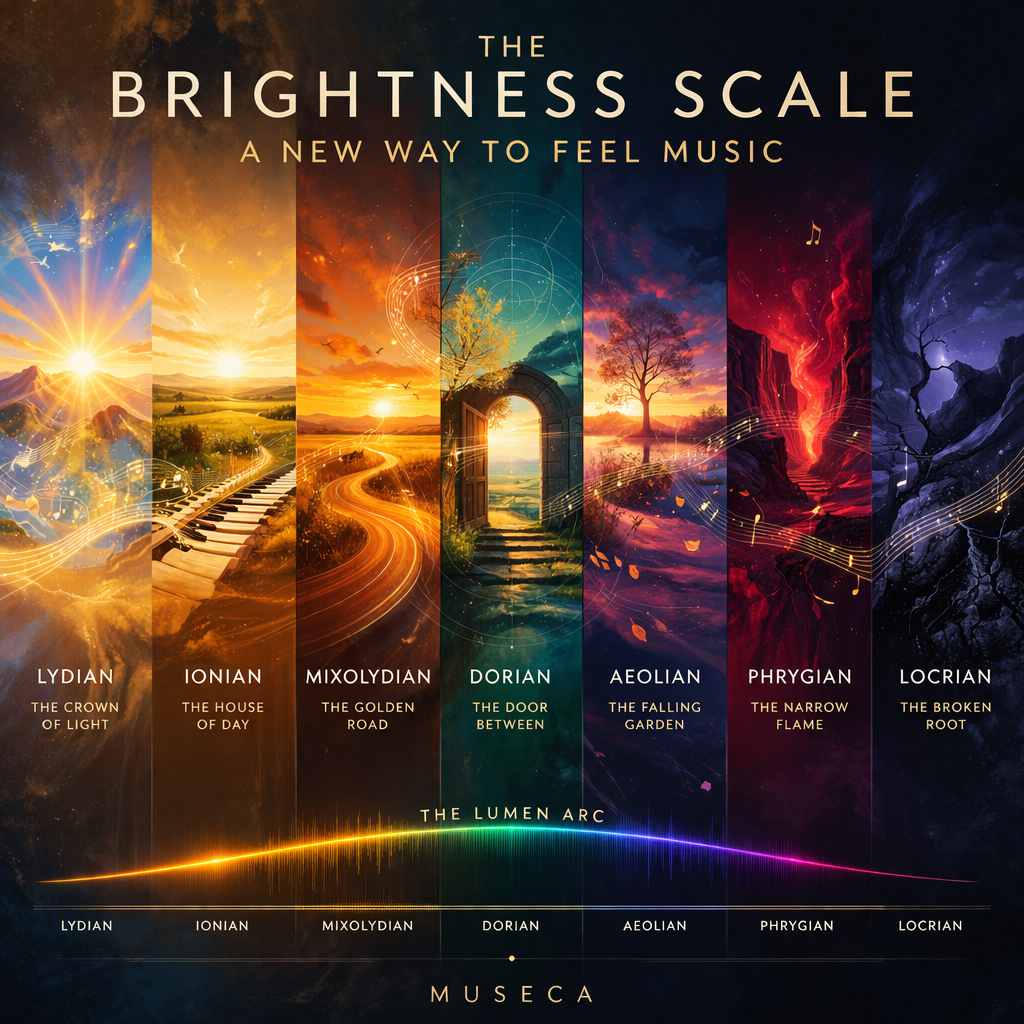
The Brightness Scale: A New Way to Feel Music is a practical listening model and compositional demonstration derived from the Lumen Arc: a reordered understanding of the seven diatonic modes according to their perceived degree of tonal radiance, gravitational pull, and structural openness. Rather than presenting the modes in the conventional scalar-rotation order—Ionian, Dorian, Phrygian, Lydian, Mixolydian, Aeolian, Locrian—this album follows a different logic: Lydian → Ionian → Mixolydian → Dorian → Aeolian → Phrygian → Locrian. This is not a historical reclassification, but a perceptual and compositional one. The Lumen Arc hears the diatonic field as a continuum of diminishing brightness.
From a technical standpoint, the Brightness Scale may be understood as a stepwise reduction of what might be called brightness-bearing scale functions. In this model, six degrees are treated as principal contributors to tonal light: ♯4, 7, 3, 6, 2, and 5. Each contributes a distinct kind of illumination. The raised fourth provides spectral lift and anti-gravitational shimmer; the leading tone supplies directed tonal attraction; the major third establishes immediate brightness of quality; the major sixth preserves openness and hope within the upper structure; the major second contributes breadth and forward space; and the perfect fifth, though often taken for granted, provides the deepest structural foundation of tonal stability. Read this way, the modes form a controlled dimming process. Lydian contains the full luminous apparatus. Ionian removes only the raised fourth. Mixolydian then weakens dominant-tonic teleology by lowering scale degree 7. Dorian darkens the third while retaining the major sixth. Aeolian lowers that sixth and withdraws the mode’s last reserve of minor-mode hopefulness. Phrygian compresses the field further by lowering the second. Finally, Locrian destabilizes the tonic structure itself by lowering the fifth, replacing foundation with fracture.
This album is therefore not merely a set of seven modal studies. It is an attempt to let composers hear the diatonic system as a single luminous continuum whose modal regions can be compared under controlled conditions. For that reason, the genre is held constant throughout: a unified lyrical cinematic orchestral language with related instrumentation, similar formal breadth, and comparable melodic clarity. The variable is not style, but modal condition. The listener is invited to attend to how each mode alters melodic contour, harmonic implication, cadential posture, registral space, and affective gravity.
Within the Lumen Arc, Dorian occupies a special position. It is the hinge of the system: still minor, but not yet resigned; darkened in quality, yet not emptied of ascent. Its retained major sixth prevents full modal closure into sorrow and gives it threshold energy—neither bright day nor full night. For this reason, Dorian functions here as the central turning-point of the album. On one side lie the brighter modes, whose interval content preserves greater openness, directedness, and tonal confidence. On the other lie the darker modes, in which closure weakens, tension narrows, and harmonic ground becomes progressively less secure.
For composers, the purpose of this album is exact and practical: to hear how modal identity is not only scalar, but structural. A mode is not simply a collection of pitches. It is a hierarchy of intervallic permissions and denials. It governs which tones attract, which tones release, which tones hover, and which tones wound the tonic from within. By arranging the seven modes into the Brightness Scale, the Lumen Arc offers a way to think compositionally about modal color as a graded phenomenon rather than a catalog of separate options. The result is a theory that can be heard immediately: one spectrum, seven stations, and a progressive transformation of tonal light into tonal shadow.
For readers who wish to explore the theoretical foundation behind this album in greater depth, the full conceptual framework is presented in the Museca Musical Textbook Series volume:
The Lumen Arc: Understanding the Seven Modes as a Brightness Spectrum
That textbook develops the underlying argument in formal detail, including the reordered modal sequence, the six brightness-bearing scale functions, the structural role of Dorian as the central hinge, and the broader applications of the system to analysis, composition, and listening. Click here to go to the textbook page.
Liner Notes
The Crown of Light opens the cycle in Lydian, the brightest position in the Lumen Arc and the point of maximum tonal lift. Its defining color is the raised fourth, which alters the gravitational behavior of the scale by loosening the ordinary subdominant frame and introducing a sense of levitation above the tonic. In compositional terms, Lydian permits tonic affirmation without immediate enclosure; the mode feels stable, but aerated. The orchestration therefore emphasizes shimmer, vertical openness, and suspended radiance. Melodic lines are allowed to arc upward into the upper structure, and harmonic pacing favors breadth over urgency. This is the system before any dimming has begun: all brightness-bearing functions remain intact.
The House of Day moves from Lydian to Ionian by making the first and most delicate subtraction: ♯4 returns to 4. Nothing else is altered. The tonic remains major, the leading tone remains active, and the upper structure retains its clarity, but the field no longer glows from within. What disappears is not brightness altogether, but spectral lift. The result is a mode that feels more earthbound, more architectonic, and more classically centered. In this track, the melodic writing becomes slightly more settled, cadential implication becomes firmer, and the orchestral light is warmer rather than haloed. Ionian is still bright, but it no longer hovers. It stands.
The Golden Road moves from Ionian to Mixolydian by lowering scale degree 7. This is a profound change, because it weakens the leading tone and therefore reduces the directed pull into tonic closure. The mode remains major through its third, but its teleology softens. One feels less arrival, more continuation. That is why Mixolydian often carries a sense of breadth, travel, and horizon: it does not insist on resolution in the same way Ionian does. In this piece, cadential rhetoric is intentionally relaxed, phrase endings breathe outward rather than inward, and melodic contours can lean into openness without the same gravitational demand to close. The color shifts from daylight structure to golden motion.
The Door Between moves from Mixolydian to Dorian by lowering scale degree 3, changing the modal quality from major to minor while retaining the major sixth. This is the crucial hinge of the whole system. With the minor third, the emotional surface darkens immediately; yet because the sixth remains raised relative to natural minor, the mode does not collapse into resignation. It remains poised, tensile, and quietly mobile. Dorian is therefore not merely “minor with a major sixth,” but a special threshold condition in which grief and resilience coexist. In this track, the harmony grows more inward, the melodic line narrows slightly and becomes more reflective, yet the retained sixth keeps the music from sealing shut. The result is a mode of passage, balance, and evening intelligence.
The Falling Garden moves from Dorian to Aeolian by lowering scale degree 6. This removes Dorian’s last reserve of upward breath. What remains is the fully darkened minor field of natural minor: stable enough to sustain lyric beauty, but no longer protected by that Dorian glimmer of continuance. The emotional effect is not merely sadness, but a particular kind of tonal inwardness in which phrases seem to remember more than they project. In this piece, the melodic contour falls more often than it rises, the harmonic pacing deepens into elegiac weight, and the orchestration softens into dusk colors. Aeolian does not wound the tonic, but it no longer brightens it from above. The mode has entered memory.
The Narrow Flame moves from Aeolian to Phrygian by lowering scale degree 2. This is one of the most dramatic single-step changes in the cycle, because the second degree governs so much of melodic approach, registral breathing, and perceived lateral space. With the lowered second, the field contracts. Motion toward the tonic becomes tighter, more pressurized, and more intimate. The mode acquires a distinctly inward heat: less lament than vigilance, less sorrow than concentrated tension. In this track, melodic gestures are shorter and closer-grained, the harmonic rhythm allows dissonant color to linger, and the lower orchestral registers become more prominent. Phrygian is not merely darker than Aeolian; it is more compressed, more ritualized, and more severe in its intervallic atmosphere.
The Broken Root moves from Phrygian to Locrian by lowering the final pillar: scale degree 5. This is the decisive break in the system, because the perfect fifth is not just another color tone; it is the deepest structural brace of the tonic. Once it is diminished, the tonic triad can no longer form in ordinary stability. The result is not simply a darker mode, but a mode in which foundation itself is compromised. Locrian therefore represents the end point of the dimming process: not only reduced brightness, but weakened ground. In this piece, melodic writing becomes fractured, harmonic implication remains suspended, and cadences are deliberately denied full settlement. The orchestration thins and darkens around the unstable axis, allowing beauty to persist without reassurance. Where Lydian began as radiance suspended above certainty, Locrian ends as form surviving at the edge of structural collapse.
Playlist
- Track 1 - The Crown of Light Museca 1:43
- Track 2 - The House of Day Museca 2:23
- Track 3 - The Golden Road Museca 3:13
- Track 4 - The Door Between Museca 2:45
- Track 5 - The Falling Garden Museca 3:23
- Track 6 - The Narrow Flame Museca 3:25
- Track 7 - The Broken Root Museca 3:40