
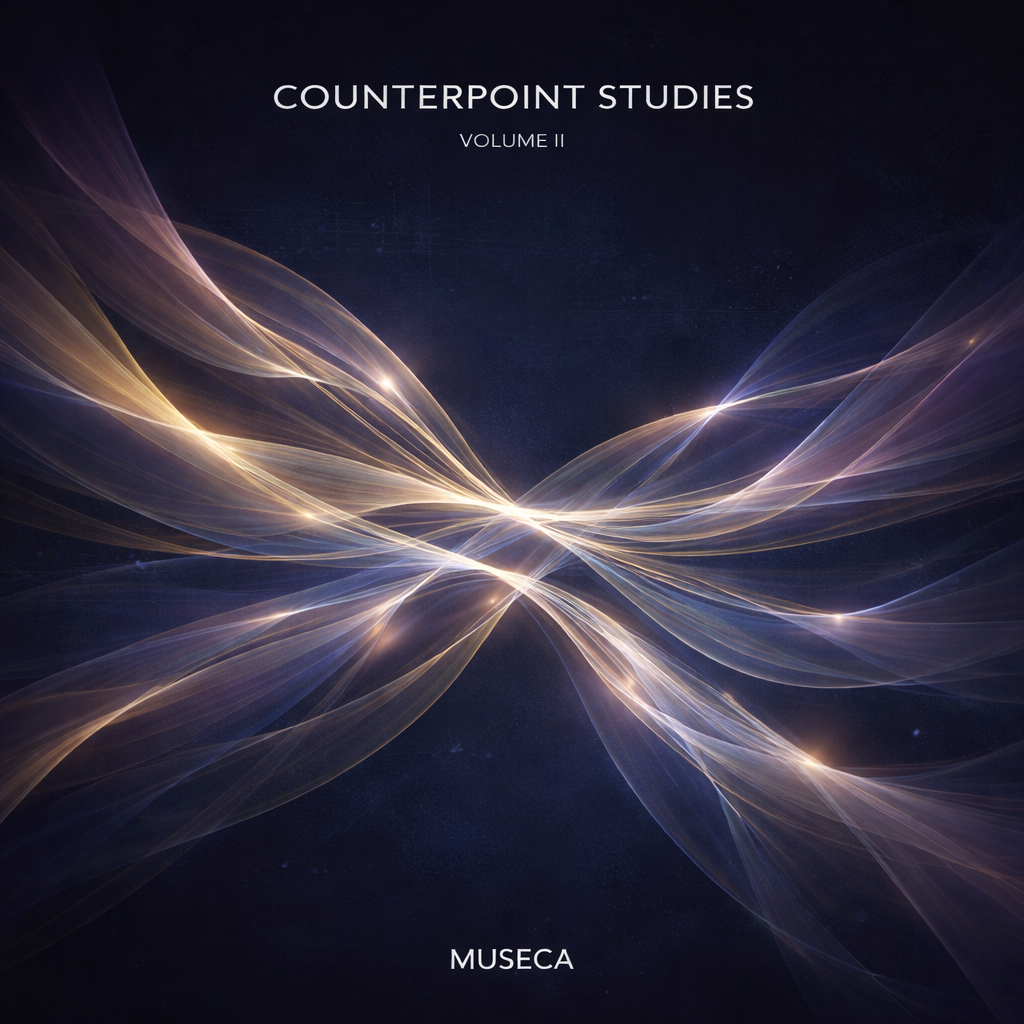
Counterpoint Studies, Vol. II takes the same core principle as the first volume—independent voices creating meaning together—and moves it into a more lyrical, poetic, and intimate world. Where Counterpoint Studies, Vol. I often presents counterpoint in its clearer architectural forms—duet, canon, invention, fughetta, six-voice polyphony, and micropolyphonic expansion—Vol. II is less concerned with demonstrating the structure and more concerned with inhabiting it. The lines still weave, imitate, answer, and overlap, but here they do so with a softer glow, a more chamber-like warmth, and a stronger sense of atmosphere.
If the first volume is the listener’s entryway into counterpoint as craft, the second feels like stepping inside the house after dark. The music is more vocal in spirit, even when instrumental; more sensual in phrasing; more reflective in tone. Pieces such as Dialogue in Still Air and Conversations in Glass Light open the album with transparency and delicacy, allowing the listener to hear contrapuntal motion as conversation rather than demonstration. Wordless Aria for Three and Voices Over Ground deepen that experience, showing how independent lines can carry both intimacy and structural elegance at once. By the time the album reaches Waltz of Two Strings, Six Windows of Light, Chamber of Six Lines, and Six Strings in Shadow, the language of counterpoint has become fully expressive—no longer simply a study of interdependence, but a chamber-poetic world of its own.
This makes the distinction between the two volumes especially satisfying. Counterpoint Studies, Vol. I leans toward clarity, progression, and the audible mechanics of the art. Its emotional arc moves from the intelligibility of two voices toward the complexity of larger polyphonic textures. Vol. II, by contrast, is more inward and artistic in its center of gravity. It still teaches, but indirectly—through beauty, mood, and repeated listening rather than formal presentation. One might say that the first volume explains how counterpoint works, while the second reveals why it matters.
Together, the two albums form a complementary pair. Vol. I offers the listener the skeleton and the architecture; Vol. II offers breath, color, and shadow. The first shows counterpoint as design. The second lets it become atmosphere, memory, and song.
Liner Notes
Taken together, Counterpoint Studies, Vol. II reveals a different side of contrapuntal writing than the first volume. These pieces are less overtly architectural and more chamber-poetic, more interested in atmosphere, intimacy, and resonance. They show that counterpoint is not only a discipline of construction, but a language of relationship—capable of stillness, tenderness, motion, and shadow, all while allowing each voice to remain fully itself.
Dialogue in Still Air
This opening piece introduces the album in its most transparent form. The lines do not press forward so much as hover, listening to one another in a shared stillness. Counterpoint here feels less like argument and more like presence—each voice distinct, each one shaping the space around it. The result is airy, reflective, and quietly invitational, as though the album is opening a window rather than making an entrance.
Conversations in Glass Light
Where the first piece breathes in open air, this one glows from within. The lines are more luminous, more finely etched, and the interplay has a glass-like clarity that lets each phrase catch the light differently. Counterpoint becomes conversation in the truest sense: ideas passed gently from one voice to another, never colliding, always refracting. The mood is intimate and lucid, with a brightness that remains delicate rather than dazzling.
Wordless Aria for Three
Here the contrapuntal language becomes almost vocal in its emotional character. Three lines move with the expressive freedom of singing, even without words, shaping a chamber aria whose meaning lies in breath, contour, and response. The voices do not support a melody; they become one another’s meaning. There is tenderness in the way they overlap, and a sense that song begins where speech gives way.
Voices Over Ground
Built above a repeating foundation, this piece explores how constancy can generate freedom rather than limit it. The ground beneath the music gives the upper lines something firm to move against, allowing the counterpoint to become more searching, more layered, and more patient. What repeats does not feel static; it feels inevitable. Above it, the voices gather, separate, and return, as though thought itself were circling a single truth from different angles.
Waltz of Two Strings
This is counterpoint in motion—graceful, lyrical, and touched by memory. The waltz rhythm gives the dialogue between the two string voices a gentle turning quality, as if they are circling the same emotional center without ever standing still. Their independence remains clear, yet they move with such mutual awareness that the music feels almost choreographed. Elegance and nostalgia meet here in equal measure.
Six Windows of Light
The album opens outward in this piece, moving from chamber intimacy toward a broader, more luminous polyphony. Six independent lines create a space that feels architectural, as if light were entering a room through multiple windows at once. Each strand carries its own contour, but together they form a radiant weave whose beauty lies in collective motion. The effect is expansive without losing clarity.
Chamber of Six Lines
If the previous piece opens the room, this one inhabits it. The same six-voice richness becomes more inward, more reflective, and more warmly enclosed. The lines interweave with a sense of patience and depth, allowing the listener to feel the architecture of the texture from the inside. Counterpoint here becomes dwelling: not simply many voices at once, but many voices belonging to the same interior world.
Six Strings in Shadow
The album closes by moving into darker ground without abandoning beauty. The six voices remain lyrical, but the harmonies grow heavier, the spacing more dramatic, and the emotional tone more shaded. Light has not disappeared; it has become shadowed, refracted through gravity and restraint. The closing sensation is not collapse, but deepening—a final reminder that counterpoint can carry not only brightness and clarity, but also mystery, weight, and dusk.
Playlist
- Dialogue in Still Air Museca 2:45
- Conversations in Glass Light Museca 2:15
- Wordless Aria for Three Museca 1:56
- Voices Over Ground Museca 2:38
- Waltz of Two Strings Museca 2:14
- Six Windows of Light Museca 1:12
- Chamber of Six Lines Museca 3:40
- Six Strings in Shadow Museca 2:59