
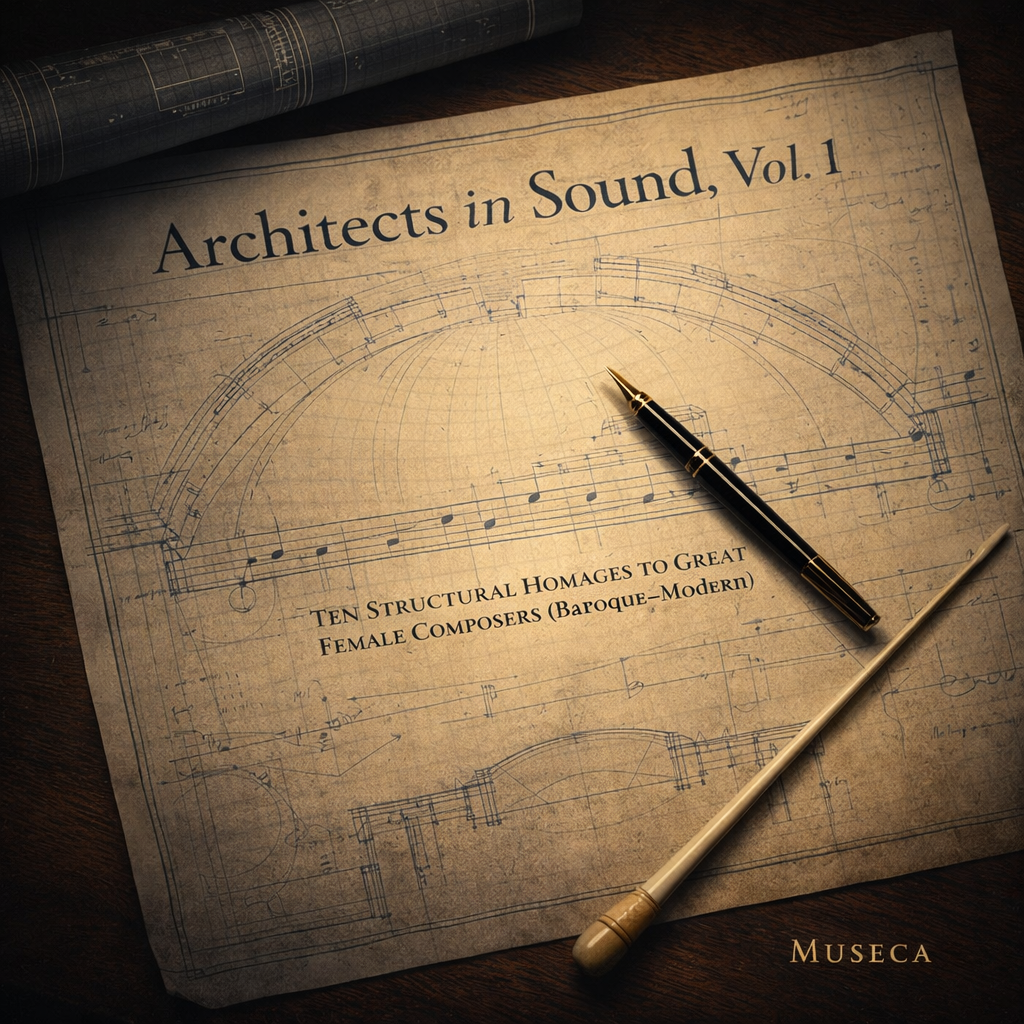
Architects in Sound, Vol. I
Ten Structural Homages to Great Female Composers (Baroque–Modern)
This album is built on a simple premise: to honor great female composers not by biography, but by architecture—the way musical time is engineered into form, the way motifs become structure, and the way instrumentation becomes a blueprint. Across five historical periods, each track is designed as a “structural portrait”: a homage that borrows a composer’s formal instincts, harmonic grammar, and textural logic, then recomposes them into new music that behaves the way their music thinks.
We begin in the Baroque with Élisabeth Jacquet de La Guerre, whose French court idiom demonstrates how elegance can still be rigor: dance-derived symmetry, lucid cadences, and ornate linework supported by continuo discipline. Beside her stands Francesca Caccini, where early opera becomes architecture through rhetoric—recitative and arioso functioning like load-bearing beams, with ritornello framing and a vocal line that moves from speech into song as the form itself.
From there the album enters Classical Vienna with Marianna Martines, a composer of balanced sonata clarity—tight thematic cells, clean development by sequencing and modulation, and a confident sense of proportion. Hélène de Montgeroult extends that classical skeleton toward Romantic intensity, demonstrating proto-Romantic architecture through chromatic inner voices, delayed resolutions, and a fantasy-sonata flow where improvisatory transitions are still controlled by structural logic.
The Romantic center of gravity is carried by Louise Farrenc, whose chamber music exemplifies large-form integrity: motivic economy, rigorous development, and contrapuntal working-out that proves why she belongs among the century’s serious architects of symphonic and quartet design. Clara Schumann complements this with lyric architecture—melody that sings, but always inside a firm plan, where returns are transformed, inner voices accumulate meaning, and intimacy never reduces structural strength.
In the early twentieth century, Florence Price expands the symphonic tradition with an American voice that is both formally grounded and culturally distinctive: bold orchestral themes, hymn-like lyricism, dance-derived vitality, and sectional orchestration that makes timbre a structural force. Rebecca Clarke turns inward to chamber scale, demonstrating how modern harmony and timbral focus can create monumental shape: arch forms, modal-chromatic perfume, and midrange density that peaks and releases like a carefully engineered span.
The album closes in the post-1945 world with two composers whose large-scale thinking reshaped contemporary expectations. Ellen Taaffe Zwilich represents modern symphonic craft at its most articulate—clear pulse, intervallic identity, transparent orchestration, and climaxes earned through registral expansion and rhythmic compression rather than sheer volume. Finally, Sofia Gubaidulina brings ritual form into the concert hall: gesture as structure, timbre and register as theology, and an arc that moves from invocation through struggle into transfiguration, ending in a hard-won afterglow.
Taken together, these ten homages argue for a lineage that is not peripheral but foundational. Architects in Sound, Vol. I is a tour of how great female composers built music that stands—through dance and drama, sonata and fantasia, quartet and symphony, modern craft and spiritual ritual—each track a new structure raised in the spirit of its maker.
Liner Notes
Suite of Gilded Hinges
Élisabeth Jacquet de La Guerre (France, 1665–1729) — Baroque
A French Baroque chamber suite reimagined as a single architectural span: court-dance energy translated into clean sectional joints, poised cadences, and ornate violin filigree supported by continuo logic. Listen for the way short figures “echo” and return—each repetition slightly re-proportioned—so elegance becomes structural rigor rather than decoration.
Thread of the Stage-Lamp
Francesca Caccini (Italy, 1587–after 1641) — Early Baroque
An intimate scena where form is drama: speech-like recitative hardens into arioso, a brief ritornello frames the space, then the final aria opens like a vaulted ceiling. The accompaniment stays deliberately transparent—continuo as skeleton—so the vocal line can build the architecture in real time, turning rhetoric into structure.
Lyrics (Italian)
O luce nascosta, guidami piano,
nel filo del respiro, nel cuore umano.
Nel buio parlo—e la notte ascolta,
una parola vera mi scioglie e mi volta.
(ritornello)
Torna, ritorna, dolce misura,
tieni la fiamma, spezza la paura.
Ah, canta l’anima, senza catene,
tra pianto e grazia, la pace viene.
Vienna in Clear Stone
Marianna Martines (Austria, 1744–1812) — Classical
A sonata-allegro homage shaped by Classical proportion: balanced thematic cells, lucid harmonic travel, and development driven by sequencing rather than density. The pleasure here is not ornament but engineering—how small motifs lock into place, how cadence points arrive with inevitability, and how clarity becomes momentum.
Chromatic Lintel
Hélène de Montgeroult (France, 1764–1836) — Classical–Romantic Bridge
A fantasy-sonata built from inner-voice tension: suspensions, appoggiaturas, and chromatic lines that behave like hidden support beams. The surface may feel improvisatory—arpeggiated fields, sudden chordal pillars—but the piece is held together by delayed resolutions and long melodic spans that keep pulling the listener forward.
Granite Quartet: Allegro
Louise Farrenc (France, 1804–1875) — Romantic
This is the album’s purest statement of chamber architecture: motivic economy, contrapuntal working-out, and development that earns every cadence. The homage is less about “Romantic atmosphere” than about structural muscle—themes treated as materials to be cut, inverted, stacked, and rejoined until the form stands on its own.
Lyric Keystone
Clara Schumann (Germany, 1819–1896) — Romantic
A study in lyric form that never softens its blueprint. A singing A section returns as A′—not repeated, but transformed—by countermelody, thicker inner voices, and sharpened harmonic purpose. The emotional effect is intimate, but the craft is architectural: the melody is the facade; the redesign happens inside.
Cathedral of the Second Theme
Florence Price (United States, 1887–1953) — Early 20th Century
A symphonic movement where orchestration defines the floor plan: bold opening statements, a warm hymn-like secondary idea, and a dance-derived surge that functions as a structural “transept” within the arc. The homage honors Price’s gift for making lyricism carry weight—melody not as ornament, but as load-bearing design.
Viola Vault: Arch Form
Rebecca Clarke (United Kingdom, 1886–1979) — Early 20th Century
An arch-form chamber portrait centered in the viola’s shadowed midrange. Modal color and chromatic perfume create a dark bloom toward the central peak, where density and register compress before releasing. Clarke’s signature here is timbral architecture: the ensemble’s pairings and blended sonorities are the form.
Pulse-Built Facades
Ellen Taaffe Zwilich (United States, 1939–) — Mid–Late 20th Century
A modern symphonic design with crisp joints and a clear rhythmic spine—fast/slow/fast energy compressed into a single coherent structure. Interval identity, registral expansion, and rhythmic compression replace traditional Romantic rhetoric: climaxes are engineered, not declared. The homage celebrates Zwilich’s gift for making contemporary language feel inevitable and legible.
Ritual of Transfiguration
Sofia Gubaidulina (Russia, 1931–) — Mid–Late 20th Century
A ritual-form finale—invocation, struggle, transfiguration, afterglow—built from gestures rather than conventional themes. Bells, low drones, and stark string writing create a ceremonial architecture in which timbre and register carry spiritual meaning. The closing light is not sweetness; it is a consonance that sounds earned, as if the structure had to survive its own trial to remain standing.
Playlist
- Jacquet de La Guerre (Instrumental) Museca 2:31
- Francesca Caccini (Vocals) Museca 1:08
- Marianna Martines (Instrumental) Museca 3:43
- Hélène de Montgeroult (Instrumental) Museca 3:40
- Louise Farrenc (Instrumental) Museca 4:10
- Clara Schumann (Instrumental) Museca 2:19
- Florence Price (Instrumental) Museca 2:20
- Rebecca Clarke (Instrumental) Museca 1:24
- Ellen Taaffe Zwilich (Instrumental) Museca 3:15
- Sofia Gubaidulina (Vocals) Museca 2:11