
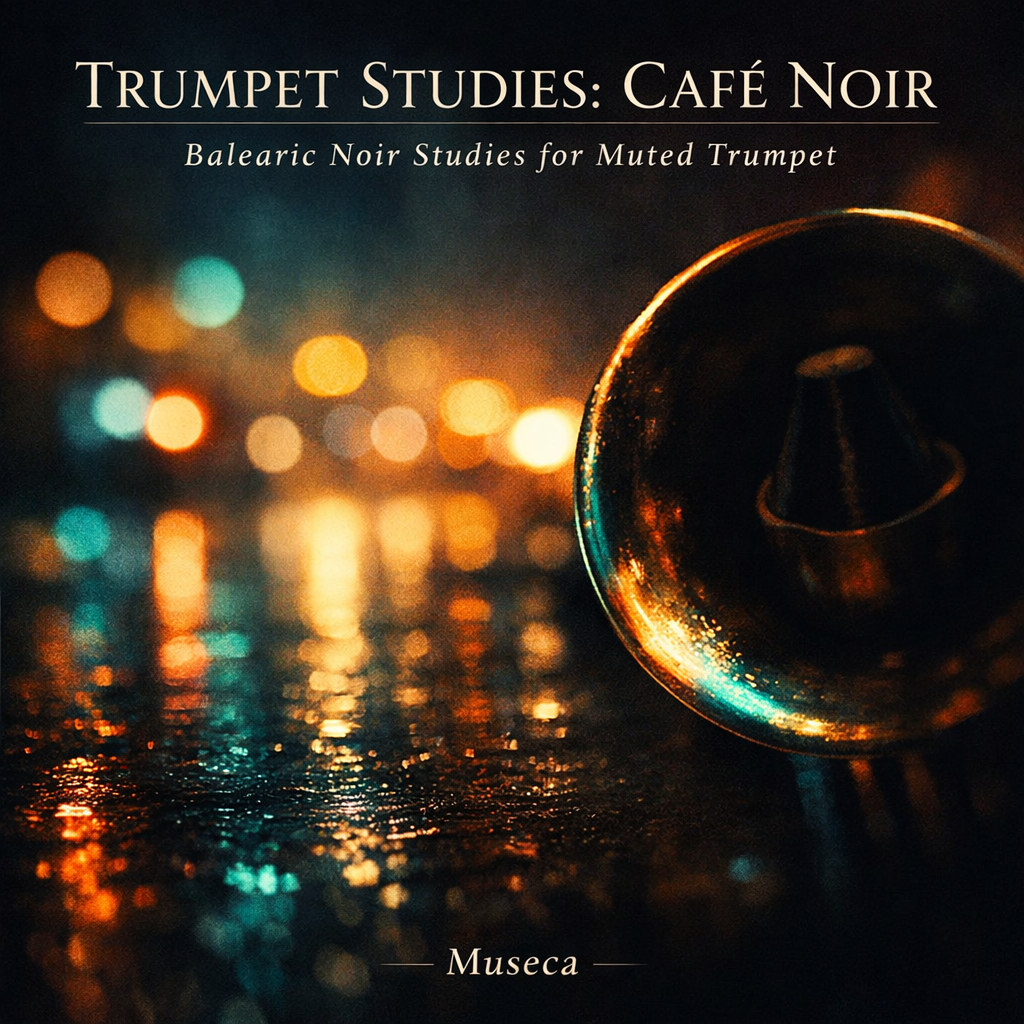
Trumpet Studies: Café Noir was constructed as a disciplined study in presence without dominance—a trumpet album where the instrument does not announce itself with fanfare, but rather inhabits the mix like a private narrator. The aesthetic foundation comes from the Café del Mar and chillout tradition: slow-burning grooves, warm harmonic beds, and the Balearic principle that music can be both rhythmic and unhurried, built for dusk, after-hours, and long interior spaces. From that ecosystem, I drew heavily on adjacent Balearic/ECM trumpet models—an approach where trumpet is treated less as a soloist and more as a timbral character: close-miked, carefully phrased, and emotionally weighted, often entering after the texture is established so that each line feels intentional.
The album’s emotional and cinematic north star is Miles Davis’s Ascenseur pour l’échafaud (Elevator to the Gallows)—one of the defining templates for nocturnal, intimate trumpet on screen. That reference is not used as imitation, but as method: trumpet as whisper and confession, shaped by breath-length phrasing, late entries, and the courage to leave space untouched. Across these six tracks, the trumpet is primarily voiced through muted color—Harmon-inflected intimacy, mid-register lament, and restrained dynamics—so that the “cry” is felt as human vulnerability rather than theatrical heroism. The result is a coherent suite of Balearic noir scenes: steady pulse below, midnight harmony around, and a single brass voice moving through it like a thought you cannot quite silence.
Liner Notes
Neon in the Rain opens the record with the album’s central premise: a Balearic pulse that never hurries, and a muted trumpet that speaks only when it has something to confess. Rhodes and warm pads establish a soft horizon line, while the trumpet drifts in mid-register—audible, intimate, and slightly behind the beat—like light catching on wet pavement. The harmony leans into bittersweet extensions, letting tension resolve slowly, as if the song is exhaling rather than concluding.
Furtive Steps (Stem In) tightens the frame into a more clandestine groove. The percussion is restrained but deliberate, and the sonic world feels closer—vinyl haze, rim detail, low-end warmth. Here the trumpet becomes a series of fragments: short motifs that appear and vanish like a thought you didn’t mean to reveal. The Harmon-muted color keeps it private, while the phrasing suggests movement through a city where everything important happens between the obvious moments.
Café des Ombres shifts the palette toward the classic chillout lounge continuum: gentle guitar color, soft hand percussion, and a harmonic bed that glows rather than shines. The trumpet is not treated as a lead voice so much as an emotional contour—doubling inner tones, leaning on thirds and sevenths, and subtly reshaping the chord’s meaning from within. It’s a track built on subtext: the melody you feel more than you hear, and the answer that arrives before the question has finished speaking.
A Hidden Lagrima is the album’s centerpiece—its most direct conversation with the nocturnal intimacy of Ascenseur pour l’échafaud. The groove remains steady, but the space around it widens, allowing the trumpet to carry a clear lament line without ever becoming heroic. Mid-register phrasing keeps the cry human, not triumphant; the mute focuses the tone into something close-miked and confessional. The track’s power is in what it refuses: no grand crescendo, no overt climax—only a sustained emotional presence that feels like it has been there all along.
Amber Streetlights (Stem Out) introduces a gentle lift in motion without breaking the album’s discipline. The Balearic engine becomes slightly more forward—soft house-adjacent, but still understated—while the trumpet takes on a clearer, more present role as a countermelody. “Stem out” opens the Harmon color just enough to glow, giving the line a wider breath and a softer halo. It supports the scene rather than starring in it, like a streetlight that makes everything visible without becoming the subject.
Last Light, First Key closes the suite by reducing the arrangement to its essentials: slow motifs, drifting harmony, and a final statement of restraint. The trumpet appears sparingly, each entrance treated as an event—one tender idea returning with small variations, then dissolving into reverb and silence. The ending is not a curtain call; it is an afterimage—what remains in the room once the music has left, and what the listener carries out into the night.
Playlist
- Track 1 — Neon in the Rain Museca 3:40
- Track 2 — Furtive Steps (Stem In) Museca 2:38
- Track 3 — Café des Ombres Museca 3:18
- Track 4 (Recomposed) — A Hidden Lagrima (Foreground Lament) Museca 4:20
- Track 5 (Recomposed) — Amber Streetlights (Stem Out) Museca 3:35
- Track 6 — Last Light, First Key Museca 3:44