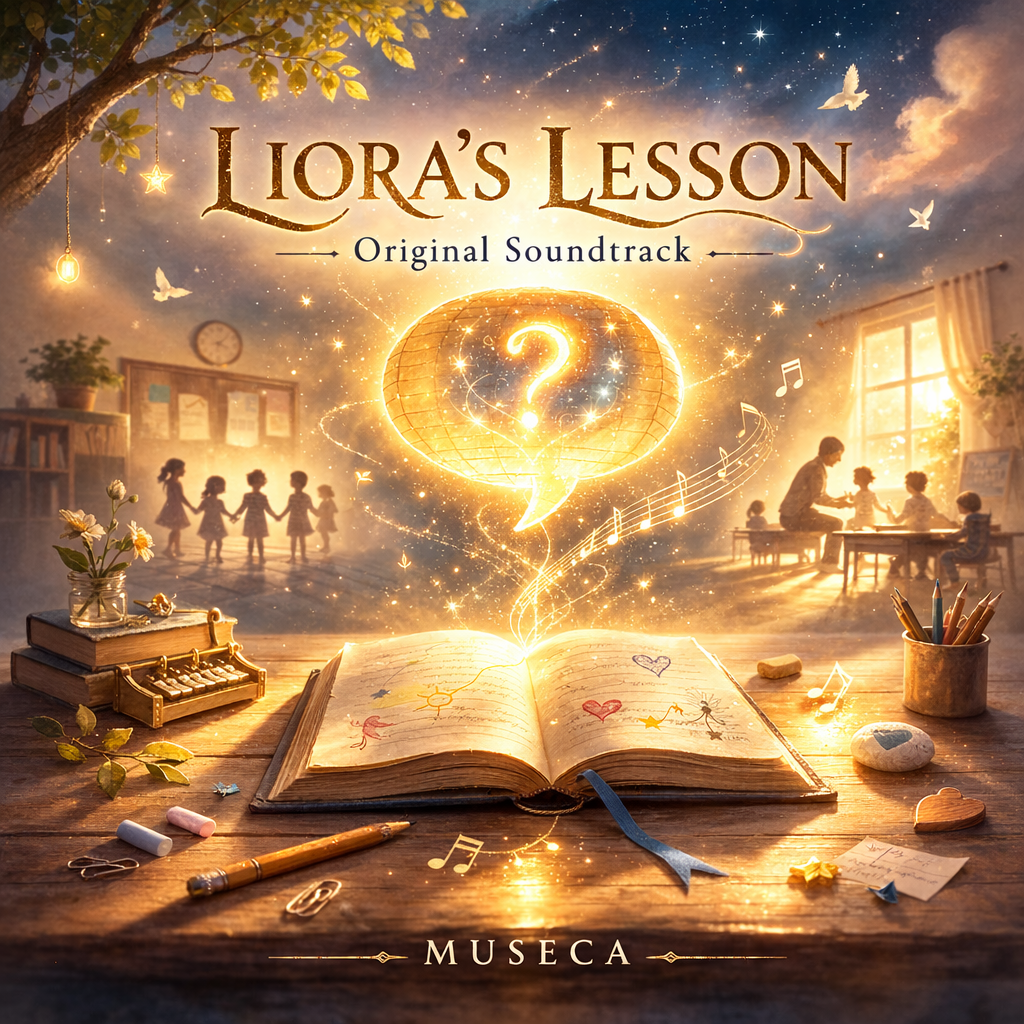
Liora’s Lesson — Original Soundtrack is a musical companion to Liora’s Lesson by P. A. Rallax, a story in which a single child’s gentle questions begin to soften an entire system. Liora doesn’t rebel with noise—she changes her classroom through curiosity, kindness, and the quiet courage to ask what others have stopped asking. As the story unfolds, familiar routines and “that’s what everyone says” thinking give way to something more human: listening with the heart, making room for stillness, seeing the unseen, and discovering that real growth rarely comes from pressure—it comes from presence.
This soundtrack follows the book’s core principles as a musical arc: questioning inherited rules, creating space for reflection, treating every student as meaningful, and letting compassion reshape authority. The album moves from clockwork order into storybook wonder, then into a luminous calm, and finally into a sense of shared belonging and lasting legacy—like a lesson that continues quietly after the last page.
Musically, I chose a children’s magical style: warm cinematic chamber writing with music-box sparkle and lullaby innocence. The palette centers on celesta (music-box light), harp (storybook shimmer), flute and clarinet (curiosity and wonder), piano (the question-maker), and soft strings—often in pizzicato or gentle legato. Percussion is intentionally minimal, favoring delicate mallet color over impact. A children’s choir appears as the emotional “glow” of the album: wordless voices in the Soul Period cue to embody shared stillness, and a tender reprise in the finale to suggest the lesson living on—quietly, sweetly, and everywhere.
You can download a PDF copy of Liora’s Lesson by P. A. Rallax to read while you listen to the soundtrack. Following along with the story as the music unfolds lets you hear how each theme reflects Liora’s questions, the “Soul Period” moments of stillness, and the classroom’s gentle transformation—making the listening experience deeper and more meaningful.
Liner Notes
Liora’s Lesson (Overture)
This opening song sets the tone of the entire album with storybook innocence and a child’s-point-of-view clarity. A simple lullaby pulse carries the book’s central principles—asking “why,” listening with the heart, choosing kindness, and letting small gestures create real change. Celesta and harp establish a music-box warmth, while the children’s choir enters like sunlight through a classroom window: gentle, pure, and quietly brave.
Lyrics
[Verse 1]
I had a little question
In the middle of the day
Why do we do it this way
When there’s another way?
[Pre-Chorus]
And when they said, “Because,”
I listened… then I smiled
’Cause “because” is not an answer
To a curious little child
[Chorus]
[Children’s choir enters softly on “ooh” doubles melody]
What if we could listen
With our hearts a little more?
What if we were kinder
Than we were the day before?
We can breathe and we can try
We can ask a brand-new “why”
And the world can start to change
From a small and gentle “hi”
[Verse 2]
Some kids feel like islands
All alone inside a crowd
But every single person
Has a light that isn’t loud
[Pre-Chorus]
So we make a little quiet
Like a pocket full of peace
And we watch the worry soften
And the heavy feelings leave
[Chorus]
[Choir a little fuller; still soft]
What if we could listen
With our hearts a little more?
What if we were kinder
Than we were the day before?
We can breathe and we can try
We can ask a brand-new “why”
And the world can start to change
From a small and gentle “hi”
[Bridge]
[Drop to piano + harp, whisper-soft]
No gold stars for being perfect
No big prize for being loud
Just a hand that says “I see you”
And a space to think out loud
[Final Chorus]
[Choir brightest here; add gentle string swell]
What if we could listen
With our hearts a little more?
What if we were kinder
Than we were the day before?
We can breathe and we can try
We can ask a brand-new “why”
And the world can start to change
From a small and gentle “hi”
[Outro]
[Choir “ooh” for 4 bars, then fade with celesta motif]
That’s What Everyone Says
A tiny clockwork motif introduces the “rule-machine” of the story—the automatic answers, the inherited scripts, the habits people repeat without thinking. The cue stays playful rather than ominous: bright celesta loops, pizzicato strings, and a neat, almost mechanical sway. Over the course of the album, this theme is designed to soften and reharmonize, mirroring how rigid structure becomes humane once someone dares to question it.
Friends at the Orange Table
This cue is the sound of belonging arriving in small, ordinary moments. A warm flute-and-clarinet duet floats over light piano and gentle chamber textures, capturing the shift from “separate kids in the same room” to “a class becoming a community.” The harmony is simple and luminous, like laughter that doesn’t need to be explained—only noticed.
Max’s Galaxy
A tender, slightly wistful theme for the child who feels unseen—whose inner world is vivid, complex, and quietly heroic. Solo viola carries the melody with soft “starlight” celesta around it, as if imagination is drawing constellations in the air. The cue is designed to honor sensitivity without turning it into sadness, letting wonder become a form of strength.
Soul Period
The heart of the soundtrack: stillness made musical. The arrangement becomes breathlike—harp harmonics, high strings, soft celesta—and then the wordless children’s choir appears, not as spectacle, but as shared presence. It’s the sound of a room learning to be quiet together without fear, and discovering that calm is not emptiness—it’s a space where the most important things can finally be heard.
The Grown-Ups Listen
This is the turning point where authority transforms. The cue begins with the feeling of structure—measured steps, tidy phrases—then gradually warms as oboe/english horn lines open into gentler strings and kinder cadences. The music suggests a subtle miracle: adults remembering that leadership is not control, but care—and that listening can be a choice, not a concession.
The Remember Book
A lullaby for meaning. Celesta and harp return as storybook signatures, but here they feel more intimate, like a child writing truth into a notebook that will outlast the moment. The melody is intentionally simple and singable, built to feel like memory itself—soft, clear, and quietly radiant. This cue holds the album’s emotional “center of gravity,” where learning becomes personal.
The Notebook on the Shelf
A quiet legacy finale—designed to end like the last page turning, not like a curtain call. The children’s choir reprises the overture refrain in a smaller, gentler voice, as if the lesson has moved from performance into permanence. Celesta, harp, and soft strings cradle the closing measures until everything fades into a final glow: the sense that the story continues, not loudly, but faithfully—whenever someone chooses to ask, to listen, and to be kind.
Lyrics
[Choir Refrain]
What if we could listen
With our hearts a little more?
What if we were kinder
Than we were the day before?
We can breathe and we can try
We can ask a brand-new “why”
And the world can start to change
From a small and gentle “hi”
[Outro]
[Wordless choir “ooh” + celesta motif, fade out]
Playlist
- Track 1 (Overture Song) — “Liora’s Lesson” (Lyric overture) Museca 3:00
- Track 2 — That’s What Everyone Says (Rule Theme) Museca 1:53
- Track 3 — Friends at the Orange Table (Belonging Theme) Museca 2:28
- Track 4 — Max’s Galaxy (The Unseen Kid Theme) Museca 1:58
- Track 5 — Soul Period (Stillness Theme) Museca 1:37
- Track 6 — The Grown-Ups Listen (Adult Shift Theme) Museca 3:25
- Track 7 — The Remember Book (Integration Theme) Museca 2:50
- Track 8 — Finale: The Notebook on the Shelf (Legacy Theme) Museca 1:06