
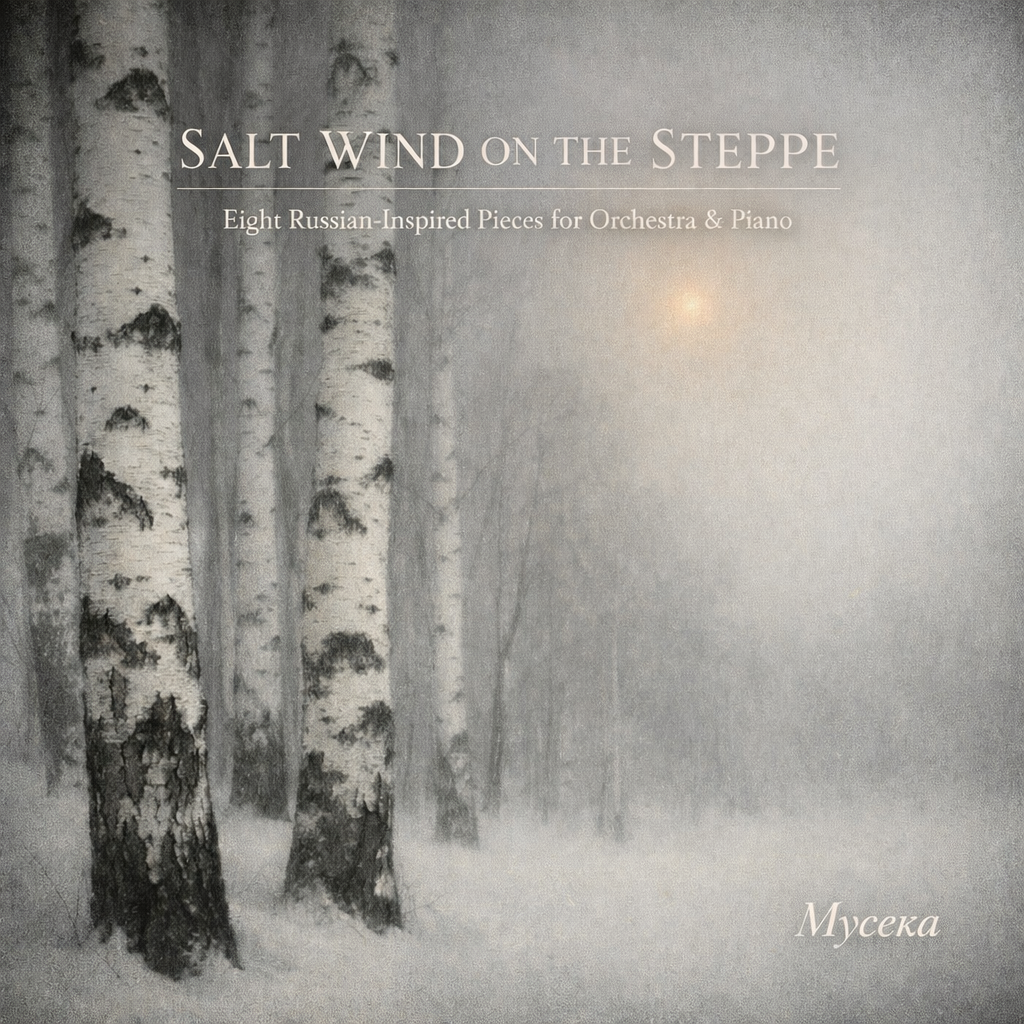
Salt Wind on the Steppe is a cycle built from a distinctly Russian paradox: music that feels as wide as landscape, yet as intimate as a confession. Across these eight pieces—four orchestral movements and four piano “diary pages”—the album traces a single emotional trajectory: village memory rendered at human scale, then expanded into cinematic lyric tragedy. The orchestra supplies the horizon and weather; the piano supplies the private room, the breath on the glass, the thought you do not say aloud. Together they form one braided language: earthy, dramatic, and unashamedly emotional—Russian in its gravity, but new in its framing.
To keep the emotional power consistent from track to track, the album follows a reusable compositional rule set—the “Salt Wind” beauty standard. Each piece is constructed to include at least four of the following seven elements (and the major pillars deliberately aim for all seven):
World: a long pedal/drone or an unhurried ground texture that establishes space and inevitability.
Person: one clearly foregrounded melodic narrator—an instrumental “voice” that feels human and singular.
Yearning: suspensions and appoggiaturas that resolve late, allowing ache to exist in time before release.
Memory / Antiquity: modal inflection—Dorian and Aeolian mobility—so the music carries the scent of older song.
One cathartic event: a single inevitable leap or registral opening at the climax, earned through restraint.
Halo: sparse bell-spectrum highlights—celesta, harp harmonics, faint glock—or their piano equivalents, used as distant light rather than decoration.
Paragraph pacing: slow harmonic rhythm, with climaxes achieved by density and register, not by speed.
This standard does not force uniformity; it creates coherence. Each track varies surface—processional lament, dusk dance, waltz of memory, elegy—while obeying the same deeper grammar: ground, voice, ache, remembrance, one release, a halo, and time spacious enough to feel. The result is an album that speaks in many scenes yet one dialect: the sound of wind over steppe grass, the weight of bass earth beneath it, and a single melodic line standing upright against fate.
Liner Notes
Salt Wind on the Steppe
A cycle of eight Russian-inspired pieces for orchestra and piano, braided from two worlds: village memory and romantic cinema. Each orchestral movement opens with earth—pedal tones, folk cells, living heterophony—then blooms into lyric tragedy. Each piano piece is a private page: the same landscape heard from indoors, through resonance and breath. Across the album, the “Salt Wind” beauty standard is the quiet engine—world, person, yearning, modal memory, one cathartic leap, a sparse halo, and slow paragraph pacing—so every track speaks a different scene in the same dialect.
Diary Under Frostglass
The same wind, now indoors. A low octave pedal anchors the room while the right hand sings in quiet, human phrases—leaning tones that resolve late, as if reluctant to let go. High, bell-like taps appear only where memory catches light. The climax is not volume but widening: a brief opening of register, then the hush returns.
Khorovod at Dusk
An earth-dance with destiny in its shadow. The rhythm turns in uneven steps, driven by drone and ostinato, as if a circle of feet is carving a path into frozen soil. A solo line emerges from the crowd, and the inner strings carry the ache—small dissonances that bloom, not break. Midway, the dance lifts into a broad romantic sweep, then settles back into dusk.
Lara Without a Name
A waltz that does not sparkle—it remembers. The left hand carries weight on the first beat, while the melody breathes with appoggiaturas, singing as if it has been singing for years. Inner voices hold suspended grief beneath the surface, and when the inevitable leap arrives it feels less like display than confession. The last echoes ring like footsteps fading into snow.
Black Birch Elegy
Dark wood, white air. A deep pedal holds the ground while the upper strings move as a living unison—close, varied, human—allowing brief clusters to glow before resolving. The solo voice is both witness and mourner, delaying release until the music can no longer contain it. When catharsis arrives, it comes late and earned, with only a sparse halo to mark the moment.
Bread, Smoke, Silence
A village page: physical, plainspoken, truthful. The piano becomes both drum and choir—percussive ostinato, modal hook, parallel motion that feels communal rather than “correct.” Brief seconds grind like grain between stones, then resolve at the pillars. A single sudden bloom of register breaks the austerity, and the piece returns to work, as if emotion must continue living inside the day.
The Long Road of Light
Love as endurance, not ornament. The opening is coded like plucked folk memory—muted pizzicato and shimmer over a low pedal—then a long melodic line begins to lengthen and lift. The harmony carries yearning in the inner suspensions, with occasional warmth that flashes like remembered sun. One large leap crowns the arc, and the bells remain distant, as if the sky refuses to intrude.
Where the Steppe Meets the Heart
The cycle’s synthesis: village and cinema braided into one organism. Heterophonic strings set the folk cell into motion over deep ground; the piano enters as resonance, widening the emotional lens without changing the language. The music blooms slowly into a full romantic paragraph, then closes with ritual weight—halo sparingly applied, cadence felt more than announced. The steppe remains, but the heart has learned how to speak in its wind.
Playlist
- Track 1 - Salt Wind on the Steppe Museca 3:29
- Track 2 — Diary Under Frostglass Museca 3:22
- Track 3 — Khorovod at Dusk Museca 3:15
- Track 4 — Lara Without a Name Museca 2:14
- Track 5 — Black Birch Elegy Museca 2:53
- Track 6 — Bread, Smoke, Silence Museca 3:38
- Track 7 — The Long Road of Light Museca 3:27
- Track 8 — Where the Steppe Meets the Heart Museca 3:17