
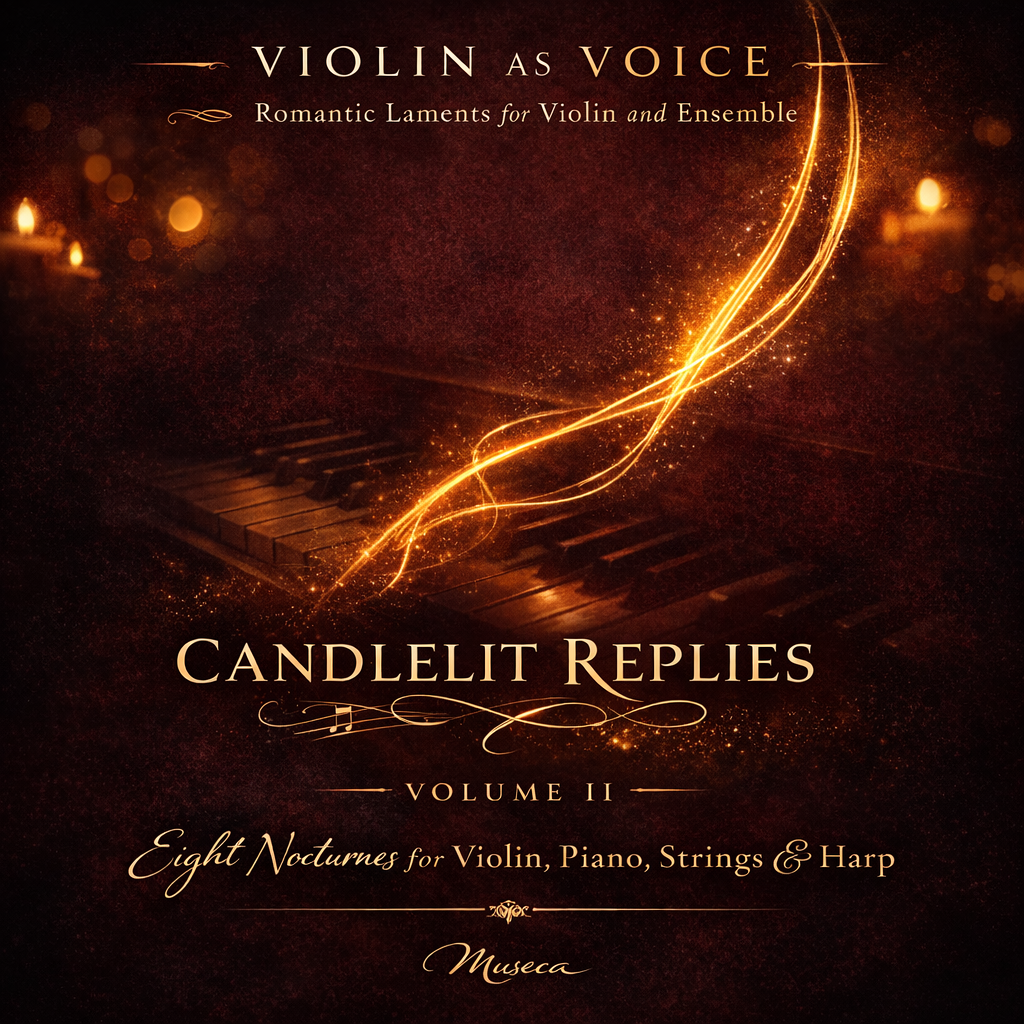
Violin as Voice — Volume II: Candlelit Replies continues the series where Volume I left off—not by leaving grief behind, but by letting it evolve into something warmer, more intimate, and more romantic. If The Longing Thread was the private lament—one voice speaking into darkness—this second volume is the correspondence that follows: eight nocturnes written as late-night replies, when emotion no longer erupts as shock but lingers as devotion, memory, and yearning. The violin remains the human voice at the center, but now it is joined more clearly by a second voice: the piano, answering in soft echoes, understatements, and quiet affirmations.
These pieces were compiled deliberately as a cycle, not as isolated tracks. We began with a defined emotional architecture—dusk to midnight vow to dawn—and then assigned each track a distinct “conversation mode” between instruments: violin leading while piano replies, piano prelude with violin entering like memory, parallel motion that briefly becomes unison, and sparer closing movements where silence itself becomes structure. That interaction map ensured the album could sustain a unified identity while avoiding repetition. Each nocturne is a different kind of letter, but all share the same handwriting.
The musical language was developed from a focused set of techniques associated with the violin’s most human expressive tradition. From John Williams, we drew the halo principle: transparent textures, slow harmonic rhythm, and an accompaniment that behaves like memory-light behind a solitary line. From Tchaikovsky, we took the operatic sense of inevitability—phrases that swell and release like breath, and climaxes that feel earned rather than imposed. Around this core, we added nocturne perfume—hints of Elgar’s noble yearning, Barber’s suspended intensity, Korngold’s romantic cinematic lineage, and a restrained nod to Rachmaninoff’s nocturnal piano language—always filtered through the series rule that the violin must remain the primary speaker.
Technically, the emotion is crafted through a small, consistent vocabulary. The violin lines prioritize long-breathed cantabile “sentence” phrasing, guided by rubato that feels spoken, not metrical. The sense of longing comes from appoggiaturas and suspensions—leaning tones placed on strong beats that resolve late—creating the audible sensation of a thought that hesitates before yielding. The piano is never a virtuoso protagonist; it is a partner voice, often limited to sparse chords, broken underpainting, or two-note sigh figures that answer the violin’s statements. The strings remain mostly muted, offering a soft enveloping bed, while the harp provides shimmer and punctuation—rolled arrivals, harmonics, and delicate arpeggios that appear like candlelight rather than rhythm.
Taken as a whole, Candlelit Replies is romance in the language of restraint: music that does not chase catharsis, but lets it arrive on its own time. These nocturnes are meant to be heard as an uninterrupted emotional evening—letters written in the same ink, sealed with the same quiet truth—until the final track extinguishes the last candle and leaves only breath, resonance, and the lingering shape of what was said.
Liner Notes
Dusk Letter
The cycle opens at the hour when the room changes color and thoughts begin to speak more freely. The violin enters as a first sentence—warm, restrained, and human—while the piano answers in soft, careful replies, never competing, only confirming. The harmony moves slowly, allowing appoggiaturas on strong beats to linger as if the voice cannot resolve its own emotion too quickly. Muted strings hold a halo behind the dialogue, and harp appears only as a faint shimmer at arrivals, like a lamp being turned low. This is not yet confession; it is the decision to write.
Candlelit Reply
A piano prelude sets the tone like a letter opened and reread, then the violin enters as memory—already mid-thought, already tender. The writing favors suspensions that hold breath over stable harmony, resolving late and quietly, so each release feels like surrender rather than closure. The piano’s role is intimate and vocal: short echoes, gentle underpainting, and soft chordal “yeses” that deepen the romance without announcing themselves. Strings remain con sordino and close-positioned, while harp gives small glints at the ends of phrases, reinforcing the Williams-like sense of time suspended.
Velvet Waltz
Here the nocturne sways. The triple meter is not dance for celebration but for longing—a candlelit waltz where every turn remembers what it cannot hold. The violin and piano move in gentle parallel, occasionally converging into brief unison as if two voices momentarily agree on a single truth. Leaning tones still define the emotional color: downbeat appoggiaturas and 4–3 suspensions shape the “ache,” while the cadence arrives late, never abrupt. Strings swell in slow arcs beneath the surface, and harp punctuates the phrase peaks with delicate rolls that feel like a soft intake of breath.
Midnight Vow
The emotional center of the album arrives not as constant intensity but as one inevitable pledge. The violin climbs into a single passionate crest—portamento used sparingly, but decisively—so the peak reads as a human cry rather than a virtuoso gesture. The piano becomes heartbeat: simple pulses and two-note sigh figures that keep the body present while the violin speaks the spirit. Suspensions lengthen, the dissonance is allowed to last longer than comfort, and the eventual resolution feels earned. Strings broaden only at key moments and avoid counter-melody, while harp offers brief high glints at the summit, like candle flame flaring once in still air.
Ember Lullaby
After midnight comes the gentle return: warmth without triumph. The rocking meter feels like intimacy restored—two voices speaking close enough to whisper. Violin and piano trade phrases in call-and-response, each answer slightly more tender than the question, while the harmonic rhythm remains slow and deliberate. Appoggiaturas are smaller here, less like sobs and more like tremors—emotion that has settled into the body. Muted strings wrap the center with a soft cushion, and harp rolls arrive like embers brightening, then fading, never turning into persistent motion.
Storm in Silk
This track carries the album’s most turbulent energy, but it remains romantic rather than theatrical: a storm heard from inside a quiet room. The violin’s arcs widen and intensify, and the harmony uses chromatic neighbors and darker inflections to tighten the emotional field, yet everything stays controlled—no percussion, no overt momentum, only pressure. The piano supports with richer chords, carefully voiced, avoiding virtuoso display so the violin retains the role of speaker. Suspensions stack and release late, and the swell resolves not with victory but with a softened exhale. The strings provide the emotional weather; the harp flashes briefly like lightning far away.
Dawn Reply
The first light does not erase the night; it reveals what the night meant. Harp opens the space with a gentle glow, and the violin sings with a calmer kind of courage—still shaped by delayed resolutions, but less resistant to release. The piano answers as echo rather than argument, reinforcing the sense of acceptance. A fragile brightening appears, not as happiness, but as perspective: the same material seen through softer air. Strings remain muted and supportive, swelling only at phrase peaks, as if the entire ensemble is breathing together for the first time.
The Last Candle
The cycle closes in restraint. The violin returns to its most intimate register—often feeling like speech on the G string—while the piano offers sparse, simple chords that fall into silence rather than pushing forward. The strings reduce toward open intervals, allowing the harmony to feel timeless and bare, and the harp becomes pure punctuation: a breath, a glint, a release. Late resolutions remain, but now they are gentle—no longer wounds, more like the final letting go of a thought that has been carried long enough. The last measures dissolve by design, leaving the listener with resonance and the quiet after a letter is finally finished.
Playlist
- Dusk Letter Museca 2:23
- Candlelit Reply Museca 2:05
- Velvet Waltz Museca 2:43
- Midnight Vow Museca 3:20
- Ember Lullaby Museca 3:11
- Storm in Silk Museca 3:55
- Dawn Reply Museca 3:33
- The Last Candle Museca 2:16