
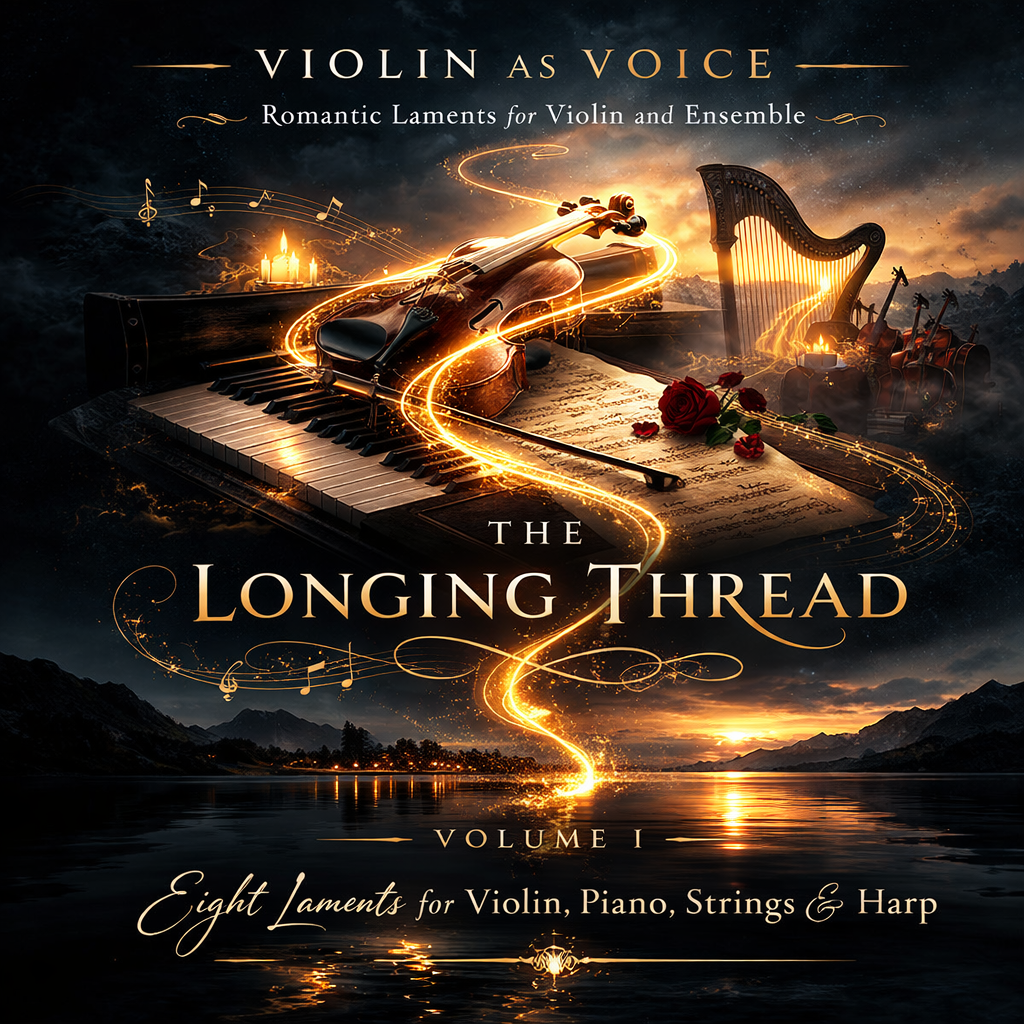
Violin as Voice — Volume I: The Longing Thread is an album of eight romantic laments built around a single premise: the violin can speak as plainly as a human throat. Each piece is written as a song without words—long-breathed, intimate, and emotionally direct—where meaning arrives through the way a note is approached, delayed, and finally released. The result is music that does not perform grief from a distance; it confesses it up close, then gradually transforms it into yearning, remembrance, and quiet acceptance.
The core musical language comes from the intersection of two traditions. From John Williams (especially the vocal, elegiac violin writing associated with Schindler’s List), we adopted the “halo” approach: transparent accompaniment, slow harmonic rhythm, and the sense that the orchestra is memory-light behind a solitary voice. From Tchaikovsky (most clearly the lyrical rhetoric of the Canzonetta), we drew the operatic arc: phrases that swell and recede like breath, a disciplined sense of form, and the Romantic instinct for tenderness without sentimentality. The album’s overall structure follows a spiral rather than a straight line—returning to the same wound with gradually changing perspective.
Technically, the emotional effect is driven by a small set of compositional devices used consistently across the cycle. The violin lines are built from cantabile “sentence” phrasing (clear beginnings, commas, and releases) and a controlled use of rubato that feels spoken rather than metronomic. Harmonic tension is expressed primarily through appoggiaturas and suspensions—leaning tones that arrive on strong beats, resist resolution, and release late—creating the audible sensation of longing. The accompaniments are designed to support that vocal illusion: muted strings (often con sordino and sul tasto) provide a soft, continuous bed; harp supplies shimmer and punctuation—rolls, harmonics, and slow broken chords that feel like breath; and piano acts as a second voice, answering, echoing, or briefly taking the lead, adding a distinctly romantic “two-person dialogue” dimension to the texture.
Alongside Williams and Tchaikovsky, the album’s emotional grammar is reinforced by a lineage of composers who specialize in lyric lament. The chain of Baroque suspension rhetoric—the tradition of delayed resolution as emotional speech—lurks beneath the surface, while the string-halo sensibility owes a debt to 20th-century elegiac writing where harmony moves slowly and the listener feels time stretch. The result is a modern romantic chamber sound: intimate enough to feel whispered, yet orchestral enough to feel inevitable.
Taken as a full arc, The Longing Thread begins in constriction—music that can barely exhale—then opens into romantic yearning, reaches a single breaking point, and finally releases into a quieter, more luminous kind of acceptance. These are not showpieces; they are conversations: violin as the speaking self, piano as the answering heart, strings as the atmosphere of memory, and harp as the light that remains.
Liner Notes
The Held Breath
A confessional opening in D minor, built to feel like a voice entering a quiet room and deciding to speak anyway. The violin line is shaped as a long sentence—an intake, a statement, a comma, and a release—using rubato as speech rather than tempo drift. The ache comes from downbeat appoggiaturas that resolve late, especially the recurring “sob” motion (♭6→5) and suspension-held breaths (4–3 and 9–8) that refuse to settle until the last possible moment. Underneath, muted strings sustain a soft halo with minimal harmonic motion, while harp punctuates the ends of phrases with rolled chords like a slow exhale. The piano appears only as a distant companion—spare, chordal, and non-virtuosic—so the violin remains unmistakably human.
The Longing Thread
Here the album’s central romantic premise emerges: two voices in dialogue. The violin leads in expansive cantabile arcs, then the piano replies in brief echoes—sometimes repeating a contour, sometimes answering with a softer truth. The writing leans into Romantic yearning through delayed resolutions, expressive portamento into key arrivals, and a gentle widening of register that never turns into display. Harmonically, the tension is carried more by voice-leading than by dense chords: suspensions hang over stable harmony, then soften into release. Strings swell only at phrase peaks and avoid counter-melody, while harp adds shimmer at emotional arrivals to keep the sound in the Williams “halo” world—intimate, luminous, and grief-lit.
The Longing Thread (Version 2)
The Unsaid Word
A piano prelude opens the wound before the violin enters as if continuing a thought already in progress. This track explores restraint as drama: slower harmonic rhythm, thinner orchestration, and a more pronounced use of “comma” silences between phrases. The violin’s melodic language is built from leaning tones placed on strong beats—appoggiaturas that arrive as truth and resolve as concession. Suspensions are extended deliberately to create the sensation of words withheld. The accompaniment stays deliberately sparse: muted strings sustain close-position chords with minimal inner motion, harp offers isolated glints rather than continuous arpeggios, and the piano remains conversational—an under-voice that suggests memory rather than narrative.
The Warm Window
A fragile lift in color—an emotional window rather than a true escape. The violin and piano move in gentle parallel more often here, creating a brief illusion of agreement: third- and sixth-like relationships, answered phrases, and shared cadences that feel tender rather than triumphant. The technique is still lament at its core: suspensions continue to delay resolution, and the melody still favors sighing stepwise descents after each reach. Strings are divisi for warmth, kept muted to preserve intimacy, while harp makes the light: rolled chords timed precisely to phrase arrivals, allowing the harmony to glow without becoming busy. The result is romantic brightness with grief still audible underneath.
The Cry Note
The album’s emotional apex is engineered as a single, controlled outcry rather than repeated climaxes. Everything points toward one arrival—approached by a gradual registral ascent, tightened by chromatic neighbor motion, and intensified by suspension chains that hold breath over dominant harmony. At the peak, the violin sustains the dissonance longer than comfort allows—an appoggiatura made into an event—then resolves late, as if the body finally releases. The piano becomes heartbeat: simple pulses, two-note sigh figures, and restrained underpainting rather than lyrical competition. Strings swell in support but avoid counter-melody, and harp adds brief, high glints at the crest to make the moment feel like light breaking through tears. It is passion with discipline—Romantic emotion shaped by Williams-like transparency and Tchaikovsky-like inevitability.
After the Cry
Not sadder—emptier. This track is built from negative space: thinner voicing, longer sustains, and fewer harmonic turns, letting the listener hear the room around the notes. The piano carries the grief first, stating the harmony with simple, resigned gestures while the violin responds quietly, almost spoken. Late resolutions remain, but they are less dramatic—more like fatigue than struggle. The violin often stays lower in register, with minimal vibrato on long tones, and uses small appoggiaturas as tremors rather than sobs. Strings return to a near-static halo, harp becomes breath and punctuation only, and the entire texture is kept intentionally uncluttered so every delayed resolution feels like a private admission.
The Return Without Pain
The language is familiar—D minor, leaning tones, suspended breath—but the emotional posture changes. Call-and-response gradually turns into brief unison, as if two inner voices finally agree on what happened. Technically, the shift is subtle: resolutions arrive a touch sooner, suspensions release with less resistance, and the melodic arcs feel more grounded. The violin still sings with Romantic warmth, but the “reach” intervals no longer feel desperate; they feel chosen. Piano and violin share cadences more often, strings swell more warmly, and harp’s shimmer becomes less mournful and more luminous. It is not a happy ending—just a steadier one.
The Quiet Yes
A benediction in the album’s language: acceptance without sentimentality. The harp opens the space first, establishing a soft glow that feels like dawn on a wound that no longer bleeds. The violin enters with the calmest version of the album’s central technique—leaning tones that resolve late, but gently, as if no longer afraid of closure. The piano closes the cycle with simple “amen” chords: slow, consonant, and quiet, offering the final cadence as a hand rather than a conclusion. Strings remain muted and halo-like, often reduced to open intervals so the ending feels timeless. The last measures dissolve by design—resolution arrives, then releases into silence, leaving the listener with breath, not argument.
Playlist
- The Held Breath Museca 3:30
- The Longing Thread Museca 3:37
- The Longing Thread (Version 2) Museca 2:47
- The Unsaid Word Museca 3:18
- The Warm Window Museca 3:27
- The Cry Note Museca 4:20
- After the Cry Museca 3:06
- The Return Without Pain Museca 2:55
- The Quiet Yes Museca 3:41