
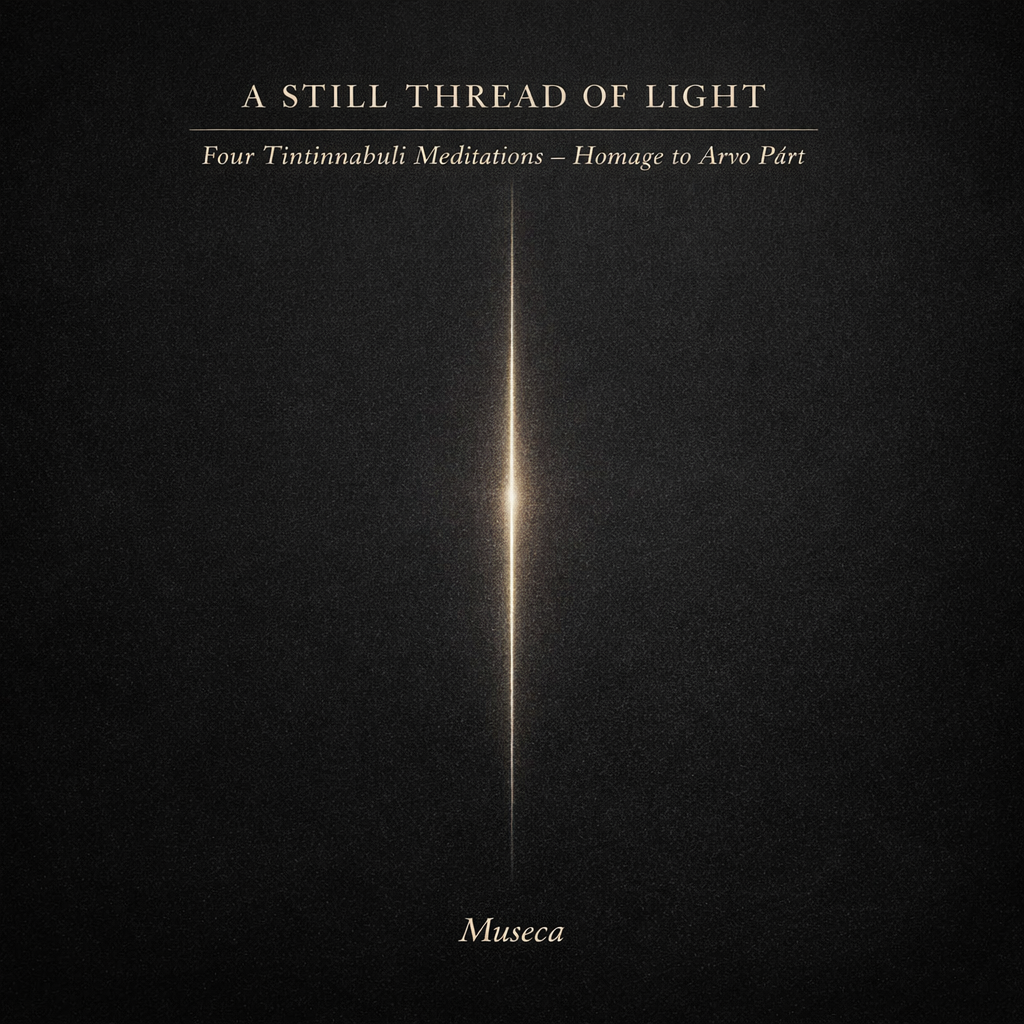
A Still Thread of Light
Four Tintinnabuli Meditations — Homage to Arvo Pärt
This album is a quiet bow of the head: four small works written as a homage to the sound–world that Arvo Pärt opened with his tintinnabuli style. Rather than imitating any specific piece, these meditations attempt to inhabit the logic and ethos of tintinnabuli: radical simplicity, a single harmonic center, and the sense that music is less an event in time than a place one enters.
At the heart of tintinnabuli is a simple proposition:
One voice walks slowly through a scale; another voice rings from a single triad.
Pärt calls these two roles the M-voice (melodic) and the T-voice (tintinnabuli). The M-voice moves stepwise through a diatonic scale, usually without leaps, ornament, or conventional thematic development. The T-voice is bound to a single tonic triad—for example D–F♯–A in D major—and is governed by a rule such as “always the nearest triad tone above the melody” or “always the nearest triad tone below.” The T-voice does not “accompany” in the traditional sense; it orbits the melody, constantly aligning itself to it according to a fixed law.
This relationship creates the characteristic tintinnabuli texture:
The melody feels human and temporal—it moves, breathes, hesitates.
The triad feels static and eternal—it does not modulate, it does not strive.
The music does not “progress” harmonically; it turns light onto the same center from many small angles.
Harmony in tintinnabuli is therefore not about progression from tonic to dominant and back; it is about remaining, about staying in one tonal home so completely that the listener begins to hear its inner anatomy: the way a third feels against a scale degree, the way a triad tone illuminates each step of a melodic line. Dissonance, when it appears at all, is usually incidental and fleeting; the prevailing impression is one of consonant gravity—a center that will not move.
Equally important is the treatment of time and silence. Tintinnabuli is often slow, but slowness is not the point. What matters is the proportion of sound to space. Phrases are separated by real rests, not just by softer notes. The listener is invited to follow a single gesture, let it fade, and then wait for the next one without anticipation. The effect is not theatrical suspense, but spiritual attention: the sense that every note, however simple, carries weight and consequence.
Across the four pieces on this album, these principles are treated as a kind of compositional vow:
Each track is anchored to one key and one tonic triad, which never modulates.
The melodic instrument is restricted to stepwise, diatonic motion, often in expanding phrases (one note, then two, then three, and so on, then mirrored back).
The second instrument is confined to triad tones only, used sparingly, often as isolated tones or small figures rather than continuous arpeggio “wash.”
Silence is allowed to remain structural, not decorative. Gaps between phrases are as important as the phrases themselves.
Dynamics are held in a narrow band—generally pp to p—so that the ear is drawn to contour, interval, and resonance rather than to dramatic contrast.
The result is a set of four “studies” not in complexity, but in constraint. Each pairing—clarinet with harp, viola with celesta, bassoon with vibraphone, flute with guitar—offers a different color of the same underlying idea: a single melodic thread moving carefully through a scale, and a triadic halo that never leaves its orbit. In this sense, the album title, A Still Thread of Light, is meant quite literally: the melody is the thread, the triad is the light, and stillness is not the absence of motion but the refusal to be distracted from a single center.
Tintinnabuli has often been described as “holy minimalism,” but its spirituality does not depend on any specific doctrine. It arises from the discipline of less: fewer notes, fewer decisions, fewer directions in which the ear is pulled. By narrowing the materials to a scale, a triad, and a simple rule that binds them, the composer steps back and lets order itself speak. These four meditations are offered in that spirit—small exercises in listening to what happens when music stops trying to go somewhere, and simply remains, quietly, where it is.
Liner Notes
A Still Thread opens the album with the most direct statement of its organizing idea. Clarinet and harp share a single center of gravity in D major: the clarinet traces a slow, stepwise line that expands one note at a time, while the harp confines itself to tones of the D–F♯–A triad. The clarinet’s phrases lengthen and then return in mirror, like a breath that gradually deepens and then gently recedes. The harp does not accompany in a romantic sense; it marks the triad in small, carefully spaced figures, letting the resonance of each plucked note hang in the air. What emerges is less a melody “over” harmony than the sound of a thread being drawn through light: two voices governed by a single, quiet law.
In Under the Quiet Light, the pairing of viola and celesta shifts the color toward something more interior and luminous. The viola’s tone, darker and more veiled than the clarinet, carries a similar stepwise expansion in A major, but here the emotional emphasis is on warmth and inwardness. The celesta, restricted again to triad tones, articulates them like tiny points of starlight, appearing and disappearing around the melodic line. Silence between gestures is just as important as the notes themselves; the music advances not by harmonic change, but by the listener growing more familiar with the same triad seen from slightly different angles. The piece feels like standing in a dim chapel where a single window admits a narrow column of light.
Glass Choir turns toward a more nocturnal register. Bassoon and vibraphone explore E minor within the same tintinnabuli discipline, but the lower tessitura and darker mode give the music a twilight, almost liturgical weight. The bassoon’s phrases expand and contract in small, diatonic steps, like a chant sung under the breath. The vibraphone answers only with isolated tones of the E minor triad, struck softly and allowed to ring into the surrounding silence. There is no rhythmic drive and no dramatic arc; instead, the listener is invited to hear how each triad tone colors the bassoon’s line, how minor sonorities can feel not tragic or tense, but grave and still. The title suggests a choir not of voices, but of resonances—each strike of metal another quiet bell in the dark.
The album closes with Where the Line Dissolves, the most fragile and intimate of the four meditations. Flute and classical guitar share a G major center, but everything here is scaled down: shorter phrase expansions, lighter articulation, an almost whispered dynamic. The flute’s stepwise melody sits close to the listener’s ear, supported only by occasional, carefully chosen triad tones on the guitar. Often, there is more space than sound; long rests separate gestures so that each entrance feels like a small decision to continue speaking. Over time the sense of “thread” becomes less about continuity and more about dispersion, as if the line were slowly releasing itself back into the silence from which it emerged. In this final piece, the tintinnabuli rule remains, but its purpose is simply to guide the music to a point where it can stop—where the light is still present, even after the last note has gone.
Playlist
- A Still Thread Museca 3:17
- Under the Quiet Light Museca 3:09
- Glass Choir Museca 1:50
- Where the Line Dissolves Museca 3:10