
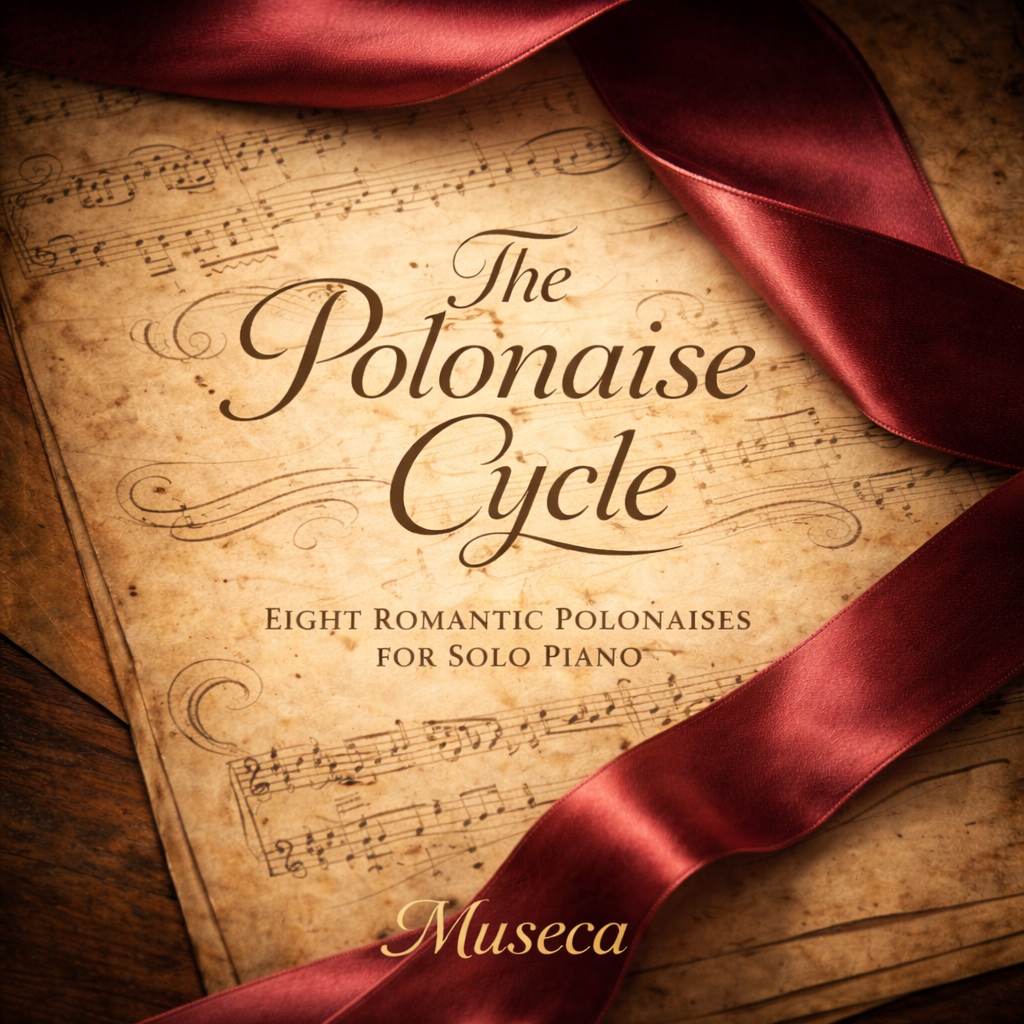
The Polonaise Cycle — Eight Romantic Polonaises for Solo Piano is a unified journey through one of the piano’s most emblematic dance forms—reimagined not as a set of detached miniatures, but as a continuous narrative of character, posture, and emotional transformation.
Rather than treating the polonaise as a single “mood,” this album is built on a deliberate through-line, like a true cycle: each piece illuminates a different facet of the polonaise archetype, progressing in dramatic sequence from ceremonial → heroic → intimate → storm → luminous → defiant → elegiac → apotheosis. The result is a coherent arc—one that begins with courtly poise and ends in triumphal release—while remaining faithful to the polonaise’s essential identity: its unmistakable three-beat gait, its dignified forward motion, and its rhetorical sense of arrival.
Across these eight polonaises, the piano is treated as both dancer and orchestra: at times a formal procession, at times a singing voice, at times a battalion of octaves and flames. Each track preserves the recognizable polonaise pulse, yet speaks in a distinct dialect—reshaping harmony, texture, and pianistic gesture to reveal new emotional angles within a single noble form.
This is not a reproduction of the past; it is a Romantic homage with an original voice—an album that wears the polonaise like a sash: sometimes velvet, sometimes iron, sometimes ribbon-black, always moving forward.
Liner Notes
Sash of Dawn
The cycle opens with ceremony: a measured procession in which the polonaise gait is presented in its purest form—weight on the first beat, poised forward motion, and a sense of doors quietly opening onto a ballroom of memory. Noble chordal proclamations give way to delicate filigree, as if formal attire were revealed to contain a private tenderness beneath its polish. The Trio does not escape the dance; it refines it—more lyrical, more intimate in its breath—before the return gathers brightness and resolves with a radiant, courtly coda.
Iron Procession
Here the polonaise becomes architecture and steel. The rhythm is the engine: emphatic downbeats, sharply articulated figures, and an unrelenting sense of stride. Octave declamation and compact harmonic rhythm create the impression of banners and stone corridors—majestic, but with a threat of storm behind the formality. The Trio offers a brief shift in color rather than comfort, and when the opening returns, it feels newly burdened—hardened into a drive that pushes the dance toward a fierce, inevitable close.
Velvet Standard
This is the heroic polonaise not as conquest, but as confidence—warm, broad, and singing. The right hand carries a long cantabile line while the left maintains the dignified dance engine, creating a dual identity: ceremony and emotion speaking at once. Inner voices briefly bloom like hidden brass in an orchestral transcription, and climaxes arrive with a feeling of earned grandeur rather than spectacle. The coda expands the room, lifting the standard high—heroism tempered by lyric grace.
Ember Mazovia
The cycle turns rustic and shadowed, letting the polonaise touch earth and smoke. Modal inflections and gritty accents roughen the surface—less ballroom, more village firelight—while the gait remains unmistakable, as if tradition persists even when the floorboards change. Broken-octave figures crackle like embers in wind; harmonic turns arrive with a folk-edged candor. The Trio deepens the color, and the return reignites the opening idea with sharpened intensity, finishing like a dance that has remembered its oldest roots.
The Mirror Hall
Luminous polish replaces grit: a crystalline polonaise that glints in the high register and feels almost architectural in its clarity. Ornamentation is not decoration but light itself—prismatic, controlled, and carefully measured against strict phrase structure. Harmonic pivots shimmer with elegant surprise, like reflections shifting as one walks through a gallery of mirrors. The Trio floats with restrained radiance, and the closing pages keep the brilliance airy—refined rather than triumphant, as if the light were designed to hover.
Black Ribbon Trio
This is the tragic center of the album: a polonaise that walks with dignity while carrying grief beneath its stride. Dark bass foundations and sighing appoggiaturas create a sense of weight and restraint—lament disciplined into dance. The Trio becomes the emotional confession: a tender cantabile line, softened textures, and a momentary suspension of armor. When the opening returns, it does so transformed—more intense, more haunted—culminating in a coda that feels like resolve without relief: grief given form, not erased.
Letter to Warsaw
Intimacy becomes narrative. A recitative-like opening suggests a private voice before the dance fully steps into the room—measured, personal, almost spoken. The polonaise gait remains, but its rhetoric is quieter: delicate ornaments, subtle chromatic turns, and cadences that feel like sentences ending with withheld emotion. The Trio reads like a remembered place—hushed, tender, and briefly suspended in time—before the return delivers a bittersweet farewell, dignified and unadorned in its final bow.
Crown in Fire
The cycle concludes in apotheosis: the polonaise as revelation, as victory forged through heat. Bold octaves and virtuosic runs turn the instrument into a full orchestra—brass-like proclamations, string-like surges, and kinetic momentum that refuses to remain merely ceremonial. Chromatic waves intensify the harmonic drama, and the return gathers power like flame finding oxygen. The coda is the crowning—defiant, radiant, and inevitable—ending the cycle not by departing the dance, but by elevating it into a final, blazing affirmation.
Playlist
- Track 1 — Sash of Dawn (Eb major) Museca 2:31
- Track 2 — Iron Procession (C minor) Museca 1:45
- Track 3 — Velvet Standard (A♭ major) Museca 3:00
- Track 4 — Ember Mazovia (D minor) Museca 1:45
- Track 5 — The Mirror Hall (B major) Museca 3:27
- Track 6 — Black Ribbon Trio (F♯ minor) Museca 2:56
- Track 7 — Letter to Warsaw (G minor) Museca 4:56
- Track 8 — Crown in Fire (E major) Museca 3:32