
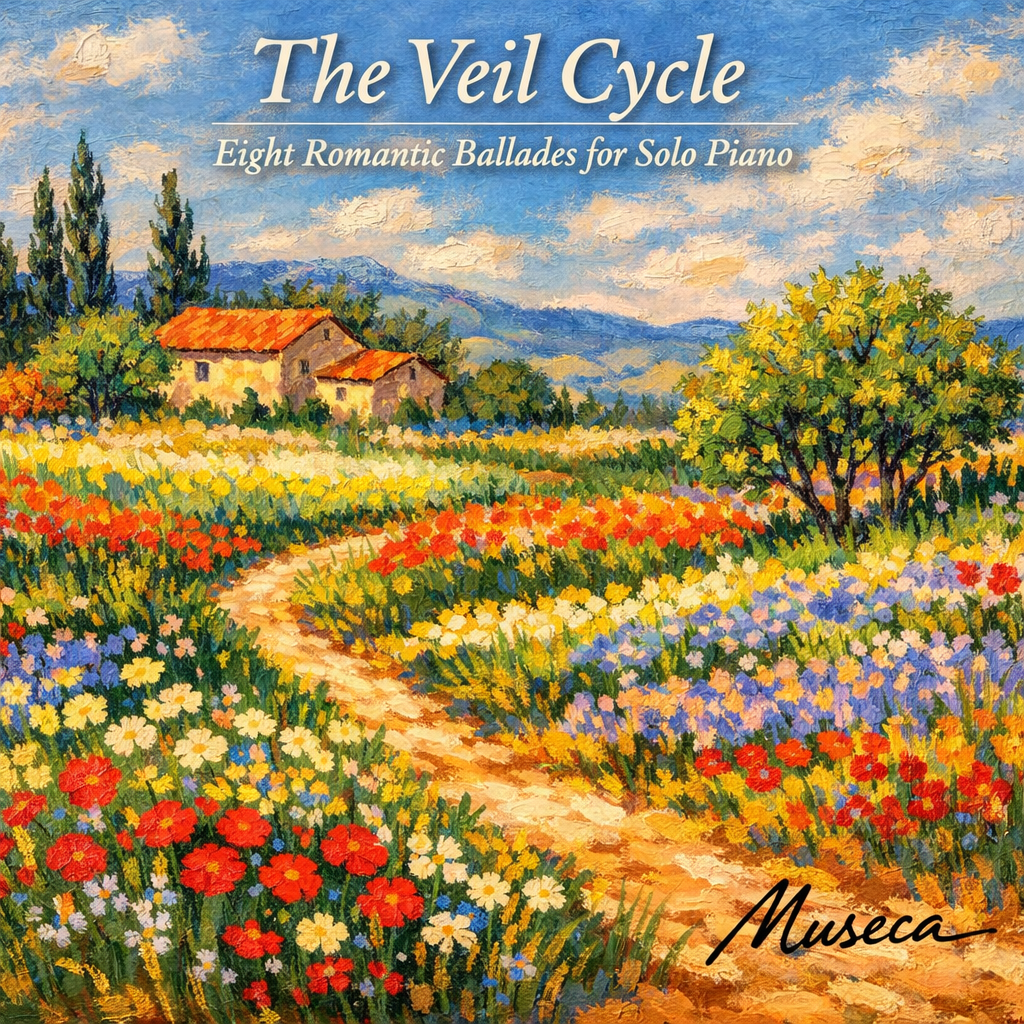
The Veil Cycle is an eight-part homage to the Romantic piano ballade—music that tells a story without ever needing words. Each piece is conceived in the classical Chopin tradition: a singing right hand, an intricate left-hand current of arpeggios and inner voices, and a rubato that breathes like thought. The sound world is intentionally pure and unadorned: no orchestration, no voices, no production gloss—only the concert grand piano carrying the entire narrative through touch, color, and time.
The cycle unfolds as a sequence of “veils,” each revealing a different shade of intimacy: midnight melancholy, pastoral tenderness, luminous suspension, and final hush—then deeper variations of rainlight, winter warmth, quiet harbor, and the edge of sleep. Harmonically, the album remains within a coherent flat-side family—E♭, C minor, A♭, and F minor—so the listener stays inside one continuous atmosphere even as the emotional light shifts from track to track.
These ballades are meant to be heard as a complete arc. Taken together, they form a single long nocturne—beautiful, contemplative, technically intricate—where the most important events happen quietly, and the final resonance lingers not as conclusion, but as presence.
Liner Notes
Veil of Midnight
A slow-opening confession in C minor, where the melody arrives like a thought you were trying not to have. The right hand sings in long, breath-length phrases while the left hand keeps a deep, rolling undertow—less “accompaniment” than weather. Small chromatic turns and inner-voice suspensions create a gentle ache that never becomes theatrical. The piece isn’t about drama; it’s about gravity—how beauty can be quiet and still feel inevitable.
Pastoral Veil
E♭ major appears here as softened daylight: tender, flowing, and unforced. The ballade moves like a remembered landscape—warm at first, then subtly shaded as C minor drifts into view. Nothing strikes suddenly; instead, the harmony darkens the way clouds cross the sun. The technical writing stays delicate—filigree that feels natural rather than showy—so the emotional shift reads as private, not performative. It ends with the sense that you’ve returned, but not unchanged.
Luminous Veil
In A♭ major and a gentle triple flow, this is the album’s suspended radiance: pearled arpeggios, a bel canto line, and a buoyant tenderness that never rushes. The brilliance is restrained—light held in the hand rather than thrown into the room. Subtle chromatic sighs keep the dream from becoming sentimental, and the phrasing leans on rubato as if the music is listening to itself. The close doesn’t resolve so much as hover—an afterglow with edges left intentionally soft.
Veil of Rainlight
This ballade is built on a “rain on glass” sensation—continuous, delicate motion that refracts the melody rather than accompanying it. The harmony stays in the A♭/E♭ family, but with soft shifts and half-lit turns that suggest changing weather. It is lyrical but slightly distant, like tenderness viewed through a window.
Veil of Winter Rose
Returning to the C minor world, this piece treats melancholy with a warmer hand—grief softened by intimacy. The ornamentation is more floral and contained, with inner-voice suspensions that bloom briefly and then fold back into hush. The emotional center is not despair, but quiet endurance: a slow unfolding that never raises its voice.
Veil of Quiet Harbor
E♭ major becomes the album’s calmest room. The melodic writing favors long, cradle-like lines, supported by a steady arpeggiated tide in the left hand—music that feels held rather than driven. Even when the harmony darkens, it does so gently, like evening light settling over water, ending in a cadence that hangs in the air.
Veil Beyond Sleep
In F minor, the cycle slips into hypnotic nocturne territory—repeating figures and subtle variations that blur the line between wakefulness and dreaming. Chromatic inner sighs create tension without speed, and the piece gains intensity by accumulation rather than volume. It withdraws at the end into a half-awake suspension, as if the music is fading before it finishes speaking.
The Final Veil
F minor turns inward and stays there. The writing is more intricate—inner voices speak more clearly, and the arpeggios feel denser, as if the harmony is gathering weight over time. Tension rises quietly, not through speed but through accumulation: closer spacing, darker color, and the sense of a line being drawn. When the peak arrives it remains controlled, almost withheld, and the ending chooses hush over closure—suspended, intimate, and final in the way a door can close without a sound.
Playlist
- Track 1 — Ballade I (C minor): Veil of Midnight Museca 1:45
- Track 2 — Ballade II (E♭ major → C minor): Pastoral Veil Museca 1:54
- Track 3 — Ballade III (A♭ major): Suspended Luminance Museca 2:36
- Track 4 — Ballade IV (A♭ family): Veil of Rainlight Museca 3:13
- Track 5 — Ballade V (C minor): Veil of Winter Rose Museca 3:08
- Track 6 — Ballade VI (E♭ major): Veil of Quiet Harbor Museca 3:19
- Track 7 — Ballade VII (F minor): Veil Beyond Sleep Museca 1:40
- Track 8 — Ballade IV (F Minor): The Final Veil Museca 2:29