
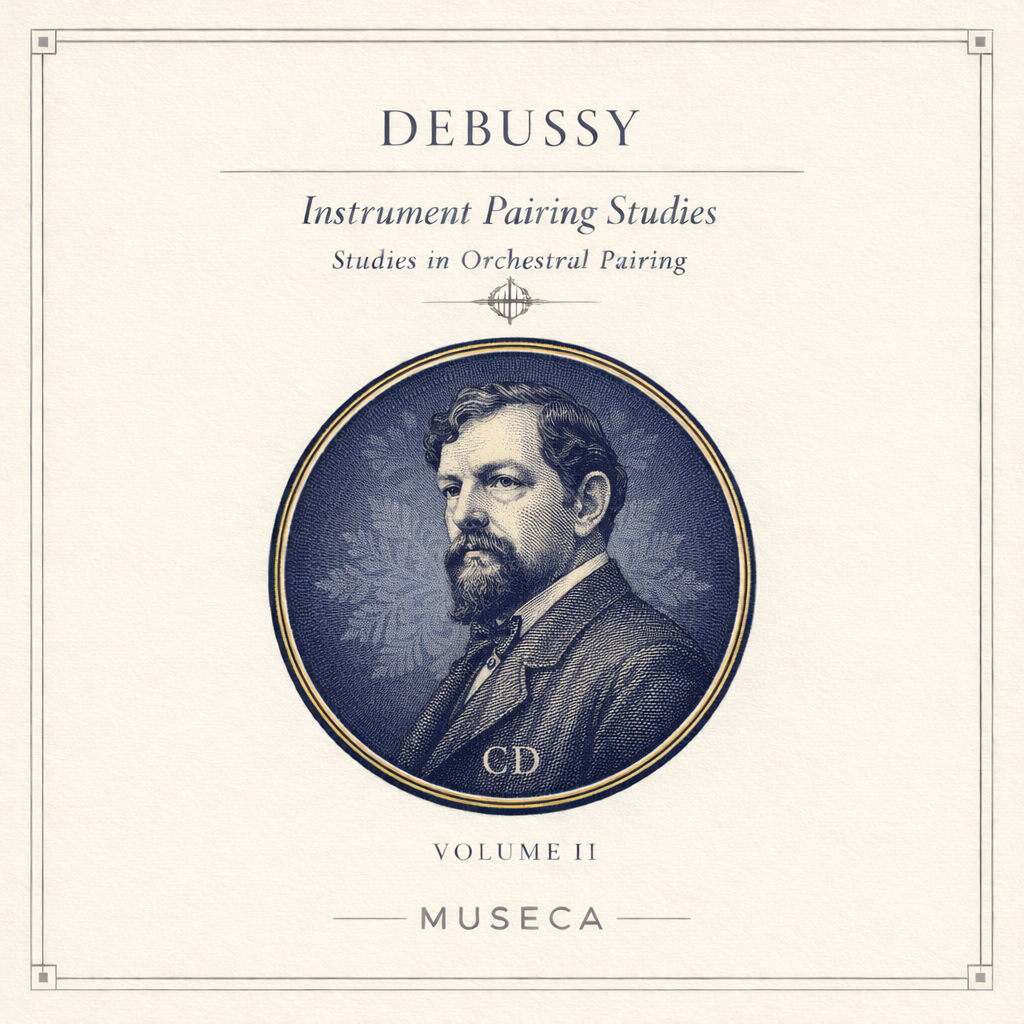
Claude Debussy’s orchestration is not built like architecture; it behaves like weather. Instead of projecting melody through muscular doublings, he dissolves edges, suspends gravity, and lets color become form. His signature “pairings” are therefore less about power and more about translucence: flute braided with harp to create air and glitter; English horn laid against low strings for a distant human ache; clarinet in its chalumeau register fused with muted violas for shadowed intimacy; horn choirs used softly as horizon-light rather than proclamation; wind-choir mixtures that bloom like stained glass; and string techniques—sul tasto, harmonics, divided desks—that turn the orchestra into a luminous haze.
This album presents eight original pairing studies that treat Debussy’s most characteristic blends as repeatable recipes. Each track isolates a specific Debussyan color-world and explores how timbre, register, and restraint can generate narrative without overt drama. These are not pastiches of particular works, but contemporary etudes in the orchestral logic Debussy perfected: sound as atmosphere, harmony as light, and instrumental pairing as the art of suggestion.
Liner Notes
Prélude of Sea-Mist
Paired instruments: Flute + Harp; Muted divided violins/violas (sul tasto)
A Debussy hallmark: flute and harp braided into a single breath, with strings pushed toward the fingerboard to soften the attack and blur the grain. The pairing does not “lead” so much as shimmer in and out of focus, like mist crossing water. Motion is created by tiny ripples—arpeggios, soft suspensions, and harmonic color shifts—rather than overt rhythm.
Nocturne: Distant Procession
Paired instruments: English horn + Low strings (violas/cellos); Bass clarinet (shadow)
English horn against low strings yields that unmistakable Debussyan melancholy—human but far away, like a memory heard through walls. The bass clarinet does not compete; it darkens the air, adding depth to the distance. The procession is implied, not marched: a slow harmonic drift that suggests movement without footsteps.
Pearl Light on Water
Paired instruments: Two flutes (unison/octaves) + Celesta (or glockenspiel); Harp harmonics + String harmonics
This is Debussy’s “light physics”: parallel flutes create a pale beam; celesta provides pinpoint reflections; harp and string harmonics turn the ensemble into a surface that catches and releases highlights. The effect is delicate but vivid—pearlescent brilliance without weight, sparkle without celebration.
Shadow in the Chalumeau
Paired instruments: Clarinet (chalumeau) + Muted violas; Bassoon + Cellos (pp response)
Low clarinet and muted viola blend into a single dusky voice—intimate, confidential, and slightly veiled. The bassoon and cellos answer like a deeper second thought, reinforcing Debussy’s taste for dialogue that feels psychological rather than theatrical. The harmony shifts by color, not cadence, and the shadows do most of the storytelling.
Arabesque Etude
Paired instruments: Oboe + Harp; Solo violin (counterline) + soft string divisi pad
Here the oboe is calligraphy—clean, curved, and expressive without operatic weight—while harp provides the ornamental filigree that makes the line seem to float. A light solo violin counter-thread adds motion like a second penstroke. Everything remains airy: the beauty is in the spacing and the negative space.
Bronze Horizon Chorale
Paired instruments: Horns (pp choir) + Bassoons; Clarinets + low string pedal (cushion)
Debussy’s horns rarely behave like fanfare; they behave like dusk. Paired with bassoons, they form a warm, bronzed chorale that feels like a horizon line—soft, steady, and inevitable. Clarinets and low strings provide a cushioned foundation, making the ensemble glow from within rather than project outward.
Wind-Choir Cathedral
Paired instruments: Flute + Clarinet + Oboe (wind choir blend); Harp arpeggios + divided strings
This is the “stained glass” sound: a wind-choir mixture that blends into a single luminous color, supported by harp arpeggios that act like light rays passing through architecture. Divided strings supply the translucent walls. The result is reverent but not grand—cathedral space suggested through timbre and resonance.
La Nuit Dissolves
Paired instruments: Bass clarinet + Contra-bassoon (or low bassoon); Muted low strings tremolo + Harp resonance
Debussy’s night music often ends by evaporating rather than concluding. Bass clarinet and low bassoon create the darkest velvet in the palette, while muted low strings tremolo provides a barely-there vibration—more sensation than rhythm. Harp resonance flickers like the last glint before darkness fully absorbs the scene.
Playlist
- Track 1 — Prélude of Sea-Mist Museca 2:54
- Track 2 — Nocturne: Distant Procession Museca 2:16
- Track 3 — Pearl Light on Water Museca 3:14
- Track 4 — Shadow in the Chalumeau Museca 2:29
- Track 5 — Arabesque Etude Museca 1:29
- Track 6 — Bronze Horizon Chorale Museca 1:54
- Track 7 — Wind-Choir Cathedral Museca 2:00
- Track 8 — La Nuit Dissolves Museca 1:55