
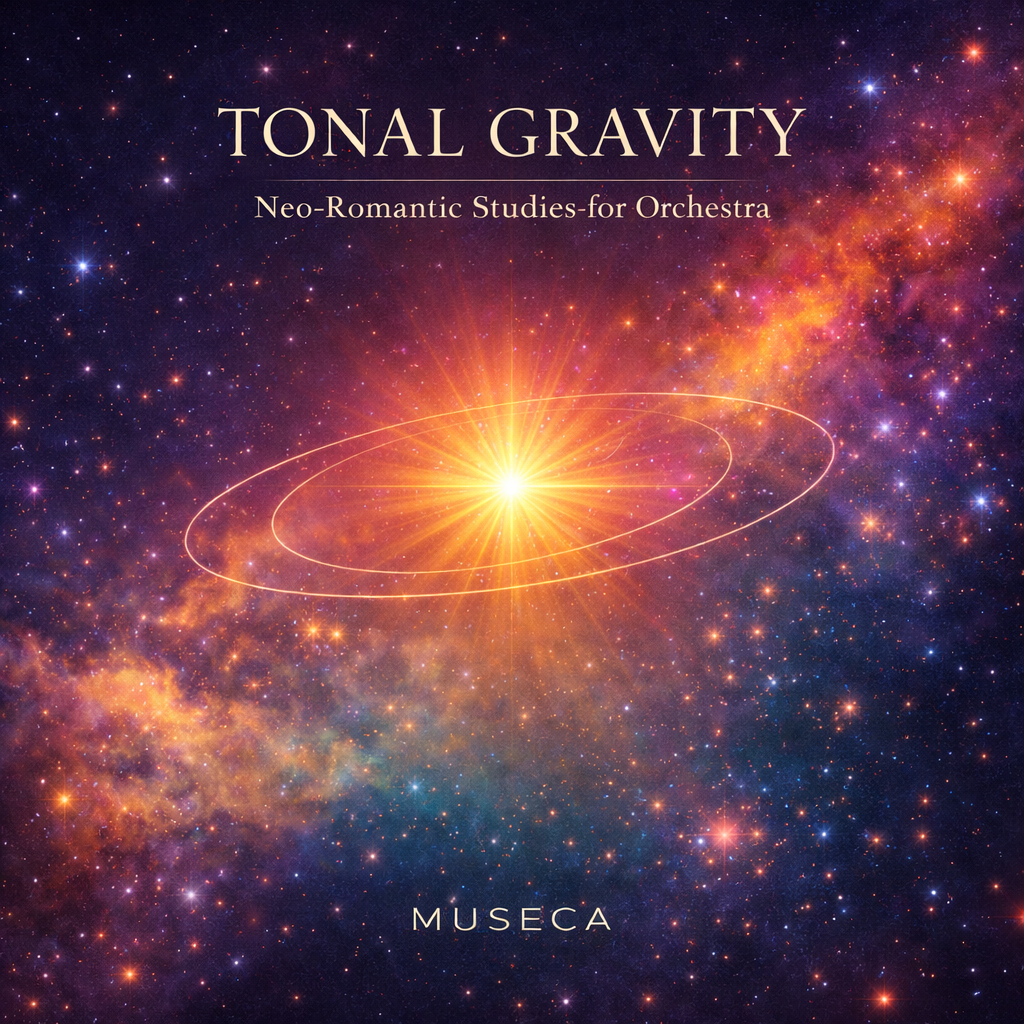
Tonal Gravity — Neo-Romantic Studies for Orchestra is a cycle of neo-Romantic studies shaped by a single governing idea: the ear’s attraction to a center of weight. Each track establishes a gravitational field—sometimes through an audible pedal tone or anchored bass, sometimes through persistent harmonic return—and then allows melody, texture, and harmony to orbit that center with increasing pressure. The result is music that moves constantly yet never loses its sense of inevitability: a Romantic narrative told through tonal pull.
In this tradition, tonality functions less as a technical framework and more as psychology. Cadences are delayed and earned late, so that release arrives with the force of something long-awaited rather than merely “resolved.” Chromatic inflections, suspensions, and brief illuminations into major serve as emotional rhetoric—sighs, surges, and hard-won consolations—rather than surface decoration. Each study is a compact argument between will and gravity: the impulse to break free set against the certainty of return.
Although the music is articulated through concentrated writing, it is conceived with orchestral imagination. Low-register anchors carry the weight of timpani and contrabasses; mid-register blocks suggest horn and viola chorales; high figuration flashes like violin shimmer or harp light. Dynamics rise in long waves—ignition, ascent, crest, recoil, and renewed climb—forming a cinematic Romantic architecture that treats the piano as a full ensemble in miniature.
Taken together, these studies form a unified nocturnal arc: urgency becoming reflection, reflection returning as deeper insistence, and insistence resolving into a final disciplined quiet. Tonal Gravity is less a collection of separate pieces than a single atmosphere explored from multiple angles—nine short tone-poems bound by the same central force.
Liner Notes
Prologue: The Fixed Star
A slow ignition in shadowed minor: a single gravitational idea introduced with restraint. Nothing is hurried. The music sets the rules of the world, establishes its center, and lets the listener feel how everything that follows will be pulled back toward this point.
Bright Orbit
The first true surge of the cycle—propulsive and intent. Harmony rotates around its anchor with increasing heat, as if the piece is testing how close it can pass to the center without yielding. The result is energized rather than celebratory: brightness as momentum.
Arc of Glass
A long-burn ascent with a more suspended, luminous tension. The tonal orbit feels narrower here, the emotional space more fragile. The climaxes arrive like pressure finally finding a seam—beautiful, but edged.
Shadow Argument
The album turns inward and grows more rhetorically intense. The music speaks in longer sentences and heavier implications, as if the orbit has become a debate—one voice insisting, another resisting—until the harmony can no longer avoid its next turn.
Summit in A
The broadest canvas in the program: expansive voicing, orchestral weight, and a sense of elevation earned rather than declared. The piano briefly becomes an ensemble—low gravity, mid-register proclamation, high shimmer—forming the album’s clearest peak.
Iron Nocturne
A return of quickened motion and sharpened edge. The energy is focused, almost metallic, yet still Romantic in its aim: virtuosity as pressure, as thought racing ahead of itself. It functions as the set’s second engine.
Return: The Anchor Reclaimed
The orbit tightens again, but with greater authority. Familiar gravitational forces reappear, now framed as acceptance rather than struggle. The emotional stance is steadier—less fight, more command—without losing intensity.
Finale: Unclosed Light
Resolution is approached with discipline, not sentimentality. The music allows light to enter, but refuses to simplify the night that preceded it. Closure arrives as a choice—clear enough to feel real, restrained enough to remain truthful.
Bright Orbit (Alternate Take)
A second lens on the album’s ignition gesture. Familiar material returns with subtle differences of weight and emphasis, like the same constellation observed at another hour. As a coda, it reinforces the album’s central idea: gravity does not change, but our approach to it does.
Playlist
- Prologue: The Fixed Star Museca 2:50
- Bright Orbit Museca 3:35
- Arc of Glass Museca 3:30
- Shadow Argument Museca 3:35
- Summit in A Museca 3:23
- Iron Nocturne Museca 2:29
- Return: The Anchor Reclaimed Museca 3:12
- Finale: Unclosed Light Museca 3:47
- Bright Orbit (Alternate Take) Museca 3:02