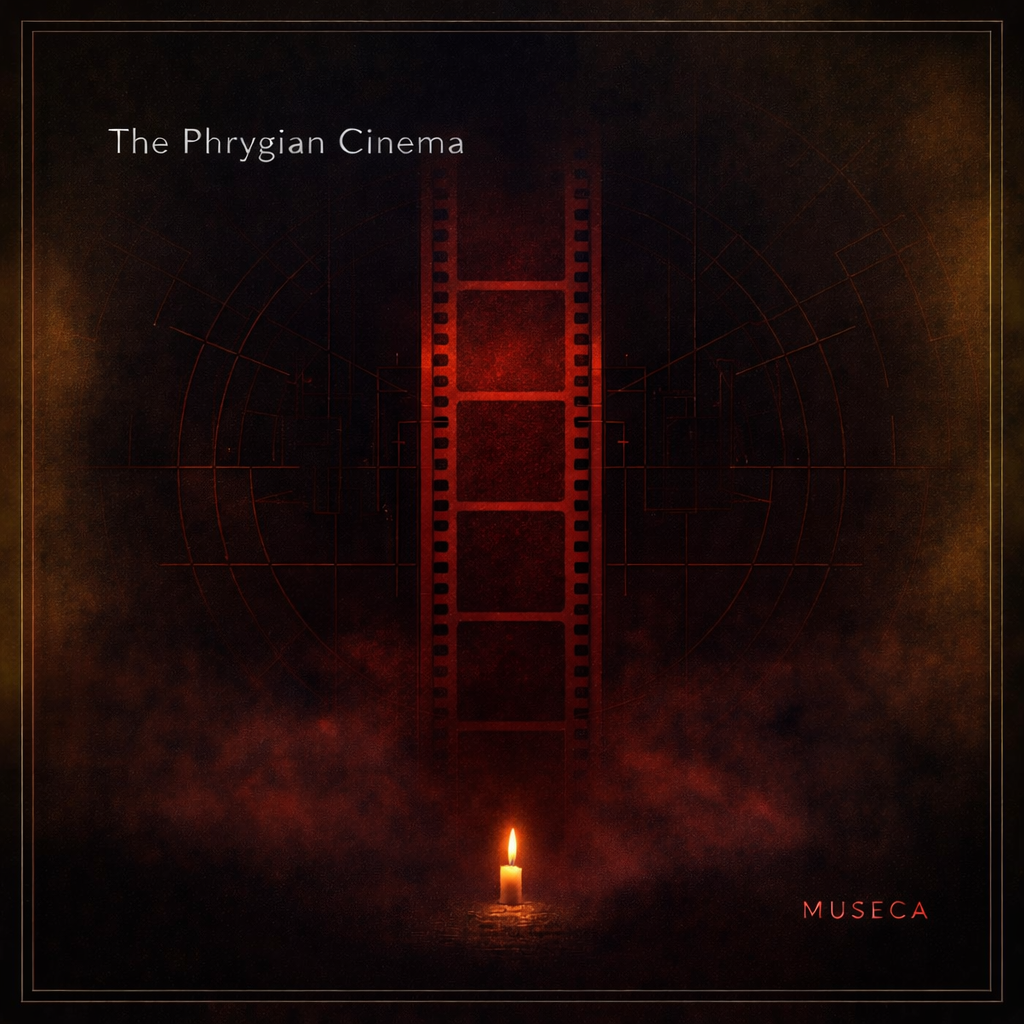
The Phrygian Cinema — Introduction
Phrygian is the cinema’s native minor of dread and antiquity. Built on the scale degrees 1–♭2–♭3–4–5–♭6–♭7 (and its brighter cousin, Phrygian-dominant: 1–♭2–3–4–5–♭6–♭7), it draws its voltage from the semitone between the tonic and the lowered second. That narrow interval concentrates tension at the ground floor of the harmony, producing an immediate sense of proximity—threat close at hand rather than far away. In narrative terms, Phrygian doesn’t simply signal “darkness”; it suggests threshold states: deserts and catacombs, rites and corridors, slow pursuit, sealed chambers, and power that is ancient rather than merely dangerous.
Film composers exploit this color in two primary ways:
1) Pedal-point gravity. Sustained tonic bass (often in contrabasses or synth sub) carries an ostinato whose harmony pivots against ♭II. Common cells include i ↔ ♭II and i–♭II–i, or expanded arcs like i–♭VII–♭VI–♭II–i. The absence of a leading tone keeps the harmony “circling,” ideal for scenes that require pressure without release—surveillance, approach, ritual, and containment.
2) Texture-first orchestration. Low strings for pulse and weight; low brass for massed swells; frame drums/bendir and tam-tam for breath and metal; bass clarinet/contrabassoon for shadow; hushed choir and granular pads for aura. Phrygian tolerates long crescendos and static meters (52–84 BPM), but it also thrives in asymmetry (e.g., 7/8) where the ostinato can feel inevitable yet off-balance.
Phrygian-dominant adds a major third over the same dark floor, trading pure menace for ceremonial gravity—“imperial procession,” “temple doors,” “the law arrives.” Both palettes interface cleanly with world-adjacent timbres (oud/nylon guitar, hand percussion) without pastiche when arranged with restraint.
This anthology curates that language: low-register ostinati, subterranean drones, and slow-burn brass that move scenes forward by compressing time rather than cutting through it. Each cue is built to function diegetically (as an identifiable space) or subtextually (as pressure in the room), favoring architectural form over melodic headline. Think vaults, not vistas; thresholds, not destinations.
Enter The Phrygian Cinema: a gallery of cues designed for corridors, rituals, and the long walk toward the unopenable door.
Liner Notes
Black Sand Citadel
A fortress at the edge of night. Low strings map the perimeter while frame-drum pulses read like patrols—steady, unhurried, inevitable. The harmony leans into i ↔ ♭II, keeping the gates shut.
Phrygian Nocturne
A minor hush with a close, candlelit register. The semitone at the root is treated as atmosphere rather than shock, turning the room itself into tension. A cue for waiting without breathing.
The Devil in a Phrygian
Sly and ceremonial. The palette hints at ritual—soft tam-tam, under-choir, brushed metal—while the bass holds court. Darkness here is learned, not impulsive.
Enkidu of the Steppe
Cinematic dust and long horizons. Hand-hewn ostinati and bowed low strings carry the weight of a mythic walk; each cadence is deferred, as if the earth itself withholds assent.
Desert Threshold
A signal piece: narrow bandwidth, coded rhythm, and a persistent tonic pedal. Built to sit under dialogue or wind, it marks the liminal moment between arrival and entry.
Indigo Gate
Ritual geometry. Repeating cells circle a center that never reveals itself, like a courtyard seen through screens. The cue’s power is rotational rather than linear.
Devil’s Ostinato
Pressure as propulsion. A single figure tightens and darkens by orchestration alone, trading volume for density. Useful for corridors, chases that prefer inevitability to speed.
Phrygian Ostinato Gate
A companion to “Indigo Gate,” focused on pattern craft. The frame drum sets the hinge; strings and low winds revolve around the ♭2 as if around a lock that will not yield.
Obsidian Core
Subterranean resonance. Contrabass weight, restrained drum strikes, and brass shadows collect into a slow-moving mass. The cue is less a melody than a chamber of pressure.
Temperance in the Dark
Measured dread. The dynamics are disciplined, the crescendos incremental, the harmony austere. Built for scenes that require authority without spectacle.
Obsidian Procession
Low-brass ceremony and choral haze, advancing by breath and gravity. This is Phrygian as civic ritual: the law arrives, doors open, and no one speaks.
Temperance in the Dark (Percussive)
An alternate reading that externalizes the heartbeat. Drum articulation sharpens the silhouettes while the harmonic field stays cool, offering a more tactical version of the original’s restraint.
Playlist
- Black Sand Citadel Museca 4:29
- Phrygian Nocturne Museca 3:49
- The Devil in A Phrygian Museca 3:04
- Enkidu of the Steppe souledout 4:03
- Desert Threshold (Phrygian Signal) Museca 3:29
- INDIGO GATE (E♭ Phrygian Ritual) Museca 2:41
- Devil’s Ostinato Museca 4:33
- Phrygian Ostinato Gate (Instrumental) Museca 3:13
- Obsidian Core (E Phrygian) Museca 3:32
- Temperance in the Dark Museca 4:28
- Obsidian Procession Museca 3:32
- Temperance in the Dark (Percussive) Museca 2:05